A passenger walked into the metro station. Cameras detect movement, analyse behaviour, and flag potential problems in seconds. In an airport, facial recognition verifies a traveller in under two seconds. Inside a hospital, AI-powered cameras watch over patients for signs of distress.
This is the world we will soon be living in, where AI surveillance systems will silently shape safety, efficiency, and decision-making across cities, workplaces, schools, and airports.
But with this transformation, an equally powerful question will come: How do we use AI to protect people without compromising their fundamental right to privacy?
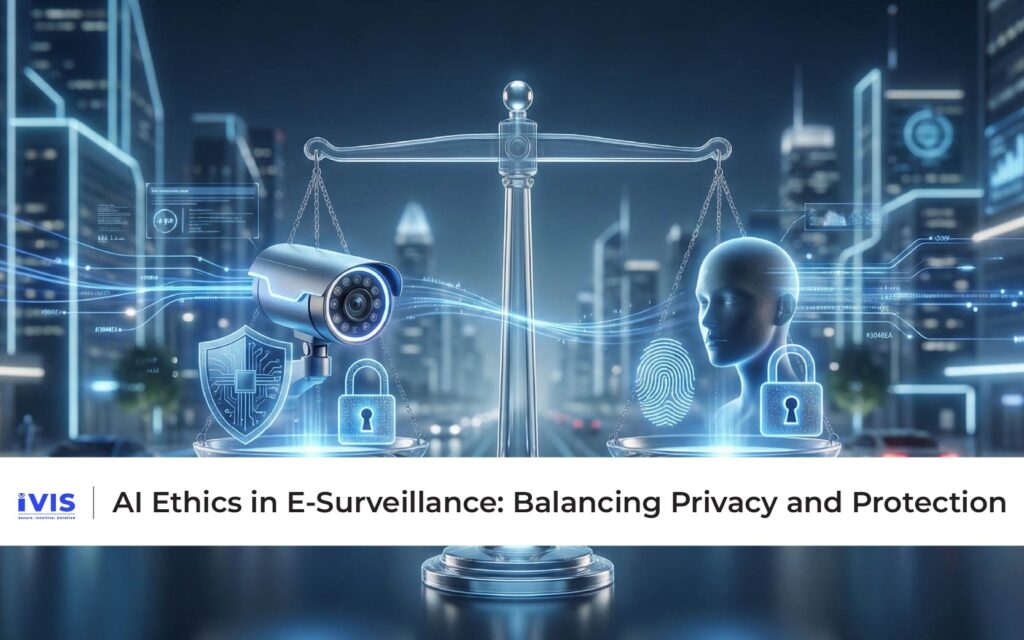
Modern surveillance is undoubtedly transforming itself. It enhances safety, speeds response time, and brings unprecedented clarity to complex environments. Yet it also touches deeply on human rights, autonomy, and civil liberties. The balance between protection and privacy, between intelligence and intrusion, defines the ethical frontier of AI surveillance today.
AI-driven surveillance is expanding rapidly. Computer vision models now detect:
And they do it faster and more accurately than manual monitoring ever could.
According to MarketsandMarkets, the AI in video analytics market will reach USD 22.6 billion by 2028, driven by demand for automation, urban safety, and operational intelligence.
At the same time, adoption raises deep societal concerns. A landmark report from Stanford’s “AI Index 2024” highlights that AI surveillance has grown in over 70 countries, triggering debates about civil liberties and transparency.
This tension between capability and caution, is exactly where ethical AI frameworks must operate.
AI ethics in surveillance is fundamentally about ensuring technology that aligns with privacy protection, fairness and lack of bias, transparent use of data, secure handling of video and biometrics, accountability for decisions and respect for human autonomy.
These pillars ensure technology protects communities without overreaching into spaces where it does not belong.
Surveillance systems handle highly sensitive data. Facial recognition and behavior analytics can identify not just who a person is, but what they are doing and where they are going. This makes privacy protection essential.
The UNESCO Recommendation on the Ethics of AI (2021) stresses that AI systems must incorporate privacy, consent, and data minimization as default settings. The European Union’s GDPR mandates that video used for analytics must be “necessary, proportionate, and limited in scope.”
In practical terms, ethical surveillance means:
Several modern systems already adopt privacy-preserving video analytics. For example, research published in IEEE Access shows that anonymized “bounding-box” video still supports analytics without revealing personal identity.
One of the most widely discussed ethical concerns in AI surveillance is bias where algorithms may misidentify or disproportionately flag certain demographics. Bias often stems from:
Certain studies revealed that facial recognition error rates were up to 34.7% for darker-skinned women, compared to less than 1% for lighter-skinned men. This doesn’t mean AI should be abandoned, but it demands stronger governance. Ethical best practices include:
Airports, for example, increasingly use AI only as a verification tool, not as a sole decision-making authority.
Ethical surveillance also requires openness. Transparency means:
A 2024 Cisco Consumer Privacy Survey found that 81% of people want companies to be more transparent about how surveillance data is used. In schools, hospitals, and workplaces, transparency becomes even more essential for maintaining trust.
AI can assist, but humans must remain in charge. Ethical systems ensure:
The NIST AI Risk Management Framework recommends that critical decisions such as access denial, threat escalation, or disciplinary actions should not be fully automated. AI should be a support system, not a replacement for human judgment.
Surveillance systems themselves hold high-risk data that must be secured. According to IBM’s 2023 Cost of a Data Breach Report, the average cost of a breach in the public sector is USD 2.6M, with video and biometrics among the most targeted assets.
Ethical surveillance therefore requires:
AI ethics and cybersecurity are not separate; one cannot be ethical if it is not secure.
While concerns around privacy and misuse are valid, ethical AI surveillance remains enormously beneficial when deployed responsibly.
Ethical surveillance doesn’t happen automatically, it must be designed intentionally.
Step 1: Define Clear Objectives – Unclear objectives lead to misuse. Systems should be deployed for:
Step 2: Use Privacy-Preserving Analytics – Technologies like:
Step 3: Implement Human Oversight – AI flags; humans decide.
Step 4: Ensure Fair, Representative Datasets – Vendors must provide evidence of:
Step 5: Adopt Regulation-Aligned Practices – Compliance with helps standardize governance:
The next era of AI surveillance will lean heavily on federated learning, edge analytics, and zero-knowledge system, enabling high intelligence with minimal data exposure.
We’ll see:
Ethical surveillance will move from compliance-driven to trust-driven, where technology earns acceptance because it respects the people it protects.
AI surveillance isn’t inherently ethical or unethical; it becomes so based on how we design, deploy, and govern it. When balanced thoughtfully, AI can dramatically enhance safety while still protecting individual rights.
The real future lies in systems that are:
Because surveillance should never be about watching people, it should be about protecting them.