
Every day, millions of people depend on public infrastructure without giving it much thought. Roads, metro stations, airports, power grids, water treatment plants, public parks, and government buildings quietly support daily life. When these systems function smoothly, they remain invisible. When they fail, the consequences are immediate and widespread.
As cities grow denser and infrastructure becomes more interconnected, safeguarding public assets and citizens has become a complex challenge. Traditional security measures, such as guards and static CCTV cameras, are no longer enough to address modern risks. Today, intelligent surveillance plays a critical role in strengthening public infrastructure, helping governments move from reactive responses to proactive protection.
E-Surveillance is no longer about watching events unfold after the fact. It has evolved into a real-time intelligence layer that enables faster decision-making, risk prevention, and coordinated responses across public systems.
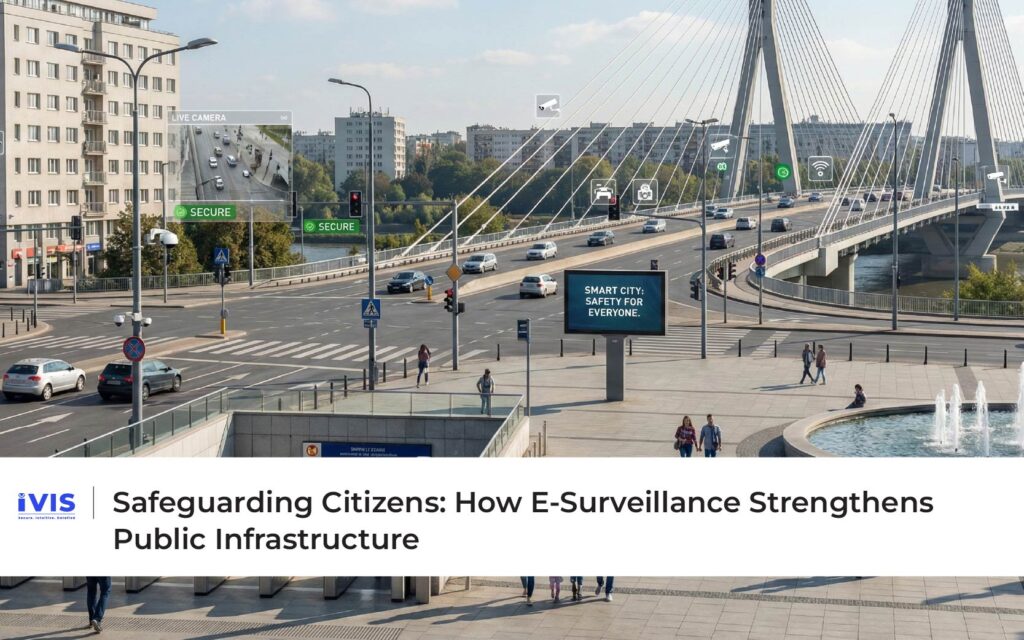
Public infrastructure today is far more complex than it was a few decades ago. Smart cities integrate digital systems with physical assets. Transport networks rely on sensors, cameras, and automated controls. Utilities are managed through centralized platforms. Public spaces see massive daily footfall, especially in urban centers.
This complexity increases vulnerability. Infrastructure is exposed to risks such as vandalism, theft, unauthorized access, crowd-related incidents, and even deliberate attacks. According to the World Economic Forum, infrastructure failures and attacks rank among the most impactful global risks due to their cascading effects on public safety and economic stability.
In this environment, surveillance becomes a foundational capability. It provides visibility across large, distributed assets and enables authorities to detect anomalies early. Without real-time awareness, even well-designed infrastructure can become fragile.
Traditional surveillance relied on passive video recording. Cameras captured footage, which was reviewed only after an incident occurred. This approach offered limited prevention and depended heavily on human monitoring.
Modern surveillance systems, powered by AI and video analytics, operate differently. They analyze live video streams continuously, detect unusual patterns, and generate alerts automatically. These systems can identify unattended objects in public areas, unusual crowd behavior, unauthorized access to restricted zones, or vehicles moving against traffic flow.
Research from McKinsey highlights that AI-enabled monitoring systems significantly improve response times and situational awareness in public operations. Instead of reacting to incidents, authorities gain the ability to anticipate and intervene early.
This shift from passive monitoring to active intelligence is what makes surveillance a strategic asset for public infrastructure.
Public spaces such as railway stations, bus terminals, city centers, and government complexes host thousands of people at any given time. Managing safety in these environments is challenging due to crowd density and constant movement.
Intelligent surveillance helps authorities monitor crowd flow and detect risks such as overcrowding, panic situations, or aggressive behavior. By analyzing movement patterns, surveillance systems can identify early signs of potential incidents and allow authorities to take preventive action, such as redirecting foot traffic or deploying personnel.
Studies cited by the UK Home Office show that CCTV, when combined with analytics and proper response mechanisms, contributes to measurable reductions in crime and antisocial behavior in public spaces. Surveillance acts both as a deterrent and as a tool for faster intervention.
Critical infrastructure includes power stations, water treatment plants, telecom facilities, and transportation control centers. Disruptions in these systems can impact millions of citizens within minutes.
Surveillance systems play a crucial role in securing these assets. Perimeter monitoring, access control integration, and anomaly detection help prevent unauthorized entry and sabotage. For example, video analytics can detect intrusion attempts near substations or identify suspicious behavior around restricted utility zones.
The U.S. Cybersecurity and Infrastructure Security Agency (CISA) emphasizes that physical surveillance is a key component of infrastructure resilience, complementing cybersecurity efforts. Physical threats and cyber threats often intersect, and visibility across physical assets strengthens overall resilience.
One of the most important contributions of surveillance to public infrastructure is its role during emergencies. Natural disasters, accidents, fires, or public disturbances require rapid coordination and accurate information.
Live video feeds provide command centers with situational awareness, helping decision-makers understand what is happening on the ground. Surveillance data supports faster deployment of emergency services, optimized evacuation routes, and better communication between agencies.
During large-scale public events or emergencies, surveillance systems help authorities monitor conditions in real time and adapt response strategies dynamically. According to research published by the International Association of Chiefs of Police, real-time video intelligence significantly improves coordination during emergency response operations.
Surveillance also strengthens public trust when used responsibly. Recorded footage creates objective records of events, supporting investigations, dispute resolution, and accountability.
In public infrastructure projects, surveillance data can help verify compliance with safety protocols, document incidents accurately, and protect both citizens and public officials from false claims. Transparency in how surveillance is used and governed plays a key role in maintaining legitimacy.
The European Union Agency for Fundamental Rights emphasizes that surveillance, when combined with clear policies, transparency, and oversight, can enhance accountability rather than undermine civil liberties.
While surveillance strengthens public infrastructure, it must be deployed carefully. Public acceptance depends on trust, transparency, and respect for privacy.
Ethical surveillance avoids monitoring private areas, limits data retention, and ensures that footage is accessed only by authorized personnel. Many modern systems use privacy-preserving techniques such as anonymization or behavior-based detection instead of identity-based tracking.
UNESCO’s Recommendation on the Ethics of Artificial Intelligence stresses that surveillance technologies must adhere to principles of proportionality, necessity, and accountability. These guidelines help governments balance public safety with individual rights.
When citizens understand why surveillance exists and how it protects them, acceptance increases. Clear communication and governance frameworks are as important as the technology itself.
Beyond safety, surveillance contributes to smarter governance. Data from video analytics helps authorities optimize resource allocation, identify infrastructure bottlenecks, and plan improvements.
For example, traffic surveillance can inform better road design, signal timing, and congestion management. Monitoring public facilities can reveal patterns of wear, misuse, or underutilization. Over time, these insights support data-driven infrastructure planning and maintenance.
According to the World Bank, data-driven infrastructure management improves service delivery and reduces long-term operational costs for public agencies.
E-surveillance systems will continue to evolve alongside smart cities and connected infrastructure. Edge computing, predictive analytics, and AI-driven orchestration will enable faster processing and reduce dependence on centralized systems.
Future e-surveillance platforms will not only detect incidents but also forecast risks based on historical data and real-time conditions. This predictive capability will help governments plan interventions before issues escalate.
At the same time, regulatory frameworks and ethical standards will shape how surveillance is deployed. The future lies in systems that are intelligent, transparent, secure, and aligned with public values.