Schools and coaching institutes are meant to be safe spaces for learning, growth, and curiosity. Yet over the past decade, these environments have also faced increasing safety challenges, from unauthorized campus access and bullying incidents to emergency response gaps and crowd management issues. As a result, educational institutions are under growing pressure to strengthen security.
At the same time, governments, parents, and educators are pushing back against excessive monitoring. They want safety, not surveillance overreach. They want protection, not constant observation. In 2026, this balance has become a defining conversation in education security. The answer lies in privacy-first, ethical e-surveillance, systems designed to protect students and staff while respecting dignity, autonomy, and trust.
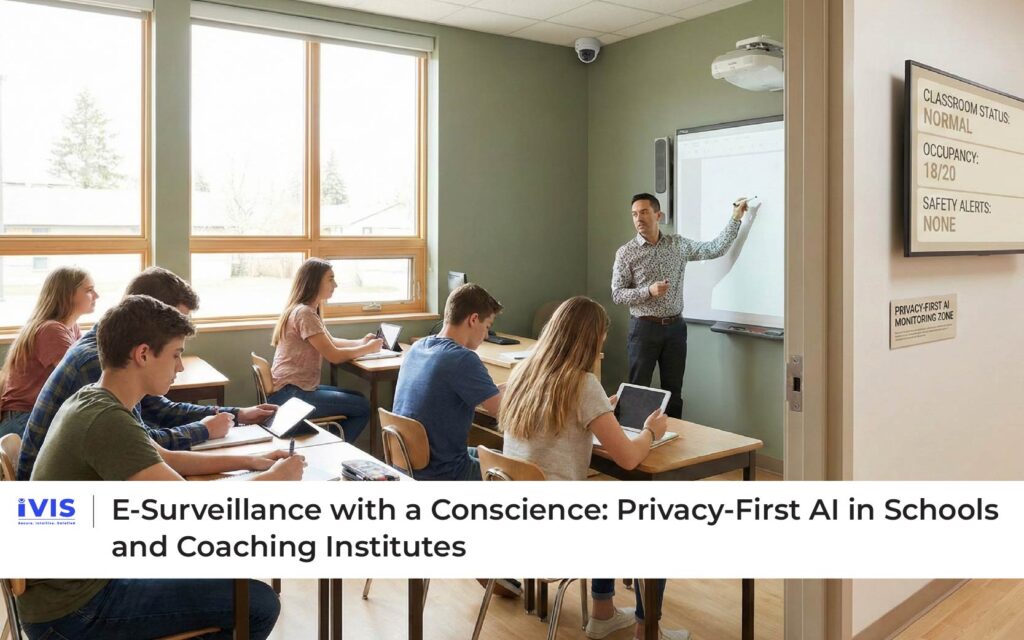
Educational campuses are complex, high-footfall environments. Students move between classrooms, corridors, libraries, cafeterias, and common areas throughout the day. Coaching institutes often operate in compact, densely populated spaces with tight schedules and peak-hour congestion.
According to UNESCO, schools must ensure safety without compromising children’s rights to privacy and freedom of expression. Traditional security approaches, such as guards, manual checks, and basic CCTV, often fall short. They react after incidents occur and rely heavily on human attention, which can be inconsistent and error-prone.
At the same time, concerns about constant monitoring have grown. Parents worry about misuse of footage. Educators worry about creating an atmosphere of mistrust. Regulators worry about data protection and consent. These competing pressures have forced institutions to rethink not whether to use surveillance, but how to use it responsibly.
Privacy-first e-surveillance is not about installing more cameras. It is about redefining how surveillance works in education spaces. Instead of focusing on identity tracking, modern systems emphasize behaviour-based analytics.
AI models analyze movement patterns, crowd density, access behavior, and safety risks without needing to identify individuals. For example, systems can detect unauthorized entry into restricted zones, overcrowding in corridors, or prolonged loitering near sensitive areas, without facial recognition or personal profiling.
Research published by IEEE Access highlights that behavior-centric video analytics significantly reduce privacy risks while maintaining high accuracy in anomaly detection. This approach aligns surveillance with safety outcomes, rather than individual scrutiny.
One of the strongest arguments for ethical e-surveillance in education is prevention. Many incidents like bullying, accidents, unauthorized access, or panic situations, show early warning signs before escalating.
AI-powered analytics can identify unusual movement patterns, sudden crowd formation, or unsafe behavior in real time. This enables staff to intervene early, often preventing harm altogether. Importantly, these alerts are contextual and prioritized, reducing noise and false alarms.
According to a report by the World Economic Forum on AI in public spaces, early-warning systems are far more effective than post-incident response, especially in environments involving children and young adults. Surveillance becomes a safety net, not a disciplinary tool.
A common concern among educators is that surveillance may make students feel watched rather than protected. Ethical deployment addresses this directly.
Privacy-first systems operate largely in the background. They are designed to support staff, not police students. Clear communication plays a critical role here. When institutions explain why surveillance exists, what it monitors, and what it does not, acceptance improves significantly.
Studies from the UK’s Information Commissioner’s Office show that transparency and proportionality are key to public acceptance of surveillance in sensitive environments like schools. When students and parents understand that systems focus on safety and not behaviour control, trust follows.
Educational institutions operate under strict regulatory frameworks. Laws such as GDPR in Europe, India’s Digital Personal Data Protection Act, and various child protection regulations worldwide impose strong obligations on how student data is collected, stored, and used.
Privacy-first e-surveillance supports compliance by minimizing data collection, limiting retention periods, and enforcing access controls. Footage is accessed only when required, and audit trails ensure accountability.
UNESCO’s Recommendation on the Ethics of Artificial Intelligence explicitly states that AI systems in education must be transparent, explainable, and aligned with the best interests of learners. Surveillance systems that follow these principles not only meet legal requirements but also uphold moral responsibility.
Ethical e-surveillance also improves daily operations in schools and coaching institutes. Crowd analytics help administrators manage peak-hour congestion during entry, breaks, and dispersal. Heatmaps reveal underutilized or overcrowded areas, enabling better space planning.
In coaching institutes, where student density is often high, real-time monitoring helps ensure safe evacuation routes and compliance with occupancy norms. According to McKinsey, data-driven insights in education infrastructure lead to better utilization of resources and improved student experiences.
When surveillance data is used for planning rather than policing, it becomes a tool for better learning environments, not just safer ones.
As institutions seek this balance between safety and privacy, they require platforms built with governance at the core. This is where IVIS plays a meaningful role.
IVIS enables schools and coaching institutes to centralize surveillance across campuses while applying privacy-first principles. By focusing on behavior-based analytics, real-time alerts, and contextual monitoring, IVIS helps institutions identify risks early without intrusive identity tracking.
Its policy-driven architecture ensures that data access, retention, and usage align with regulatory requirements and institutional ethics. IVIS supports hybrid deployments of edge, on-prem, and cloud, allow sensitive data to remain local while still enabling centralized oversight.
In education environments, IVIS acts not as a watchful eye, but as a quiet guardian, supporting safety, transparency, and trust simultaneously.
By 2026 and beyond, education surveillance will continue to evolve toward prediction and prevention. AI models will better understand environmental context, enabling even earlier detection of risks. Edge computing will reduce latency and data exposure, while federated learning will allow systems to improve without sharing sensitive data.
At the same time, regulatory scrutiny will increase. Institutions that adopt ethical, privacy-first approaches today will be better positioned to adapt tomorrow. The future belongs to surveillance systems that are intelligent yet restrained, powerful yet principled.
E-surveillance in schools and coaching institutes no longer needs to be a trade-off between safety and privacy. With privacy-first AI, institutions can protect students, support staff, and comply with regulations, without crossing ethical lines.
When deployed thoughtfully, ethical surveillance fosters trust rather than fear. Platforms like IVIS show how this balance can be achieved, turning surveillance into a safeguard for learning rather than a source of concern.
In education, conscience matters as much as capability. And in 2026, the institutions that understand this will set the standard for safe, respectful learning environments.