
A guest walks into a hotel lobby after a long journey. The space feels calm, organized, and welcoming. There are no visible signs of tension, no delays at the front desk, no congestion near elevators. Behind this smooth experience is something guests rarely notice, but deeply appreciate: a hotel that anticipates rather than reacts.
Hospitality has always been about foresight. Knowing what guests need before they ask. Today, that philosophy extends into security and operations through predictive e-surveillance. Instead of merely recording events or responding after incidents occur, modern surveillance systems help hotels anticipate risks, manage crowd flow, and support service delivery in real time. In an industry where experience defines reputation, predictive surveillance is becoming a quiet differentiator.
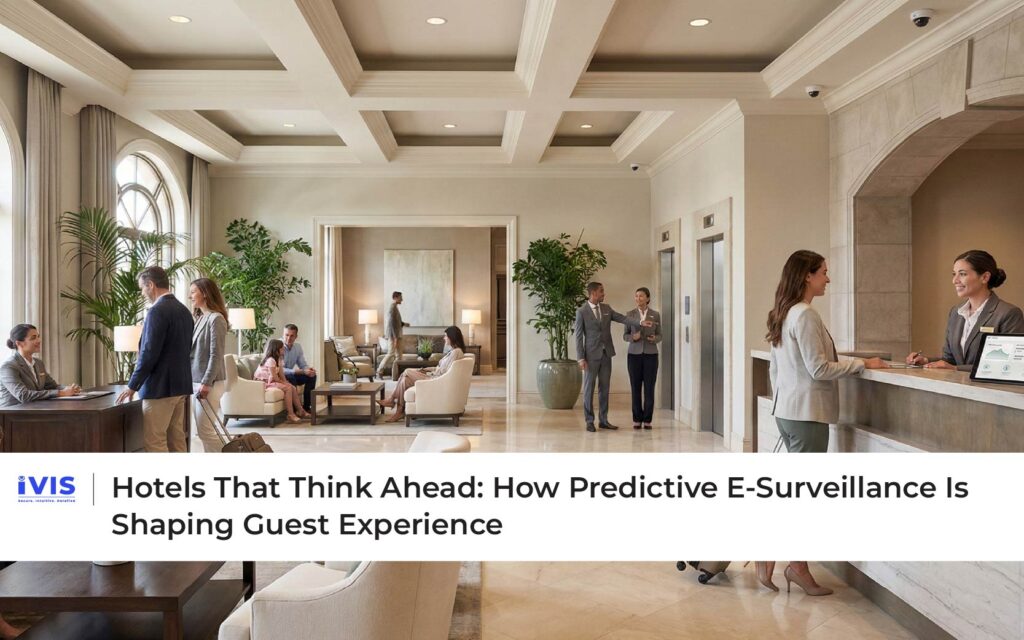
Hotels operate in a uniquely open environment. Lobbies are public-facing. Guests, visitors, vendors, and staff move constantly through shared spaces. Events, peak seasons, and late-night activity add layers of complexity. Traditional surveillance systems, designed primarily for post-incident review—struggle to keep up with this dynamic flow.
According to the World Tourism Organization, guest perceptions of safety significantly influence satisfaction and return intent. At the same time, the hospitality industry faces ongoing challenges such as theft, unauthorized access, crowd-related incidents, and operational disruptions.
Reactive security addresses problems after they surface. Predictive e-surveillance, by contrast, focuses on early indicators, patterns and anomalies that suggest something may go wrong if left unattended. This shift aligns security with hospitality’s core promise: seamless care.
Predictive e-surveillance combines AI-powered video analytics, behavioral modeling, and historical data to forecast risk. These systems continuously learn what “normal” looks like in a hotel environment, daily guest movement, staff routines, peak traffic times and flag deviations that may require attention.
For example, predictive analytics can identify unusual loitering in corridors late at night, anticipate congestion in lobbies during check-in surges, or detect abnormal movement near restricted back-of-house areas. Instead of triggering alarms for every movement, the system prioritizes alerts based on context and likelihood of impact.
Research published in IEEE Access shows that predictive video analytics significantly improve detection accuracy while reducing false alarms by focusing on behavior patterns rather than isolated events. For hotels, this means fewer disruptions and more meaningful interventions.
The most powerful aspect of predictive surveillance is its impact on guest experience. When risks are anticipated, staff can act discreetly and proactively.
For instance, if analytics predict crowd build-up near elevators after a conference session ends, hotel teams can redirect flow or deploy additional staff. If the system detects unusual activity near guest rooms, security can intervene quietly before guests are disturbed. Even safety-related incidents such as slips or medical emergencies, can be identified faster through behaviour and posture analysis.
Cornell University’s School of Hotel Administration notes that guests value safety most when it is invisible yet effective. Predictive surveillance supports this by preventing incidents rather than responding visibly after they occur.
Hotels rely on coordination across multiple teams front desk, housekeeping, security, facilities, and food & beverage. Predictive e-surveillance supports these teams with operational intelligence.
By analyzing movement patterns and space utilization, systems can highlight understaffed areas, delayed room servicing, or congestion in service corridors. This enables managers to make informed, real-time decisions that improve efficiency and reduce stress on staff.
McKinsey research on hospitality operations emphasizes that data-driven decision-making leads to higher service consistency and lower operational costs. Surveillance analytics add a visual and behavioural dimension to this intelligence, helping hotels align security with service excellence.
Loss prevention remains an important concern for hotels, especially in high-traffic properties. Predictive surveillance strengthens asset protection without resorting to intrusive monitoring.
AI models can identify suspicious behavior patterns, such as repeated access attempts to restricted areas or unusual movement near storage zones before losses occur. Alerts allow staff to intervene early and discreetly, reducing confrontation and maintaining a welcoming atmosphere.
Deloitte’s hospitality risk studies highlight that proactive monitoring significantly lowers shrinkage and internal losses. When combined with predictive analytics, surveillance becomes a preventive tool rather than a visible deterrent.
Hotels are built on trust. Guests expect privacy in personal spaces and respect in shared ones. Predictive e-surveillance must therefore operate within strict ethical boundaries.
Modern systems emphasize behaviour-based analytics over identity tracking. Private areas such as guest rooms and restrooms are excluded entirely. Data access is restricted, retention periods are defined, and usage is governed by policy.
Frameworks such as GDPR and UNESCO’s Recommendation on the Ethics of Artificial Intelligence stress proportionality, transparency, and accountability. Clear communication through signage and privacy policies helps guests understand that surveillance exists to protect, not intrude.
Ethical deployment ensures that predictive intelligence enhances hospitality rather than undermining it.
As hotels adopt predictive surveillance, they need platforms capable of unifying intelligence across spaces while maintaining governance and scalability. This is where IVIS plays a meaningful role.
IVIS enables hotels to centralize surveillance across lobbies, corridors, parking areas, and back-of-house zones into a single intelligent operational view. By combining real-time video analytics with historical pattern analysis, IVIS helps hotels anticipate risks and manage guest flow proactively.
Its hybrid architecture spanning edge, on-prem, and cloud, ensures low-latency analytics on-site while supporting centralized oversight across multiple properties. Policy-driven controls and secure data handling align predictive capabilities with privacy and regulatory requirements.
In hospitality environments, IVIS supports a shift from reactive security to anticipatory service, allowing hotels to think ahead without disrupting the guest experience.
Predictive e-surveillance will continue to evolve alongside smart hospitality technologies. Integration with property management systems, event schedules, and occupancy data will enable even more precise forecasting. Edge computing will allow instant local responses, while AI models will refine predictions over time.
As hotels compete on experience rather than amenities alone, those that adopt predictive intelligence will stand out. The future of hotel security is not about control, it is about care delivered at the right moment.
Hotels that think ahead create experiences guests remember for the right reasons. Predictive e-surveillance enables this foresight by turning security into a silent partner in service delivery.
By anticipating risks, managing flow, supporting staff, and respecting privacy, predictive surveillance aligns perfectly with hospitality’s core values. Platforms like IVIS demonstrate how hotels can adopt this approach responsibly, enhancing safety while preserving comfort and trust.
In the next generation of hospitality, the best security will be the kind guests never see, but always feel.