
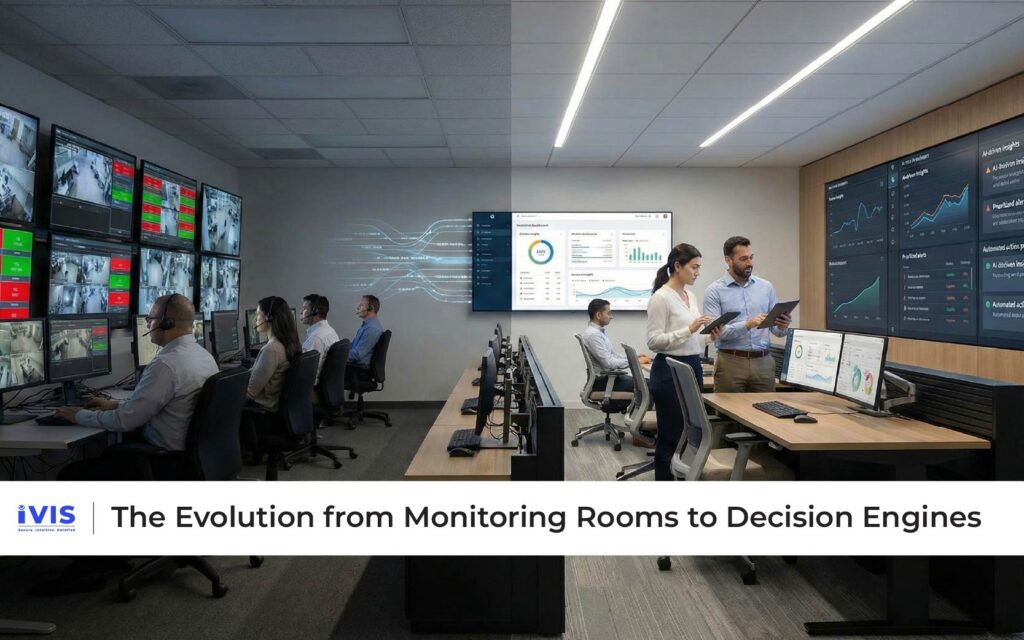
Not long ago, surveillance command centers were quiet, dimly lit rooms filled with video walls and rows of operators watching dozens, sometimes hundreds of camera feeds. Their job was simple in theory but exhausting in practice: observe, wait, and respond when something went wrong. These monitoring rooms were the nerve centers of security operations, yet they were largely reactive, dependent on human attention and hindsight.
Today, that model is undergoing a fundamental transformation. Modern command centers are no longer just places where footage is watched. They are becoming decision engines, intelligent hubs that analyze data, predict outcomes, and orchestrate responses across people, systems, and locations. This evolution reflects a broader shift in surveillance itself: from passive monitoring to active, intelligence-driven decision-making.
The limitations of traditional monitoring rooms were not due to lack of effort, but to human constraints. Operators are expected to monitor multiple screens for long periods, identify anomalies, and make quick judgments under pressure. Research has consistently shown that sustained attention degrades rapidly in such settings, increasing the risk of missed events.
At the same time, the scale of surveillance has expanded dramatically. Cities deploy thousands of cameras. Enterprises manage distributed facilities across regions. Public infrastructure, transport hubs, and campuses generate vast volumes of real-time data. Monitoring rooms designed for a simpler era struggle to keep pace with this complexity.
According to studies cited by the World Economic Forum, the gap between data generation and human decision capacity is one of the biggest challenges in modern security operations. This gap is what set the stage for the rise of analytics-driven command centers.
The first step in this evolution was the introduction of video analytics. Instead of relying solely on human eyes, systems began to detect motion, count people, and flag predefined events. While helpful, early analytics were still limited they reacted to individual triggers rather than understanding context.
The real transformation began when analytics matured into contextual intelligence. AI models started correlating data across cameras, timeframes, and sources. They learned patterns of normal behavior and identified anomalies that suggested emerging risks. Command centers could now prioritize alerts, reduce false positives, and focus attention where it mattered most.
Research published in IEEE journals highlights that context-aware analytics significantly improve detection accuracy and response efficiency. This marked the transition from monitoring rooms to environments that assist decision-making, rather than simply presenting information.
Modern decision engines are built around situational awareness, not screen density. Instead of overwhelming operators with raw feeds, they synthesize information into actionable insights. Dashboards present what is happening, why it matters, and what actions are recommended.
For example, a command center overseeing a large campus might receive a single prioritized alert indicating abnormal crowd behavior near an exit, supported by video snippets, historical context, and suggested responses. This is a far cry from manually scanning dozens of feeds hoping to notice something unusual.
According to McKinsey, organizations that move from data monitoring to decision support see faster response times and more consistent outcomes. In surveillance, this means fewer missed incidents and better coordination during critical moments.
The evolution does not stop at real-time awareness. The most advanced command centers now incorporate predictive analytics. By analyzing historical data alongside live inputs, decision engines can forecast risks before they materialize.
In transport systems, this may involve predicting congestion or safety incidents based on time, events, and past patterns. In industrial environments, it may mean anticipating unsafe interactions between humans and machines. In public spaces, it can involve forecasting crowd surges or emergency response needs.
The World Bank notes that predictive, data-driven decision systems improve resilience by enabling proactive interventions rather than reactive fixes. Command centers that adopt this approach move from managing incidents to preventing them.
What truly distinguishes a decision engine from a monitoring room is integration. Modern command centers do not operate in isolation. They ingest data from video systems, access controls, IoT sensors, alarms, and operational platforms.
By correlating these inputs, decision engines provide a holistic view of the environment. A door access alert gains meaning when paired with video analytics. A sensor anomaly becomes actionable when visual confirmation is available. This integration reduces ambiguity and speeds decision-making.
Industry frameworks for smart cities and critical infrastructure consistently emphasize integration as a cornerstone of effective command centers. Without it, even the most advanced analytics remain siloed.
As command centers evolve, the role of humans evolves with them. Operators are no longer passive watchers. They become decision supervisors, validating insights, managing exceptions, and coordinating responses.
This shift reduces fatigue and improves job satisfaction. Instead of staring at screens, teams focus on judgment, communication, and continuous improvement. Importantly, humans remain accountable for high-impact decisions, ensuring ethical and legal oversight.
Standards bodies such as NIST stress the importance of human-in-the-loop or human-on-the-loop models for AI-driven systems. Decision engines enhance human capability; they do not replace it.
As organizations transition from monitoring rooms to decision engines, they need platforms designed for orchestration, intelligence, and governance. This is where IVIS plays a meaningful role.
IVIS enables command centers to move beyond passive monitoring by unifying video analytics, contextual data, and operational workflows into a single intelligent platform. Instead of presenting raw feeds, IVIS supports prioritized alerts, real-time insights, and coordinated response mechanisms. Its architecture allows data to be processed at the edge for speed, while maintaining centralized oversight for strategy and compliance.
By embedding policy-driven controls, audit trails, and scalable integration, IVIS ensures that decision engines remain transparent, secure, and aligned with regulatory requirements. In practice, IVIS helps organizations transform their command centers into operational brains, places where information becomes insight, and insight becomes action.
As decision engines gain autonomy and influence, governance becomes critical. Clear rules must define what systems can decide automatically and what requires human approval. Transparency and explainability are essential to maintaining trust among stakeholders.
Global frameworks on AI ethics emphasize accountability, proportionality, and oversight. Command centers that adopt these principles ensure that intelligence serves safety and efficiency without crossing ethical boundaries.
Trust is not built by technology alone; it is built by how that technology is governed.
Monitoring rooms were built for a world where watching was enough. Today’s world demands more. As environments grow more complex and data-rich, surveillance must evolve into intelligence and command centers must become decision engines.
By combining analytics, integration, prediction, and human oversight, modern decision engines transform how organizations respond to risk and opportunity. Platforms like IVIS illustrate how this transformation can be achieved responsibly, turning surveillance from a reactive function into a strategic capability.
The future of command centers is not about seeing more. It is about deciding better.