Compliance has always been a cornerstone of regulated industries. Whether in banking, healthcare, manufacturing, energy, or public infrastructure, organizations are expected to prove that processes are followed, risks are controlled, and people are protected. Traditionally, compliance auditing relied heavily on documentation, manual inspections, and periodic reporting. While these methods served their purpose, they were often time-consuming, reactive, and limited in scope.
Today, that model is changing. Video intelligence is the combination of video surveillance with AI-powered analytics, is reshaping how compliance is monitored, validated, and enforced. Instead of relying solely on paper trails and after-the-fact checks, organizations are using visual data to gain real-time, objective evidence of compliance. Auditing is no longer just about reviewing the past; it is increasingly about continuous assurance.
Modern compliance requirements are growing in both complexity and frequency. Regulators expect higher transparency, faster reporting, and stronger proof that controls are effective. At the same time, organizations operate at greater scale, across distributed locations and hybrid environments.
Manual audits struggle to keep up with this pace. Site visits are expensive and infrequent. Self-reported checklists are prone to error or bias. Gaps between audits allow non-compliance to go unnoticed until it becomes a serious issue.
According to Deloitte, organizations that rely solely on periodic audits face higher operational and regulatory risk because violations often occur between reporting cycles. This has driven a shift toward continuous monitoring models, where compliance is validated as operations happen, not weeks or months later.
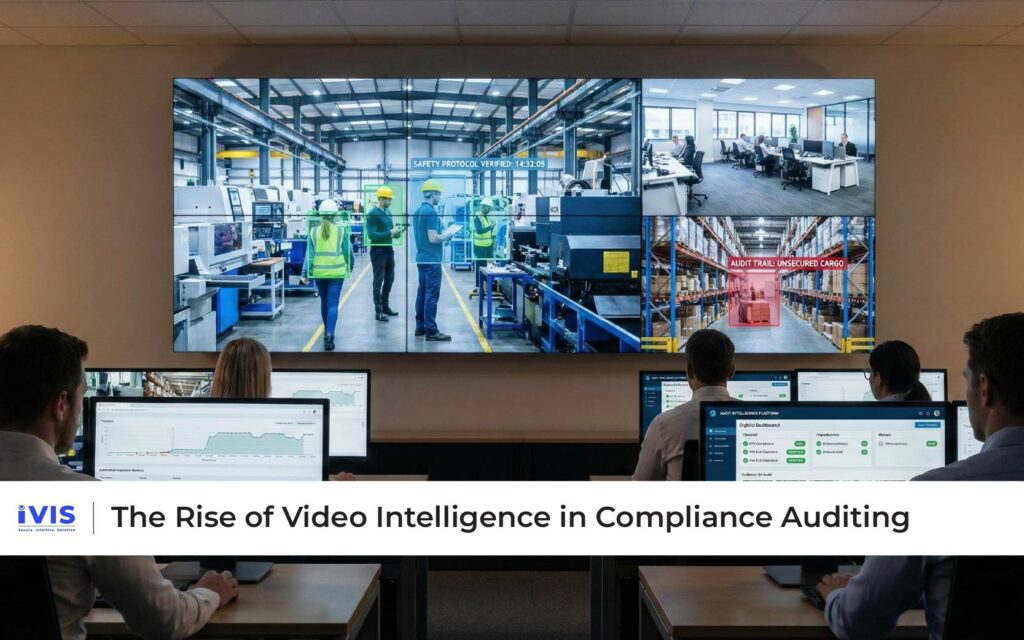
Video intelligence transforms surveillance footage into structured, searchable, and actionable data. Instead of passively recording video, AI models analyze scenes to detect behaviors, conditions, and deviations from defined standards.
For example, in an industrial facility, video analytics can verify whether workers are wearing required personal protective equipment, whether restricted zones are respected, or whether safety procedures are followed consistently. In BFSI environments, video intelligence can validate access control compliance, monitor sensitive areas, and ensure procedural adherence during cash handling.
Research published in IEEE Access shows that intelligent video analytics significantly improve accuracy in detecting rule violations compared to manual observation, while also reducing human bias. Video becomes not just evidence, but insight.
One of the most significant impacts of video intelligence is the move from periodic audits to continuous compliance auditing. Instead of sampling behavior at fixed intervals, organizations gain ongoing visibility into operations.
This approach allows compliance teams to identify trends, not just isolated incidents. Repeated minor violations, which might go unnoticed in traditional audits, become visible through pattern analysis. Early intervention becomes possible, reducing the likelihood of major breaches or penalties.
The World Economic Forum highlights continuous monitoring as a key pillar of modern governance, especially in highly regulated and safety-critical sectors. Video intelligence supports this model by providing an always-on validation layer.
Compliance audits often hinge on evidence. Video intelligence provides objective, time-stamped records that are difficult to dispute. Unlike written reports or verbal confirmations, visual data offers direct proof of what occurred.
This is particularly valuable during regulatory inspections or internal investigations. Auditors can review specific events, verify corrective actions, and assess whether controls are effective in practice. Video analytics can also generate automated compliance reports, reducing manual effort and speeding up audit cycles.
According to PwC, organizations that leverage digital evidence and automation in compliance processes report faster audits and lower operational disruption. Video intelligence strengthens audit readiness by making evidence accessible and reliable.
While video intelligence offers powerful compliance benefits, it must be deployed responsibly. Compliance monitoring should not come at the expense of privacy, dignity, or trust.
Modern systems increasingly rely on behaviour-based analytics rather than identity recognition. The focus is on what is happening, not who is involved, unless identification is legally required. Private areas are excluded, access to footage is controlled, and retention periods are clearly defined.
Regulations such as GDPR and emerging data protection laws emphasize proportionality, transparency, and accountability in monitoring systems. UNESCO’s Recommendation on the Ethics of Artificial Intelligence reinforces that AI-driven oversight must respect human rights and be explainable. Ethical deployment is essential to ensuring that video intelligence strengthens governance rather than undermines it.
The rise of video intelligence in compliance auditing spans multiple sectors.
In manufacturing, it supports safety compliance, quality control, and process adherence. In energy and utilities, it helps validate perimeter security, operational protocols, and contractor safety. In healthcare, it supports hygiene standards, access control, and patient safety processes. In BFSI, it strengthens oversight of sensitive operations and physical security controls.
Across these sectors, the common thread is the need for verifiable, real-time compliance assurance, something traditional audits alone cannot provide.
As compliance requirements evolve, organizations need platforms that can unify video intelligence with governance and reporting. This is where IVIS plays a meaningful role.
IVIS enables organizations to centralize video analytics across locations and environments, transforming surveillance data into actionable compliance insights. By applying AI-driven analytics to live and recorded video, IVIS supports continuous monitoring of policies, procedures, and safety standards. Alerts, logs, and audit trails help compliance teams identify gaps early and document corrective actions clearly.
Designed for hybrid deployments across edge, on-prem, and cloud, IVIS ensures that compliance monitoring remains scalable and secure. Policy-driven access controls and configurable retention support regulatory alignment, while centralized dashboards simplify audit preparation. In practice, IVIS helps organizations move from reactive audits to proactive compliance intelligence.
The future of compliance auditing will be increasingly automated, data-driven, and predictive. Video intelligence will integrate with other enterprise system access control, IoT sensors, and risk management platforms to provide a holistic view of compliance posture.
AI models will not only detect violations, but also predict areas of elevated risk based on historical trends and contextual factors. This will allow organizations to allocate resources more effectively and prevent non-compliance before it occurs.
As regulators continue to demand transparency and accountability, video intelligence will become a standard component of compliance frameworks, not an optional enhancement.
Compliance auditing is evolving from a retrospective exercise into a continuous, intelligence-led discipline. Video intelligence sits at the heart of this transformation, providing real-time visibility, objective evidence, and actionable insight.
When deployed ethically and governed responsibly, video-driven compliance strengthens trust with regulators, customers, employees, and the public. Platforms like IVIS demonstrate how organizations can harness this capability to move beyond checklists and reports, toward compliance that is visible, verifiable, and resilient.
In the era of heightened accountability, seeing is no longer just believing, it is proving.