
Every four minutes, a life is lost on Indian roads.
That statistic is not rhetorical. According to the Ministry of Road Transport and Highways (MoRTH), India recorded over 1.68 lakh road accident deaths in 2022, making it one of the highest road fatality figures globally. Behind each number is a family altered forever. Behind each crash lies a pattern, often predictable, sometimes preventable.
For decades, road safety interventions have been reactive. Accidents occur. Authorities respond. Blackspots are identified after repeated incidents. Enforcement increases only after fatalities spike. But in a country as vast and dynamic as India, reacting is no longer enough.
The next chapter in road safety is being written through AI-driven, predictive, hyperlocal intelligence, a model that shifts the focus from post-incident analysis to real-time prevention.
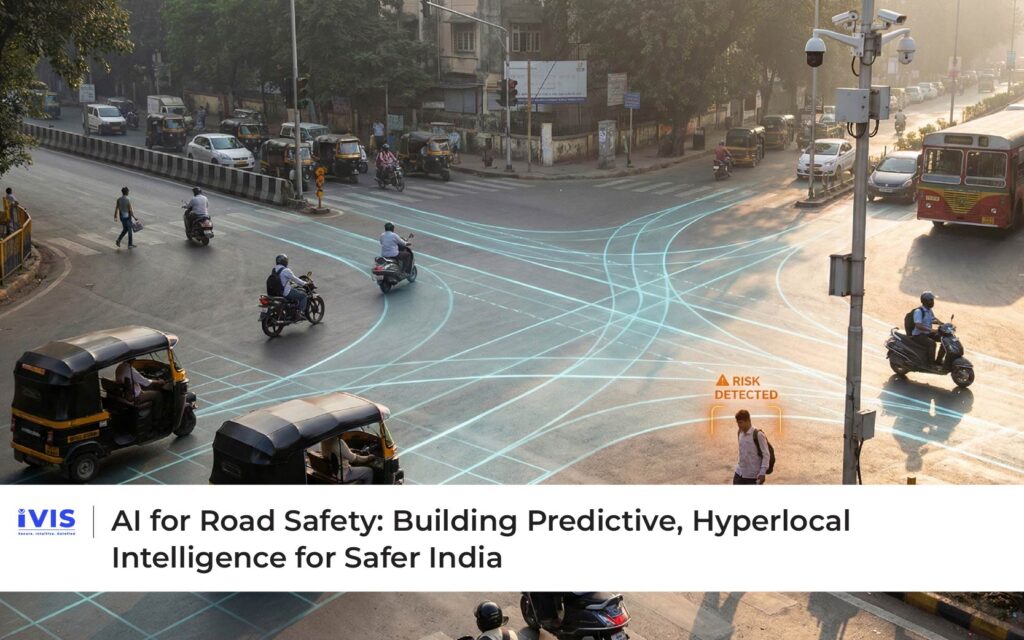
India has one of the world’s largest and most diverse road networks. From congested urban intersections to high-speed national highways and rural roads lacking basic signage, conditions vary dramatically within short distances.
According to MoRTH’s Road Accidents in India report, over-speeding accounts for the majority of fatal crashes, followed by dangerous driving behaviors and infrastructure-related risks. The World Health Organization also highlights that low- and middle-income countries bear a disproportionate share of global road traffic deaths, despite having fewer vehicles relative to population.
Traditional enforcement models, manual monitoring, periodic checks, and reactive policing; struggle to keep pace with this complexity. India needs solutions that operate continuously, scale efficiently, and adapt locally.
Predictive road safety powered by AI goes beyond installing cameras at intersections. It combines video analytics, traffic data, environmental inputs, and behavioral modeling to anticipate risk in real time.
Hyperlocal intelligence means analyzing road conditions at the micro level – specific intersections, pedestrian crossings, accident-prone stretches, school zones, or toll plazas. Instead of broad national averages, AI systems learn patterns unique to each location.
For example, an urban junction may show repeated near-miss events between turning vehicles and pedestrians during peak evening hours. A highway segment may exhibit erratic lane switching before collisions. AI systems can detect these precursors, flag risk levels, and trigger preventive measures, before a fatal crash occurs.
Research published in IEEE on intelligent transportation systems demonstrates that AI-based traffic analytics significantly improve early detection of hazardous behaviors compared to manual observation. The key shift is from counting accidents to predicting them.
AI-enabled road surveillance systems analyze live feeds to detect speeding, signal jumping, wrong-side driving, helmet violations, seatbelt non-compliance, and lane discipline issues.
However, the real value lies not just in issuing challans, but in understanding behavior patterns. For instance, repeated red-light violations at a specific intersection may signal poor signal timing or visibility issues. High pedestrian conflict in a market area may indicate inadequate crossing infrastructure.
According to the World Economic Forum, smart mobility systems that integrate real-time monitoring with predictive analytics can significantly reduce traffic fatalities when combined with targeted interventions.
AI transforms enforcement from punitive to preventive. It helps authorities intervene early, through signage changes, road redesign, enforcement presence, or public awareness campaigns.
India has historically identified “blackspots” based on past accident data. While useful, this method inherently looks backward.
Predictive AI models can instead analyze near-miss incidents, sudden braking patterns, crowding behaviors, and abnormal vehicle trajectories to identify high-risk zones before fatalities spike.
Studies in urban mobility research show that analyzing near-miss data provides earlier signals of systemic risk than waiting for confirmed accidents. This approach enables proactive infrastructure adjustments, improved lighting, rumble strips, speed calming measures, or lane redesign.
In a country with high traffic density and mixed vehicle types from two-wheelers to heavy trucks, such foresight can be life-saving.
AI-powered road surveillance does more than detect violations; it generates actionable insights for planners.
Heatmaps of pedestrian flow help design safer crossings. Vehicle trajectory data informs signal timing optimization. Congestion patterns reveal the need for flyovers or service lanes. School zone monitoring supports safer dispersal strategies.
McKinsey’s research on smart cities emphasizes that data-driven mobility planning leads to measurable improvements in safety and efficiency. When traffic analytics feed into municipal dashboards, road safety becomes part of long-term urban intelligence.
Hyperlocal analytics empower cities to move from broad policy to precise action.
In road safety, response time matters. AI-enabled surveillance systems can automatically detect collisions, stalled vehicles, or sudden crowd formation after incidents. Immediate alerts to emergency services reduce delays in medical assistance.
The World Bank notes that reducing post-crash response time significantly lowers mortality rates in road accidents. Automated incident detection systems ensure that help is dispatched quickly, even if bystanders do not report the crash immediately.
In high-speed corridors and remote areas, this capability can make the difference between life and death.
Deploying AI on public roads must be done responsibly. Road surveillance systems capture public movement, making transparency and governance essential.
Best practices prioritize behavior-based detection over intrusive identity tracking. Data minimization, secure storage, defined retention periods, and strict access controls are fundamental safeguards.
Frameworks such as GDPR and UNESCO’s Recommendation on the Ethics of Artificial Intelligence emphasize proportionality, explainability, and accountability in AI systems. Ethical deployment ensures that road safety intelligence strengthens public trust rather than undermines it.
Public communication about how data is used and how it protects citizens, plays a critical role in acceptance.
To enable predictive, hyperlocal road intelligence, cities and state authorities require scalable and integrated platforms. This is where IVIS plays a meaningful role.
IVIS supports AI-driven video analytics across distributed road networks, integrating feeds from intersections, highways, toll booths, and urban corridors into a centralized intelligence framework. Through real-time violation detection, anomaly analysis, and risk scoring, IVIS enables authorities to move from reactive enforcement to predictive prevention.
Its hybrid architecture allows edge-based analytics for low-latency decision-making while maintaining centralized dashboards for broader oversight. Configurable workflows ensure alerts reach traffic police, emergency responders, or municipal authorities instantly.
Importantly, IVIS incorporates policy-driven governance and secure data handling, aligning road safety initiatives with regulatory and ethical standards. In practice, IVIS helps transform road surveillance into a comprehensive road safety intelligence system.
India’s commitment to reducing road fatalities aligns with global Vision Zero principles, aiming for zero traffic deaths through systemic safety improvements.
AI-driven predictive surveillance is not a standalone solution, but it is a critical enabler. When combined with infrastructure upgrades, policy reform, driver education, and enforcement, hyperlocal intelligence accelerates progress.
The future of road safety in India will not rely solely on stricter penalties. It will rely on smarter systems, systems that see patterns humans miss, predict risk before tragedy, and act in real time.
India’s commitment to reducing road fatalities aligns with global Vision Zero principles, aiming for zero traffic deaths through systemic safety improvements.
AI-driven predictive surveillance is not a standalone solution, but it is a critical enabler. When combined with infrastructure upgrades, policy reform, driver education, and enforcement, hyperlocal intelligence accelerates progress.
The future of road safety in India will not rely solely on stricter penalties. It will rely on smarter systems, systems that see patterns humans miss, predict risk before tragedy, and act in real time.
Road accidents are not random. They are the result of identifiable behaviors, infrastructure gaps, and environmental conditions. AI for road safety brings clarity to this complexity.
By building predictive, hyperlocal intelligence, India can shift from counting casualties to preventing them. Surveillance, when deployed ethically and intelligently, becomes more than monitoring, it becomes a guardian of public life.
Platforms like IVIS demonstrate how technology can empower authorities to create safer roads, faster responses, and more resilient urban systems.
Because on India’s roads, every second, and every insight, counts.