Security is often designed for permanence. Fixed campuses, established hospitals, long-standing government buildings; these environments justify structured surveillance systems, layered access control, and dedicated monitoring rooms.
But what happens when the space itself is temporary?
A large-scale public exam conducted across thousands of centers for just one week. A vaccination drive in a converted community hall. A disaster relief camp assembled overnight. A construction site that evolves month by month. A major event venue built for three days and dismantled the next.
Temporary spaces are dynamic, high-pressure, and high-risk. They bring together dense crowds, sensitive operations, or valuable materials – often without the luxury of permanent infrastructure. In 2026, as public mobility increases and rapid deployment operations become more common, fast-deploy, intelligent e-surveillance has become essential for securing pop-up environments and mobile infrastructure.
Temporary environments share three characteristics: unpredictability, scale, and time constraints.
In disaster response camps, large populations gather under stress. According to the World Health Organization (WHO), emergency settings significantly increase vulnerability to safety incidents, disease spread, and logistical breakdowns. Effective monitoring improves coordination and protection.
During large public events, crowd surges and panic can escalate quickly. Research published in IEEE on crowd analytics highlights how early detection of density anomalies significantly reduces the risk of stampedes or structural strain.
Education boards conducting national-level examinations face integrity risks like paper leaks, impersonation, crowd mismanagement; across geographically dispersed centers. Similarly, vaccination drives or mobile clinics manage sensitive medical supplies and personal data under tight timelines.
Construction sites, which are inherently temporary, remain among the most accident-prone environments globally. The International Labour Organization (ILO) identifies construction as one of the highest-risk sectors for workplace injuries, often due to insufficient monitoring and rapidly changing site layouts.
The common thread is this: risk concentrates where infrastructure is transient and oversight is limited.
Traditional surveillance systems depend on cabling, permanent camera mounts, and centralized control rooms. Temporary spaces rarely offer such stability.
Modern e-surveillance addresses this through portable, wireless, and edge-enabled systems. Rapid-deploy cameras, mobile command units, solar-powered towers, and cloud-integrated dashboards allow authorities to establish operational visibility within hours.
Edge computing plays a crucial role here. By processing video analytics locally, systems reduce reliance on stable connectivity which is a frequent challenge in disaster zones or rural exam centers. Critical alerts such as crowd density spikes, unauthorized entry, or suspicious activity are generated instantly, even before full cloud synchronization.
According to the World Economic Forum’s analysis on smart infrastructure, edge-enabled monitoring significantly improves operational resilience in dynamic and decentralized environments.
Temporary spaces require systems that move as fast as the environment changes.
Examination security is increasingly under scrutiny. Large-scale exams involve thousands of candidates, temporary invigilators, and rented venues.
AI-powered e-surveillance helps monitor entry points, detect impersonation attempts, and flag irregular crowd patterns. Behavior-based analytics can identify unauthorized movement within examination halls or unusual congregation near restricted areas.
The value is not only in preventing malpractice but in providing verifiable transparency. Education boards benefit from time-stamped visual records that support audit trails and public trust.
With public confidence in examination systems closely tied to fairness and integrity, proactive monitoring strengthens institutional credibility.
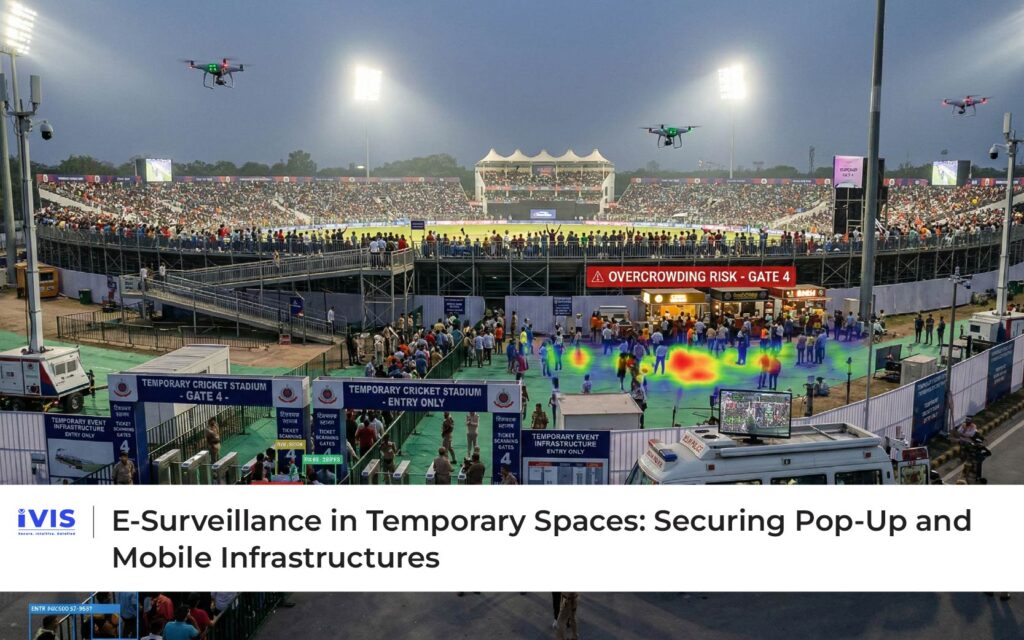
Temporary event venues for concerts, sports tournaments, political gatherings, can host tens of thousands of attendees. Crowd management is critical.
AI-driven crowd analytics monitor density, flow direction, and abnormal behavior. If congestion builds near entry gates or emergency exits, alerts allow organizers to redirect movement before risk escalates.
IEEE research on crowd anomaly detection shows that AI-based monitoring significantly enhances early warning capabilities compared to manual supervision. Combined with emergency response coordination, this intelligence reduces panic-driven incidents.
For event organizers, surveillance is not only about security, it is about reputation protection and liability mitigation.
In emergency response scenarios, speed saves lives. Temporary shelters must manage crowding, medical supply distribution, and security concerns simultaneously.
Surveillance supports equitable resource allocation, perimeter monitoring, and identification of distress signals. WHO emphasizes that structured coordination mechanisms in emergency camps reduce operational breakdowns and improve safety outcomes.
Mobile surveillance units equipped with AI analytics can operate independently, transmitting critical alerts to centralized response centers. In environments where infrastructure is compromised, such autonomy is vital.
Construction sites evolve daily. New equipment arrives. Structures rise. Access points shift.
AI-enabled video analytics detect unsafe behavior, PPE non-compliance, and unauthorized access to hazardous zones. The ILO notes that proactive monitoring reduces workplace injuries significantly when combined with safety training.
Portable surveillance towers and wireless cameras ensure coverage adapts alongside site changes. Rather than waiting for periodic inspections, continuous monitoring improves compliance and documentation.
In a sector where safety violations carry legal and reputational consequences, real-time visibility is a strategic advantage.
Temporary does not mean exempt from regulation. Even short-term surveillance must comply with privacy and ethical standards.
Best practices include limiting monitoring to operational zones, encrypting data, defining clear retention periods, and communicating purpose transparently. UNESCO’s Recommendation on the Ethics of Artificial Intelligence reinforces proportionality and accountability in AI deployment.
Trust is especially important in public-sector deployments. Citizens must understand that surveillance exists to protect, not intrude.
Delivering fast-deploy intelligence across diverse temporary settings requires scalable and adaptable platforms. This is where IVIS plays a critical role.
IVIS enables rapid configuration of distributed surveillance networks for exams, disaster camps, construction sites, and event venues. Its architecture supports edge-based analytics for low-latency alerts, while cloud integration ensures centralized oversight across multiple temporary locations.
Configurable workflows allow authorities to route alerts instantly to designated officials whether examination supervisors, event coordinators, or emergency responders. Real-time dashboards provide a unified operational view, even when infrastructure is temporary.
Importantly, IVIS incorporates policy-driven data governance, access controls, and audit trails, ensuring that temporary deployments meet regulatory expectations. In practice, IVIS transforms short-term setups into intelligent, accountable, and resilient operational environments.
As public services grow more mobile with pop-up healthcare units, seasonal exam centers, infrastructure projects, and temporary event spaces; the demand for adaptable surveillance will continue to rise.
The future of temporary space security lies in portability, intelligence, and governance. Systems must be quick to deploy, smart enough to predict risk, and transparent enough to maintain trust.
Temporary spaces may be short-lived. The responsibility to secure them is not.
Pop-up environments and mobile infrastructure present unique security challenges. They operate under time pressure, limited infrastructure, and heightened public scrutiny.
E-surveillance bridges this gap by delivering fast-deploy, AI-driven intelligence that protects people, assets, and processes. From examination halls to vaccination centers, from construction sites to disaster relief camps, intelligent monitoring ensures that temporary does not mean vulnerable.
With platforms like IVIS, organizations can build temporary spaces that are not only functional – but secure, accountable, and resilient.
Because in a world that moves fast, security must move faster.