
Walk into a modern hospital corridor. The lighting subtly adjusts as you pass. Digital signboards shift directions based on foot traffic. Doors unlock automatically for authorized personnel. A silent alert is triggered when a patient wanders beyond a defined safety zone. No alarms. No visible commands. No manual intervention.
The space understands.
This is the emerging reality of ambient intelligence in e-surveillance, where monitoring systems do not merely record events but actively sense, interpret, and respond to human presence. Surveillance is no longer confined to control rooms and camera feeds. It is blending with ambient computing, creating environments that adapt in real time without explicit triggers.
In smart hospitals, campuses, airports, and corporate offices, this shift represents a new paradigm: security embedded into the fabric of space itself.
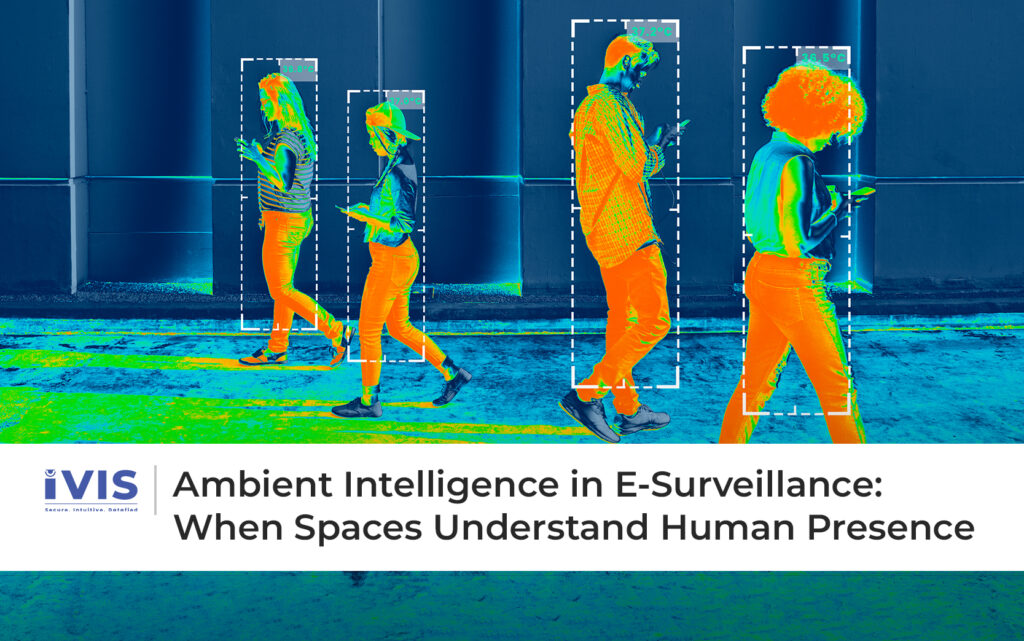
Ambient intelligence (AmI) refers to digital environments that are sensitive and responsive to the presence of people. Coined in early research by the European Commission’s Information Society initiatives, the concept envisioned environments enriched with sensors, AI, and contextual computing.
In the context of e-surveillance, ambient intelligence merges AI-powered video analytics, IoT sensors, access control systems, and environmental data to create context-aware security ecosystems. Instead of waiting for a manual alarm or explicit rule violation, systems interpret patterns – movement flows, dwell times, proximity behaviours, and adjust conditions dynamically.
The difference is subtle but profound. Traditional surveillance answers the question: What happened? Ambient intelligence asks: What is happening, and how should the space respond?
Modern public and corporate environments are more complex than ever. Hospitals operate with constant patient flow and sensitive medical equipment. Airports manage thousands of passengers per hour. University campuses resemble small cities. Corporate offices blend physical and hybrid workspaces.
According to the World Economic Forum’s research on smart infrastructure, urban environments are becoming increasingly data-rich, demanding intelligent coordination between digital systems and physical operations. Manual supervision alone cannot manage this scale.
At the same time, expectations around seamless experiences have grown. People expect security without friction. They want spaces that feel safe but not restrictive.
Ambient intelligence addresses both needs, enhanced safety and minimal disruption.
Ambient e-surveillance systems rely on layered intelligence. Cameras equipped with AI analyze movement patterns. IoT sensors detect environmental shifts such as temperature, noise, or air quality. Access control systems verify identity and movement authorization. Edge computing processes data locally to reduce latency.
These inputs feed into a centralized orchestration platform. Machine learning models establish baselines, what normal behavior looks like at a particular location and time. Deviations trigger adaptive responses.
For example, if crowd density builds unexpectedly near an airport gate, digital signage can redirect passengers automatically. If a patient in a hospital shows abnormal wandering behavior, staff receive a quiet alert. If after-hours presence is detected in a restricted corporate office zone, lighting increases and security is notified.
Research published in IEEE on context-aware computing confirms that multi-sensor integration significantly improves anomaly detection accuracy compared to single-stream monitoring.
Ambient intelligence transforms surveillance into an active participant in operational flow.
Healthcare environments benefit significantly from ambient intelligence. Hospitals are high-risk, high-sensitivity spaces where safety and privacy must coexist.
AI-enabled surveillance can detect patient falls or unusual immobility patterns, enabling faster response. WHO emphasizes that early intervention reduces severity in patient safety incidents. Ambient systems can also monitor sterile zones, track equipment movement, and adjust lighting or climate conditions based on occupancy.
Crucially, these systems operate discreetly. Instead of loud alarms, they trigger contextual workflows, quiet notifications to nurses or automated documentation logs.
Security becomes part of patient care, not an intrusive presence.
University campuses and corporate offices are dynamic ecosystems. Students, faculty, employees, and visitors interact across classrooms, labs, meeting rooms, and common areas.
Ambient surveillance systems monitor occupancy levels, detect unauthorized access to research labs, and manage emergency evacuation flows. In corporate settings, they integrate with smart building systems to adjust energy use based on real-time presence.
According to McKinsey’s research on smart buildings, intelligent occupancy-based management can improve operational efficiency while enhancing safety and sustainability.
When surveillance integrates seamlessly with facility management, it supports both security and operational optimization.
Airports exemplify the need for adaptive environments. Passenger movement fluctuates rapidly. Security lines expand and contract. Boarding gates change.
Ambient intelligence enables real-time crowd management, predictive queue adjustments, and risk-based monitoring. Behavior-based analytics identify unusual movement patterns without relying solely on identity recognition.
The International Air Transport Association (IATA) has emphasized the role of intelligent systems in enhancing passenger experience while maintaining security compliance. Ambient surveillance aligns with this objective, balancing efficiency with vigilance.
As spaces grow more responsive, ethical considerations intensify. Ambient intelligence must respect boundaries.
Best practices prioritize behavior-based analysis rather than continuous identity tracking. Data is encrypted, anonymized where possible, and retained only for defined durations. Transparency, clear communication about system purpose and scope—remains essential.
UNESCO’s Recommendation on the Ethics of Artificial Intelligence stresses proportionality, explainability, and human oversight in AI deployments. Ambient surveillance must follow these principles to maintain trust.
An intelligent space should feel supportive, not invasive.
Delivering ambient intelligence requires a unified platform capable of integrating video analytics, IoT data, and workflow orchestration. This is where IVIS plays a meaningful role.
IVIS enables organizations to centralize multi-source surveillance inputs into a cohesive operational intelligence framework. Through AI-powered video analytics and contextual risk modeling, IVIS supports adaptive responses across smart hospitals, campuses, airports, and corporate offices.
Its edge-enabled architecture allows real-time processing at source devices while maintaining centralized oversight for compliance and analytics. Configurable workflows enable automated responses such as alert routing, environmental adjustments, or access restrictions, without compromising human oversight.
Importantly, IVIS incorporates policy-driven governance, access controls, and audit trails. This ensures that ambient intelligence remains aligned with regulatory standards and ethical guidelines.
In practice, IVIS helps transform static surveillance systems into living, responsive ecosystems, spaces that understand presence and adapt accordingly.
The future of e-surveillance lies in invisibility. Not in secrecy, but in seamless integration. The most effective security systems are those that enhance safety without disrupting experience.
Ambient intelligence represents this evolution. It merges surveillance, automation, and contextual computing into a unified layer of environmental awareness.
According to Gartner’s research on smart environments, ambient computing will increasingly define next-generation digital infrastructure. Surveillance will no longer be a standalone function; it will be embedded into operational design.
Spaces will not just observe, they will respond.
Ambient intelligence in e-surveillance signals a shift from reactive monitoring to responsive environments. By sensing presence, interpreting context, and adapting operations, these systems redefine what safety looks like in modern spaces.
From hospitals and campuses to airports and corporate offices, intelligent environments enhance both security and experience. When deployed ethically and governed responsibly, they build trust while protecting people.
Platforms like IVIS demonstrate how ambient computing and surveillance can converge to create environments that are not only secure, but aware.
Because the future of security is not about watching harder. It is about understanding better.