
Trust is the backbone of the BFSI sector. Every transaction, every interaction, and every digital touchpoint relies on the assurance that systems are secure, people are protected, and risks are under control. Yet today, banking and financial services no longer operate within the four walls of a branch. ATMs span cities, data centers power digital channels, field agents operate on the ground, and customers interact through hybrid physical-digital journeys.
In this expanded landscape, security must travel wherever trust is expected. This is where e-surveillance beyond branches becomes critical. Modern BFSI surveillance is no longer just about monitoring branch interiors; it is about securing spaces, assets, people, and processes across a distributed ecosystem.
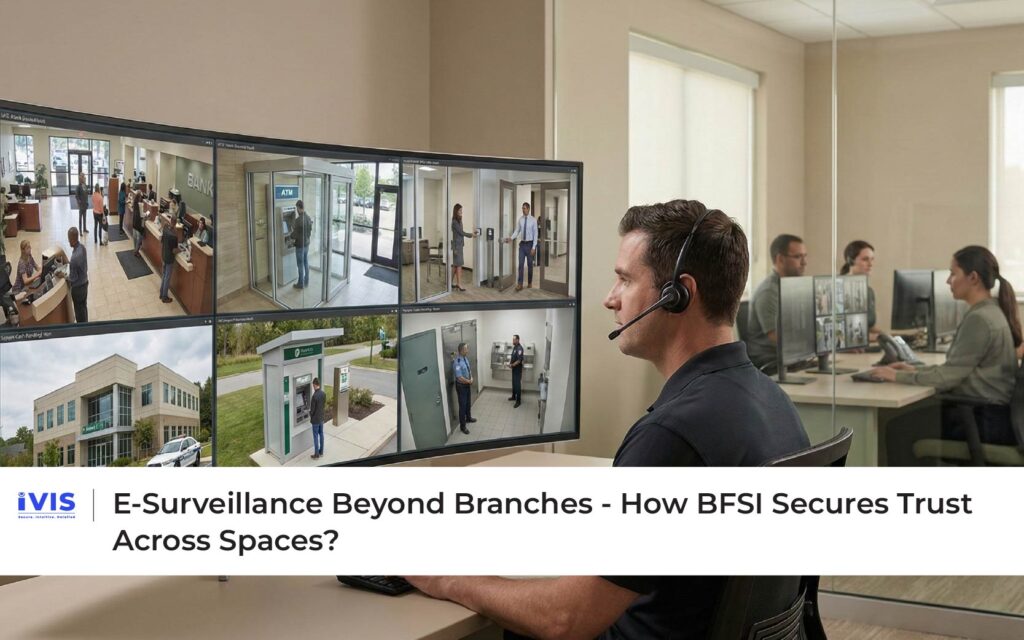
Traditional bank surveillance focused on branch safety with cameras at teller counters, vaults, and entrances. While still essential, this model is no longer sufficient. BFSI operations now extend to ATMs, cash vans, call centers, operations hubs, data centers, partner locations, and even temporary field setups.
At the same time, financial institutions face increasing threats. According to the Reserve Bank of India, fraud incidents in the banking sector have grown in volume and sophistication, with both physical and digital vectors playing a role. Global reports from PwC also note that financial services remain one of the most targeted sectors for both fraud and security breaches.
This convergence of distributed operations and elevated risk has pushed BFSI organizations to rethink surveillance, not as a static security layer, but as a dynamic, intelligence-driven system that reinforces trust everywhere the institution operates.
E-surveillance in BFSI combines video monitoring, AI analytics, access control integration, and centralized command systems to provide real-time visibility across physical environments. Unlike traditional CCTV, modern e-surveillance systems actively analyze events as they unfold.
These systems can detect unauthorized access to restricted zones, abnormal behavior near ATMs, tailgating at secure entrances, or suspicious activity during off-hours. Instead of reviewing footage after a breach, security teams receive alerts in real time, enabling faster intervention and damage prevention.
Research from McKinsey highlights that AI-enabled monitoring systems significantly improve situational awareness and reduce response times in high-risk industries such as financial services. This proactive capability is particularly valuable in BFSI, where delays can lead to financial loss and reputational damage.
ATMs are among the most vulnerable BFSI assets. Often located in semi-public or remote areas, they are exposed to theft, vandalism, skimming, and physical tampering.
AI-powered surveillance strengthens ATM security by monitoring not just presence, but behavior. Video analytics can identify loitering, repeated access attempts, or abnormal activity near ATM panels. Combined with time-of-day analysis and historical patterns, systems can flag high-risk situations early.
According to studies referenced by the European Central Bank, intelligent video monitoring has proven effective in reducing ATM-related crimes when paired with rapid response mechanisms. Surveillance, in this context, becomes a deterrent, a detector, and a source of evidence, reinforcing trust in self-service banking.
Beyond ATMs, BFSI operations involve cash handling, document processing, and sensitive back-office functions. Cash management centers, vaults, and logistics operations are critical nodes where security failures can have cascading effects.
E-surveillance systems monitor access to these areas, correlate video data with access logs, and provide audit trails for compliance and investigation. Unusual movement patterns, unauthorized presence, or deviation from standard procedures can be detected and escalated instantly.
Deloitte’s research on financial services risk management emphasizes the importance of physical surveillance as part of a broader risk mitigation strategy, especially in environments handling cash and sensitive information.
Compliance is non-negotiable in BFSI. Regulators require institutions to demonstrate control over physical and operational risks, maintain auditability, and ensure customer and employee safety.
E-surveillance supports these requirements by creating objective records of events. Video data, when governed correctly, helps validate adherence to procedures, investigate incidents, and respond to regulatory inquiries. It also supports internal governance by reducing ambiguity in incident analysis.
According to the Basel Committee on Banking Supervision, operational risk frameworks must account for physical security and incident management. Surveillance systems provide the visibility needed to meet these expectations consistently.
While surveillance strengthens security, BFSI institutions must balance protection with privacy. Banks operate in customer-facing environments where trust is paramount. Surveillance must therefore be transparent, proportionate, and compliant with data protection regulations.
Frameworks such as GDPR and India’s Digital Personal Data Protection Act emphasize data minimization, purpose limitation, and accountability. Many BFSI surveillance systems now use behavior-based analytics rather than identity-based tracking, ensuring risks are detected without unnecessary personal identification.
UNESCO’s Recommendation on the Ethics of Artificial Intelligence reinforces the need for responsible AI deployment, especially in sectors that directly impact citizens’ financial lives. Ethical surveillance practices are essential to sustaining long-term trust.
As BFSI environments grow more distributed, institutions need platforms that unify visibility across locations while maintaining governance and scalability. This is where IVIS plays a strategic role.
IVIS enables BFSI organizations to centralize surveillance across branches, ATMs, offices, and operational facilities into a single intelligent platform. By combining real-time video analytics with contextual data and centralized monitoring, IVIS supports proactive risk detection and faster response across the BFSI ecosystem.
Its architecture is designed to operate across hybrid environments like edge, on-prem, and cloud, ensuring performance in remote locations while meeting compliance and data residency requirements. Policy-driven controls and secure workflows help BFSI institutions align advanced surveillance capabilities with regulatory and ethical standards.
In effect, IVIS helps BFSI organizations extend trust beyond branches, ensuring that wherever the institution operates, security and oversight remain consistent.
The future of BFSI surveillance lies in prediction and orchestration. AI models will increasingly forecast risks based on historical trends, transaction timing, and behavioral patterns. Surveillance systems will integrate more deeply with fraud detection, access control, and operational intelligence platforms.
Edge analytics will enable faster local decision-making at ATMs and remote sites, while centralized command centers will provide strategic oversight. Surveillance will evolve from a protective layer into a trust infrastructure, supporting resilience, compliance, and customer confidence.
As financial services continue to blend physical and digital experiences, surveillance will play a central role in securing that convergence.
BFSI security no longer begins and ends at the branch door. It extends across ATMs, operations centers, cash networks, and field environments. E-surveillance beyond branches is essential to protecting assets, ensuring compliance, and, most importantly, sustaining trust.
When implemented responsibly, intelligent surveillance strengthens both security and governance. Platforms like IVIS demonstrate how BFSI institutions can unify oversight, anticipate risks, and protect stakeholders across spaces, ensuring that trust travels wherever financial services operate.