Safe Campuses, Smart Campuses: Reimagining Surveillance in Education Institutions
The school gates open each morning, sharp at 7am. A rush of students runs inside with backpacks slung over their shoulders, cycles rolling, parents waiting at drop-off points. Classrooms buzz, playgrounds echo with laughter; corridors flow with shifting crowds. Between this daily rhythm, campus administrators face a complex challenge: how to ensure safety, manage risk, and maintain an environment conducive to learning.
The answer lies increasingly in smart e-surveillance – combining technology and vigilance to build campuses that are safe and trusted.
As education evolves, so must security. Modern school surveillance systems are redefining campus safety: from perimeter control and crowd management to incident prevention and evidence-based investigation. These systems are enriched with AI video analytics, real-time alerts, and intelligent video monitoring, which help create safer, more responsive, and confidence-driven learning environments.
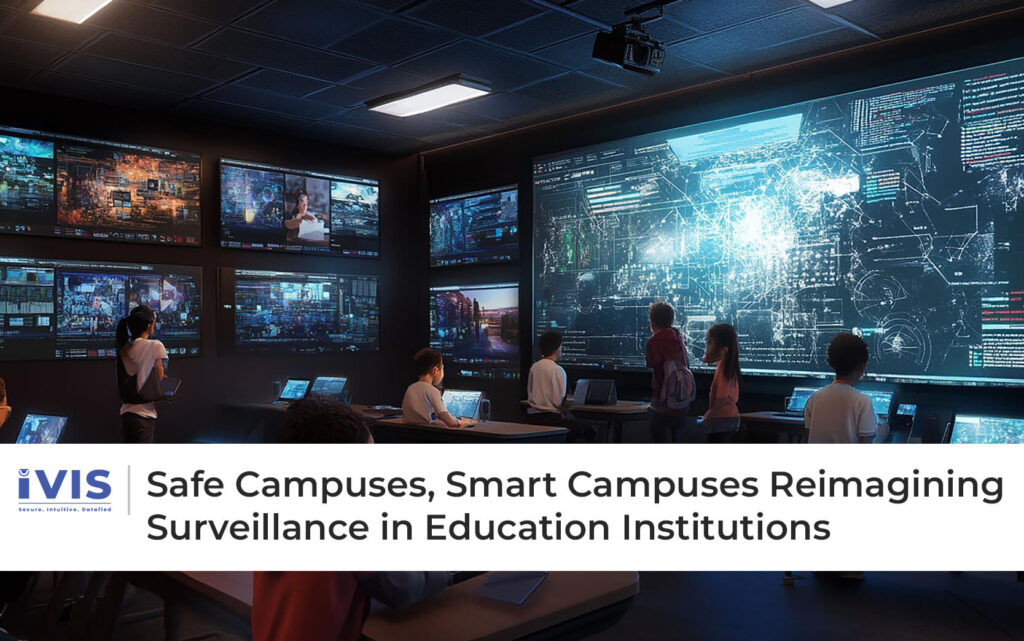
Why Schools Need More Than Lockers and Guards
Schools today resemble mini-cities: multiple entry/exit points, classrooms, sports grounds, hostels, labs, parking lots, and public-access zones. With such complexity comes exposure to trespassers, theft, bullying, vandalism, safety lapses, and unauthorized access.
Data shows surveillance is already widespread: video cameras are present in a large majority of public schools in many countries, marking a shift from reactive monitoring to continuous oversight.
However, static cameras are just recording footage and relying on human review and are no longer enough. Human monitors can’t watch hundreds of video feeds simultaneously; they miss incidents when overloaded, fatigued or distracted. Surveillance coverage becomes shallow, and critical events can slip through, whether a perimeter breach late at night or a safety incident on the playground.
That’s where intelligent surveillance changes the game. By automating detection and alerting, it transforms passive CCTV into active guardians of student safety.
What Smart Surveillance Brings to Campuses
Modern campus security AI-powered by video analytics and automation offer a suite of capabilities tailored for educational environments. Among the most valuable:
- Real-Time Threat Detection & Response: AI-enabled systems can monitor all video feeds continuously, 24/7 — something human staff can’t. They detect:
- Trespassers or unauthorized individuals near campus perimeters.
- Unusual loitering, crowd clustering, or movement during off-hours.
- Potential violence, fights, or unauthorized intrusions in restricted zones.
Alerts can be triggered automatically by notifying security teams, locking doors, or activating alarms. Thus, ensuring faster reaction than a manual call for help.
- Crowd and Movement Monitoring: Large campuses often host events, assemblies, sports meets, places where crowd density spikes. Smart surveillance offers crowd-safety analytics: real-time detection of overcrowding, movement bottlenecks, or sudden surges. This helps administrators intervene proactively, preventing stampedes, overcrowding, or chaos.
Similarly, during peak hours or shift changes, campuses can manage foot traffic, routing flows more effectively and avoiding congestion.
- Access Control & Perimeter Security: Not all campus zones are open to everyone. Labs, staff quarters, storage rooms, parking lots require restriction. Smart surveillance when integrated with access control and analytics — ensures only authorized individuals enter sensitive areas. It tracks badge swipes, detects tailgating, and flags unauthorized access.
This layering of video + authentication + analytics, adds a strong security posture, far superior to traditional lock-and-key systems.
- Prevention, Deterrence and Documentation: The mere presence of visible cameras acts as a deterrent. Studies show that vandalism, theft, bullying, and other misconduct reduce significantly when people know they are being watched.
Moreover, when incidents occur, recorded footage becomes objective evidence. For disputes, investigations, or disciplinary action whether for theft, violence, or misconduct, administrators rely on video records rather than conflicting testimonies.
- Operational Insights and Campus Management: Beyond safety, video analytics supports campus operations. Attendance monitoring, visitor management, parking lot usage, crowd flow during events, all can be analyzed. Security becomes part of a larger data-driven campus management system.
This helps institutions make informed decisions for staffing, layout redesign, resource allocation to improve both security and operational efficiency.
Evidence from Real Deployments & Industry Research
- According to a recent analysis, AI-powered video analytics systems in schools and universities have markedly improved detection of threats and optimized resource use, shifting campuses from reactive to proactive safety models.
- Reports note that when surveillance integrates video analytics with access control and perimeter monitoring, incidents of unauthorized entry, theft, and vandalism drop dramatically producing safer, more controlled environments.
- Safety experts emphasize that intelligent video analytics delivers functionality beyond classic CCTV including anomaly detection, loitering identification, perimeter intrusion alerts and crowd monitoring, effectively covering multiple threat vectors in one system.
These examples show how technology, when properly deployed and managed, can significantly raise safety standards in educational institutions.
Implementation: Best Practices for Smart Surveillance in Schools & Campuses
Deploying surveillance in education requires a careful and balanced approach. Here’s a recommended framework:
- Map Risk Zones & Prioritize Coverage: Begin with a risk assessment. Identify high-risk areas: entry/exit gates, dormitories, labs, parking lots, perimeter boundaries, playgrounds, common areas. Prioritize camera coverage and analytics where incidents are more likely or consequences are severe.
- Use Quality Hardware, Smart Analytics & Resilient Infrastructure: Cameras should have high resolution, night vision / low-light capability, and weather-resistant housing (for outdoor zones). Analytics software must be capable of real-time motion detection, anomaly detection, loitering detection, crowd analytics and integration with access control.
- Integrate with Access Control and Multi-Layer Security: Video monitoring alone isn’t enough. Combine surveillance with controlled gate systems, visitor management, school-ID badges, restricted-area protocols and regular audits to enforce policy.
- Establish Clear Privacy, Compliance & Usage Policies: Respect for privacy is essential. Surveillance shouldn’t invade private zones (washrooms, dorm rooms without consent). Footage access must be restricted, stored securely, and used only under defined policies. Transparency with students, parents, and staff builds trust. Many institutions adopt anonymized or behavior-focused analytics to minimize privacy risks.
- Combine AI Alerts with Human Oversight: While AI can detect and flag, humans must assess context and respond. Schools should define clear incident response workflows -alert → verify → act. Training campus security teams to deal with events ensures accuracy and trust.
- Maintain and Review Continuously: Hardware and software must be maintained. Analytics models require periodic retraining to adapt to changing campus behaviour. Regular audits, reporting, and review of analytics alerts help fine-tune the system.
Ethical Considerations & Community Trust
Surveillance in educational spaces walks a fine line. On one side: safety, deterrence, accountability. On the other: privacy, student comfort, and trust.
- Transparency matters. Inform students, parents, and staff about where cameras are, what is monitored, how long footage is stored.
- Anonymity or behavior-focused monitoring (rather than identity-focused) can mitigate concerns. Some AI systems detect “suspicious behavior” without storing personally identifiable data.
- Clearly defined policies ensure that surveillance is safe, not intrusive monitoring. Areas with privacy expectations (restrooms, changing rooms) must remain out of scope.
When done right, surveillance becomes an enabler of trust rather than a source of suspicion.
Looking Ahead: The Future of Smart Campuses
Surveillance in educational spaces walks a fine line. On one side: safety, deterrence, accountability. On the other: privacy, student comfort, and trust.
- Transparency matters. Inform students, parents, and staff about where cameras are, what is monitored, how long footage is stored.
- Anonymity or behavior-focused monitoring (rather than identity-focused) can mitigate concerns. Some AI systems detect “suspicious behavior” without storing personally identifiable data.
- Clearly defined policies ensure that surveillance is safe, not intrusive monitoring. Areas with privacy expectations (restrooms, changing rooms) must remain out of scope.
When done right, surveillance becomes an enabler of trust rather than a source of suspicion.
Conclusion
School is the place where generations learn, grow, and build futures. They deserve safety, dignity, and peace of mind. In a world of growing safety concerns, evolving threats, and complex infrastructures, smart, AI-powered surveillance systems offer more than security. They deliver confidence, to students, parents, teachers, and administrators.
By combining technology with thoughtful policy, human oversight, and ethical deployment, campuses can evolve into spaces where safety is invisible yet assured. Where every entry and exit, crowded corridor, late-evening lab session is covered not with suspicion, but with assurance.
A school is more than bricks and mortar. It’s a community. And like any community, it thrives best when people feel safe, respected, and protected. With intelligent video analytics for education, we can help build such communities — safe, smart, and future-ready.