
In modern industrial and institutional environments, the greatest risks do not always lie at the perimeter. They lie much closer, often within the last 50 meters. The final stretch between a worker and a robotic arm. The space between a forklift and a pedestrian footpath. The few feet separating a technician from a high-voltage panel. The zone around a surgical robot in an operating theatre.
These human-machine interaction zones – robot corridors, loading bays, elevators, laboratory benches, diagnostic rooms, automated production lines are where speed, automation, and human judgment converge. And it is precisely in these moments of interaction that risk peaks.
As factories adopt Industry 4.0 systems, hospitals integrate smart equipment, and warehouses automate operations, ensuring safety in these high-stakes micro-environments has become mission-critical. E-surveillance, powered by AI and real-time analytics, is emerging as a key safeguard for securing these “last 50 meters.”
Automation improves efficiency, but it also introduces complexity. According to the International Labour Organization (ILO), workplace injuries remain a significant global concern, with industrial and mechanical environments accounting for a substantial portion of serious incidents. In India and globally, industrial safety data shows that unsafe interaction with machinery, improper lockout/tagout practices, and human error near equipment are leading contributors to workplace accidents.
The U.S. Occupational Safety and Health Administration (OSHA) reports that struck-by and caught-in/between incidents often involving machinery, are among the most common causes of serious injuries in industrial settings. In hospitals, the World Health Organization (WHO) notes that healthcare workers face occupational hazards related to medical equipment, biological materials, and workflow congestion.
In warehouses, the expansion of automation and robotics has improved throughput but increased interaction points between humans and autonomous systems. According to McKinsey’s research on automation in logistics, while robotics increases efficiency, it requires sophisticated safety coordination to minimize collision and proximity risks.
The pattern is clear: when humans and machines operate side by side, risk multiplies unless carefully managed.
Security strategies traditionally focus on outer perimeters – gates, fences, and access control points. However, incidents rarely happen at the outer boundary. They happen at the operational edge, where humans physically interact with machinery.
The “last 50 meters” refers to these localized, high-intensity operational zones:
These spaces are dynamic. Workers move unpredictably. Machines operate at high speed. Environmental factors like noise, fatigue, time pressure, further increase risk.
Securing these zones requires more than perimeter cameras. It requires contextual, behaviour-aware surveillance capable of interpreting movement patterns in real time.
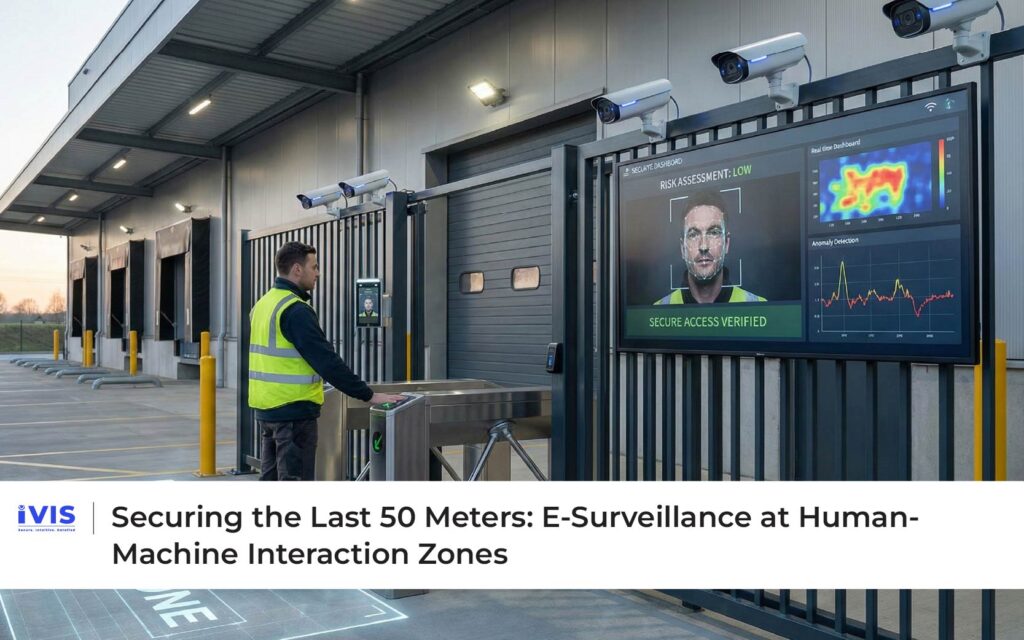
Modern AI-driven video analytics can identify unsafe proximities, unauthorized access into restricted robot zones, improper personal protective equipment (PPE) usage, and abnormal movement trajectories.
Unlike traditional CCTV, which records passively, intelligent surveillance systems actively analyze posture, gait, and spatial positioning. For example, if a worker enters a robotic arm’s safety envelope without proper authorization, the system can trigger an alert or initiate an automatic slowdown. If a forklift veers into a pedestrian lane, proximity analytics can flag imminent collision risk.
Research published in IEEE on industrial computer vision demonstrates that AI-based proximity detection significantly improves early hazard identification in collaborative robot environments.
In hospitals, AI-enabled surveillance can monitor compliance with sterile zone protocols or detect overcrowding around critical equipment, reducing procedural errors. The WHO emphasizes that workflow visibility and monitoring improve patient and staff safety outcomes.
The value lies in speed. Milliseconds matter in interaction zones. Real-time detection reduces response time dramatically compared to manual supervision.
The true potential of e-surveillance in human-machine zones is predictive capability. By analyzing patterns over time, AI models can identify recurring near-miss incidents, congestion trends, or unsafe behaviors before accidents occur.
For example, repeated near-collisions between forklifts and workers at a warehouse corner may signal poor layout design. Frequent PPE non-compliance in a manufacturing cell may indicate operational fatigue or insufficient training. Elevator crowding patterns in a hospital may expose emergency bottlenecks.
Studies in safety engineering show that analyzing near-miss data is one of the most effective ways to prevent major incidents. Intelligent surveillance transforms near-miss visibility from anecdotal reporting into quantifiable insights.
This shifts safety management from reactive investigation to proactive redesign.
Regulated industries must demonstrate adherence to safety protocols. Manufacturing facilities comply with occupational safety standards. Hospitals align with infection control regulations. Warehouses must follow operational safety mandates.
AI-powered e-surveillance generates time-stamped visual evidence of compliance. It can document PPE adherence, restricted-area access, machine lockout procedures, and safe handling practices.
According to Deloitte’s research on digital risk management, continuous monitoring reduces compliance gaps and improves audit efficiency. Visual analytics provide objective proof that processes are followed, not just documented.
In high-risk environments, that proof matters.
While safety is paramount, deploying surveillance in close-proximity workspaces requires sensitivity. Workers and healthcare professionals must not feel over-monitored or distrusted.
Ethical deployment prioritizes behavior-based analytics over identity tracking. Private spaces remain excluded. Data is encrypted, access-controlled, and retained only as long as necessary.
Global frameworks such as UNESCO’s Recommendation on the Ethics of Artificial Intelligence emphasize transparency and proportionality in AI deployment. Systems must clearly communicate purpose: protecting workers, not policing them.
Trust is a prerequisite for effective safety systems.
To operationalize safety at the last 50 meters, organizations need platforms capable of unifying multiple data streams and delivering real-time intelligence. This is where IVIS plays a meaningful role.
IVIS integrates AI-driven video analytics across factories, hospitals, and warehouses, enabling centralized oversight of high-risk interaction zones. By applying proximity detection, anomaly recognition, and policy-driven alerts, IVIS helps identify unsafe conditions before escalation.
Its hybrid architecture supports edge-based processing for ultra-low latency in robot cells and loading docks, while maintaining centralized dashboards for compliance monitoring and performance insights. Configurable workflows ensure alerts reach safety officers instantly, enabling rapid intervention.
Importantly, IVIS incorporates secure access controls, audit trails, and data governance mechanisms to align operational safety with regulatory requirements. In practice, IVIS transforms surveillance from passive observation into active operational intelligence at the most critical point of risk.
As automation deepens across industries, human-machine interaction will only increase. Collaborative robots, autonomous vehicles, AI-assisted diagnostics, and smart elevators are becoming standard components of modern infrastructure.
The International Federation of Robotics notes steady global growth in industrial robot adoption. With this expansion comes responsibility. Safety systems must evolve in parallel with automation technologies.
The future of safety lies not in isolating humans from machines, but in enabling them to work together securely. Intelligent surveillance at interaction zones ensures that collaboration remains productive rather than perilous.
The greatest risks in modern operational environments often lie within a few meters, where human judgment meets mechanical precision. Securing these last 50 meters requires more than cameras. It demands contextual intelligence, predictive analytics, and ethical governance.
AI-powered e-surveillance brings visibility to interaction zones that were once blind spots. By detecting unsafe proximity, analyzing near-misses, and enabling rapid response, it protects workers, patients, and assets alike.
Platforms like IVIS demonstrate how safety and innovation can coexist, ensuring that as machines grow smarter, the spaces where humans meet them grow safer.
Because in the final stretch between human and machine, awareness is protection.