iVIS | e-Surveillance Company

Write to us about any queries you have

Contact Form Demo

Advanced E-Surveillance

Securing Factories in the Age of Automation
Blog

Securing Factories in the Age of Automation

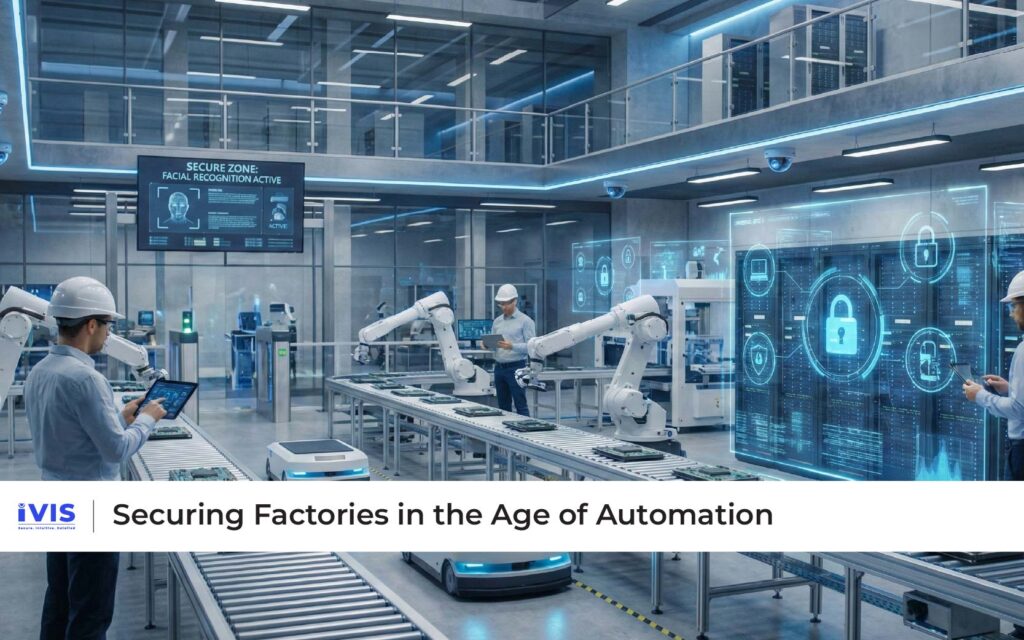
Securing Factories in the Age of Automation Factory floors today look very different from what they did even a decade ago. Conveyor belts now move in sync with robotic arms. Sensors communicate with machines in real time. Autonomous vehicles transport materials across production lines. Automation has transformed manufacturing into a highly efficient, data-driven environment.  Yet with this transformation comes a new challenge: security. As factories become smarter and more connected, they also become more exposed to safety risks, unauthorized access, operational disruptions, and cyber-physical threats. Securing factories in the age of automation is no longer just about locks and guards. It requires intelligent, integrated surveillance systems that can keep pace with machines that never sleep.  Why Automation Has Changed the Security Equation Automation has introduced speed, scale, and complexity into manufacturing. A modern factory may run 24/7, with limited human presence during night shifts. Machines operate at high speeds, often in close proximity to people. Supply chains flow in and out continuously, bringing vendors, vehicles, and contractors into the facility.  According to the World Economic Forum, advanced manufacturing environments are among the most complex operational ecosystems due to the convergence of physical systems, digital platforms, and human workers. This convergence increases both productivity and risk.  Traditional surveillance systems struggle in such environments. Static cameras that merely record footage cannot detect unsafe behavior, restricted-area breaches, or early warning signs of failure. Manual monitoring is also ineffective at scale. As factories automate, security must automate alongside them.  The Role of Intelligent Surveillance in Modern Factories Intelligent surveillance brings AI-driven analytics into the heart of factory security. Instead of simply capturing video, these systems continuously analyze live feeds to detect patterns, anomalies, and risks in real time.  AI-powered video analytics can identify unauthorized entry into restricted zones, monitor machine-human interactions, and flag unusual movement near critical assets. In high-risk areas such as robotic cells or heavy machinery zones, surveillance systems can detect when safety protocols are violated, such as missing protective gear or unsafe proximity to moving equipment.  Research published by McKinsey highlights that AI-enabled monitoring systems significantly reduce incident response times in industrial environments by providing real-time visibility and actionable alerts. This shift from reactive review to proactive detection is essential in automated factories where seconds matter.  Enhancing Worker Safety in Automated Environments Automation does not eliminate human presence; it reshapes it. Workers now supervise machines, manage exceptions, and perform specialized tasks. This hybrid environment where humans and machines coexist, introduces unique safety challenges.  The International Labour Organization reports that manufacturing remains one of the sectors with the highest rates of workplace injuries, often due to interaction with machinery. Intelligent surveillance helps mitigate these risks by monitoring behavior rather than just spaces.  For example, AI-based systems can detect when a worker enters a hazardous zone without authorization, when safety barriers are bypassed, or when abnormal motion suggests a fall or injury. Early alerts allow supervisors to intervene immediately, reducing the likelihood of serious accidents.  In automated factories, surveillance becomes an extension of safety culture—reinforcing compliance without slowing down operations.  Securing Assets, Intellectual Property, and Operations Factories house valuable assets beyond physical equipment. Designs, processes, and proprietary workflows represent significant intellectual property. Unauthorized access, theft, or sabotage can cause severe financial and reputational damage.  Intelligent surveillance strengthens asset protection by providing layered security across entry points, production areas, and storage zones. Video analytics can detect tailgating at access-controlled doors, unusual after-hours activity, or abnormal vehicle movements within factory premises.  According to a report by Deloitte on manufacturing risk, internal theft and unauthorized access remain persistent threats, particularly in large, distributed facilities. Surveillance systems that combine video intelligence with access control data create a stronger defense by correlating physical movement with authorization records.  Supporting Operational Continuity and Efficiency Security in automated factories is not only about preventing incidents; it is also about ensuring continuity. A halted production line can cost manufacturers thousands of dollars per minute.  Surveillance data provides valuable operational insights. By analyzing movement patterns, machine downtime events, and workflow congestion, factories can identify inefficiencies that impact both security and productivity. For example, repeated congestion near a loading dock may indicate process bottlenecks that increase accident risk.  The World Bank notes that data-driven monitoring improves industrial efficiency by enabling predictive maintenance and informed decision-making. Surveillance systems contribute to this intelligence by offering a visual and analytical layer that complements machine data.  Cyber-Physical Security: Where Digital and Physical Meet As factories adopt Industry 4.0 technologies, physical security and cybersecurity become deeply intertwined. Surveillance cameras, sensors, and analytics platforms are connected to networks that also control machines and data systems.  The U.S. Cybersecurity and Infrastructure Security Agency (CISA) emphasizes that physical breaches can often lead to cyber incidents, especially in industrial environments. An intruder gaining physical access to a control room or network port can compromise entire operations.  Modern surveillance platforms address this by securing both endpoints and data flows. Encryption, access controls, and audit trails ensure that surveillance systems themselves do not become vulnerabilities. Ethical and secure deployment is essential for maintaining trust in automated environments.  The Role of IVIS in Securing Automated Factories In the age of automation, factories require surveillance platforms that do more than monitor they must integrate, analyze, and orchestrate. This is where platforms like IVIS play a critical role.  IVIS enables factories to unify video feeds, sensor inputs, and operational data into a centralized, intelligent surveillance environment. By combining real-time monitoring with AI-driven analytics, IVIS supports early detection of safety risks, unauthorized access, and operational anomalies. Its architecture is designed to scale across large, multi-site industrial operations, ensuring consistent visibility without compromising performance.  Equally important, IVIS aligns surveillance with governance and compliance needs. Policy-driven controls, secure data handling, and transparent workflows ensure that security measures support productivity while respecting workforce trust. In automated factories, IVIS acts as a digital nerve center connecting safety, security, and operations into a cohesive whole.  Balancing Surveillance with Workforce Trust One of the most sensitive aspects of factory surveillance is its impact on workers. Surveillance must enhance safety and security without creating a culture of constant monitoring or mistrust.  Transparency is key. Clearly communicating why surveillance exists, how data is used, and what protections are in place helps build acceptance. Many factories adopt behavior-focused analytics rather than identity-focused tracking, ensuring that
Safeguarding Citizens - How E-Surveillance Strengthens Public Infrastructure
Blog

Safeguarding Citizens – How E-Surveillance Strengthens Public Infrastructure

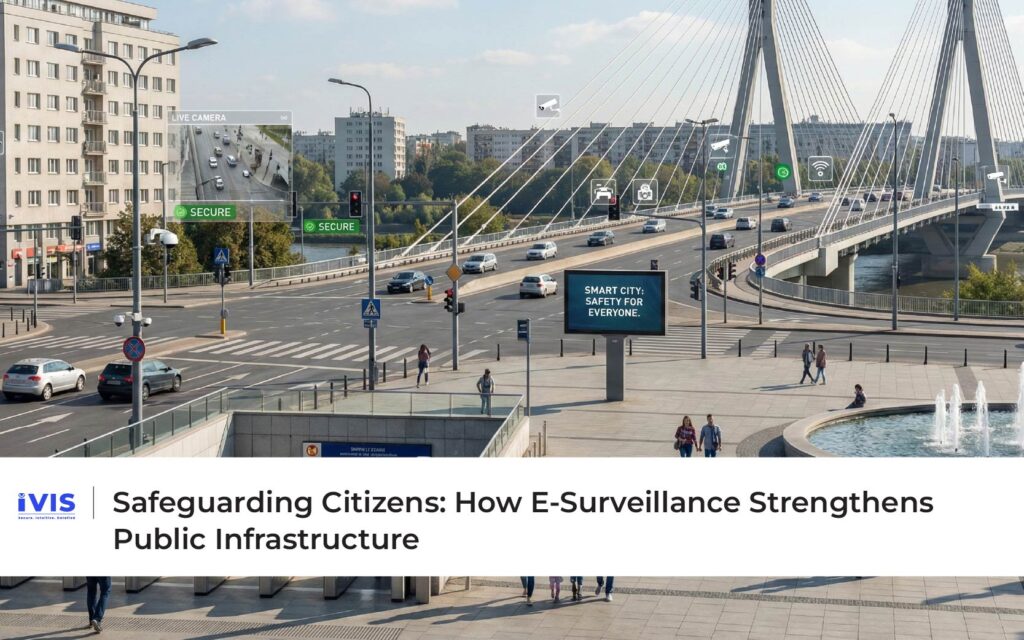
Safeguarding Citizens – How E-Surveillance Strengthens Public Infrastructure Every day, millions of people depend on public infrastructure without giving it much thought. Roads, metro stations, airports, power grids, water treatment plants, public parks, and government buildings quietly support daily life. When these systems function smoothly, they remain invisible. When they fail, the consequences are immediate and widespread.  As cities grow denser and infrastructure becomes more interconnected, safeguarding public assets and citizens has become a complex challenge. Traditional security measures, such as guards and static CCTV cameras, are no longer enough to address modern risks. Today, intelligent surveillance plays a critical role in strengthening public infrastructure, helping governments move from reactive responses to proactive protection.  E-Surveillance is no longer about watching events unfold after the fact. It has evolved into a real-time intelligence layer that enables faster decision-making, risk prevention, and coordinated responses across public systems.  The Growing Complexity of Public Infrastructure Public infrastructure today is far more complex than it was a few decades ago. Smart cities integrate digital systems with physical assets. Transport networks rely on sensors, cameras, and automated controls. Utilities are managed through centralized platforms. Public spaces see massive daily footfall, especially in urban centers.  This complexity increases vulnerability. Infrastructure is exposed to risks such as vandalism, theft, unauthorized access, crowd-related incidents, and even deliberate attacks. According to the World Economic Forum, infrastructure failures and attacks rank among the most impactful global risks due to their cascading effects on public safety and economic stability.  In this environment, surveillance becomes a foundational capability. It provides visibility across large, distributed assets and enables authorities to detect anomalies early. Without real-time awareness, even well-designed infrastructure can become fragile.  How Modern E-Surveillance Has Evolved Traditional surveillance relied on passive video recording. Cameras captured footage, which was reviewed only after an incident occurred. This approach offered limited prevention and depended heavily on human monitoring.  Modern surveillance systems, powered by AI and video analytics, operate differently. They analyze live video streams continuously, detect unusual patterns, and generate alerts automatically. These systems can identify unattended objects in public areas, unusual crowd behavior, unauthorized access to restricted zones, or vehicles moving against traffic flow.  Research from McKinsey highlights that AI-enabled monitoring systems significantly improve response times and situational awareness in public operations. Instead of reacting to incidents, authorities gain the ability to anticipate and intervene early.  This shift from passive monitoring to active intelligence is what makes surveillance a strategic asset for public infrastructure.  Enhancing Public Safety in Shared Spaces Public spaces such as railway stations, bus terminals, city centers, and government complexes host thousands of people at any given time. Managing safety in these environments is challenging due to crowd density and constant movement.  Intelligent surveillance helps authorities monitor crowd flow and detect risks such as overcrowding, panic situations, or aggressive behavior. By analyzing movement patterns, surveillance systems can identify early signs of potential incidents and allow authorities to take preventive action, such as redirecting foot traffic or deploying personnel.  Studies cited by the UK Home Office show that CCTV, when combined with analytics and proper response mechanisms, contributes to measurable reductions in crime and antisocial behavior in public spaces. Surveillance acts both as a deterrent and as a tool for faster intervention.  Protecting Critical Infrastructure and Utilities Critical infrastructure includes power stations, water treatment plants, telecom facilities, and transportation control centers. Disruptions in these systems can impact millions of citizens within minutes.  Surveillance systems play a crucial role in securing these assets. Perimeter monitoring, access control integration, and anomaly detection help prevent unauthorized entry and sabotage. For example, video analytics can detect intrusion attempts near substations or identify suspicious behavior around restricted utility zones.  The U.S. Cybersecurity and Infrastructure Security Agency (CISA) emphasizes that physical surveillance is a key component of infrastructure resilience, complementing cybersecurity efforts. Physical threats and cyber threats often intersect, and visibility across physical assets strengthens overall resilience.  Supporting Emergency Response and Incident Management One of the most important contributions of surveillance to public infrastructure is its role during emergencies. Natural disasters, accidents, fires, or public disturbances require rapid coordination and accurate information.  Live video feeds provide command centers with situational awareness, helping decision-makers understand what is happening on the ground. Surveillance data supports faster deployment of emergency services, optimized evacuation routes, and better communication between agencies.  During large-scale public events or emergencies, surveillance systems help authorities monitor conditions in real time and adapt response strategies dynamically. According to research published by the International Association of Chiefs of Police, real-time video intelligence significantly improves coordination during emergency response operations.  Enabling Accountability and Transparency Surveillance also strengthens public trust when used responsibly. Recorded footage creates objective records of events, supporting investigations, dispute resolution, and accountability.  In public infrastructure projects, surveillance data can help verify compliance with safety protocols, document incidents accurately, and protect both citizens and public officials from false claims. Transparency in how surveillance is used and governed plays a key role in maintaining legitimacy.  The European Union Agency for Fundamental Rights emphasizes that surveillance, when combined with clear policies, transparency, and oversight, can enhance accountability rather than undermine civil liberties.  Balancing E-Surveillance with Privacy and Ethics While surveillance strengthens public infrastructure, it must be deployed carefully. Public acceptance depends on trust, transparency, and respect for privacy.  Ethical surveillance avoids monitoring private areas, limits data retention, and ensures that footage is accessed only by authorized personnel. Many modern systems use privacy-preserving techniques such as anonymization or behavior-based detection instead of identity-based tracking.  UNESCO’s Recommendation on the Ethics of Artificial Intelligence stresses that surveillance technologies must adhere to principles of proportionality, necessity, and accountability. These guidelines help governments balance public safety with individual rights.  When citizens understand why surveillance exists and how it protects them, acceptance increases. Clear communication and governance frameworks are as important as the technology itself.  Operational Efficiency and Smarter Governance Beyond safety, surveillance contributes to smarter governance. Data from video analytics helps authorities optimize resource allocation, identify infrastructure bottlenecks, and plan improvements.  For example, traffic surveillance can inform better road design, signal timing, and congestion management. Monitoring public facilities can reveal patterns of wear, misuse, or underutilization. Over time, these insights support data-driven infrastructure planning and maintenance.  According to the World Bank, data-driven infrastructure management improves service delivery and reduces long-term operational

Hybrid Surveillance Models: Bridging Cloud, Edge, and On-Prem Systems
Blog

Hybrid Surveillance Models: Bridging Cloud, Edge, and On-Prem Systems 

Hybrid Surveillance Models: Bridging Cloud, Edge, and On-Prem Systems Security today looks nothing like it did a decade ago. Surveillance systems have evolved from simple CCTV setups to intelligent, analytics-driven ecosystems supporting real-time threat detection, automation, and predictive insights. However, this evolution has also brought a fundamental challenge: where should all this video and data be processed?  Should it live in the cloud? Stay on-premises? Or be analyzed at the network edge?  Increasingly, the answer is all three; through a hybrid surveillance model that blends cloud scalability, edge speed, and on-prem stability into one cohesive solution. As organizations scale their physical and digital footprint, hybrid models ensure surveillance remains resilient, cost-efficient, and future-ready.  This is the new backbone of modern security and here’s why the shift is happening.  Why Hybrid Surveillance Matters Today The explosion of AI video analytics, 4K/8K IP cameras, IoT sensors, and multi-location operations has made centralized architectures insufficient. A single organization may generate terabytes of video every day. Sending all this footage to the cloud is costly and bandwidth-intensive; processing everything on-prem is equally limiting.  That’s why 72% of organizations now deploy workloads across hybrid environments, balancing cloud and on-prem systems to maximize performance and control.  Source: Flexera State of the Cloud Report 2023.  For surveillance, this blended approach isn’t just preferable, it’s necessary.  Understanding the Three Pillars of Surveillance Architecture Cloud Surveillance: Scalable, Remote, and Connected – Cloud video surveillance allows organizations to store unlimited footage, access live and recorded video remotely, integrate AI analytics at scale and enable seamless multi-site monitoring. Cloud platforms provide agility. According to MarketsandMarkets, the cloud video surveillance market will grow from $2.2 billion in 2022 to $6.3 billion by 2027, driven largely by analytics adoption and global operations expansion.  But pure cloud models face constraints like:  High bandwidth consumption for continuous uploads  Dependency on internet availability  Data residency and compliance limitations This is where the next pillar helps.  Edge Surveillance: Fast, Local, and Intelligent – Edge surveillance refers to analytics performed on the device, inside cameras, NVRs, or edge gateways. Instead of sending raw footage to the cloud, devices process events locally and send only actionable insights. This model is essential for low-latency detection, locations with weak connectivity and real-time threat response. A study by Cisco found that 82% of organizations consider edge computing critical for future digital transformation, especially for AI-driven workloads requiring immediate action. In surveillance, edge analytics can instantly detect:  perimeter intrusions  unauthorized access  loitering  crowd surges  abandoned objects  safety violations  The ability to trigger alerts within milliseconds can prevent severe incidents.  On-Prem Surveillance: Secure, Compliant, and Controlled – On-prem systems remain vital for industries with strict data governance, such as BFSI, healthcare, or government institutions.  Benefits include:  Complete control over data retention  High-security environments  No dependency on external networks  Integration with legacy systems  According to IBM’s Cost of a Data Breach Report 2023, organizations with fully on-prem data systems had the lowest breach cost at $3.45M, compared to hybrid or cloud-only setups. This reinforces why many institutions maintain an on-premises core for sensitive video data. However, on-prem systems don’t scale efficiently and can become cost-heavy as camera counts multiply.  The Hybrid Surveillance Model: Best of All Worlds A hybrid surveillance architecture integrates all three layers:  Edge handles real-time video analytics  On-prem stores and manages critical/sensitive footage  Cloud connects sites, runs large-scale analytics, and offers remote access  This creates a flexible, resilient system uniquely suited for modern operations.  What Hybrid Enables  Real-Time AI With Edge Compute: Edge analytics detect threats instantly, enabling organizations to act faster than cloud-only models.  Lower Bandwidth and Storage Costs: Only essential footage or metadata is sent to the cloud; bulk storage can stay on-prem.  Centralized Monitoring for Multiple Sites: Airports, campuses, retail chains, factories all can synchronize surveillance across locations.  Compliance and Data Governance: Sensitive data stays on-prem while cloud powers insight generation.  Built-In Redundancy: If cloud connectivity fails, edge + on-prem nodes continue functioning independently.  This multi-layer resilience is why hybrid surveillance is emerging as the dominant model across industries. Real-World Use Cases of Hybrid Surveillance Smart Cities: Citywide surveillance depends on thousands of cameras across traffic zones, public spaces, and critical infrastructure. Hybrid systems provide:  Edge analytics for instant event detection  Cloud dashboards for centralized command centers  On-prem storage for law-enforcement evidence retention  Smart cities like Singapore and Dubai actively rely on edge-cloud surveillance models to strengthen public safety.  Healthcare: Hospitals need HIPAA-equivalent compliance, patient privacy, and fast incident detection. Hybrid systems help by:  Storing sensitive footage on-premises  Running patient-safety analytics at the edge  Using cloud connectivity for remote supervision and audit reporting  Manufacturing & Logistics: Factories and warehouses operate in high-risk environments where seconds matter. Edge nodes detect:  PPE violations  restricted-zone breaches  fire/smoke indicators  unsafe machinery interaction  Cloud systems then analyse workforce efficiency, patterns, and risk trends, enabling preventive interventions.  Retail Chains – Retail brands with hundreds of stores benefit immensely:  Edge detects theft, fraud, and footfall instantly  Cloud centralizes dashboards for regional teams  On-prem stores footage for evidence  This creates a unified loss-prevention ecosystem.  Why Organizations Are Moving Toward Hybrid Models The Need for Speed: AI models for intrusion, crowd recognition, and anomaly detection require millisecond-level response. Cloud-only models cannot deliver this speed due to upload latency. Increasing Camera Density & Resolution: Today’s 4K/8K cameras generate massive data volumes. Uploading it all is impractical. Rising Cybersecurity Concerns: Hybrid models reduce attack surfaces by decentralizing compute nodes and using cloud only where necessary. Flexible Scalability: Organizations can scale cloud resources during peak times while maintaining stable on-prem operations. Regulatory Pressure: Data localization laws in India (DPDP Act 2023), EU (GDPR), and APAC regions require sensitive data to remain in-country or on-prem. Hybrid solves these constraints without compromising innovation.  Challenges to Overcome While hybrid surveillance is powerful, implementation must be strategic.  Complexity of Integration: Legacy CCTV, VMS, access control, IoT sensors — stitching these together requires strong architecture.  Cybersecurity Management: Multi-layer systems create distributed surfaces; consistent encryption and identity controls are essential.  Analytics Consistency: AI models must perform uniformly across cloud, edge, and on-prem processors.  Operator Training: Teams must understand how alerts from each

Above and Beyond: Modern Surveillance in Aviation Security
Blog

Above and Beyond: Modern Surveillance in Aviation Security 

Above and Beyond: Modern Surveillance in Aviation Security Walking into a modern airport is like stepping into a city on the move, thousands of travelers, rolling suitcases, security checkpoints, boarding gates, baggage belts, and transport zones all humming simultaneously. In such a dynamic, high-density environment, safety, speed, and precision are critical.  Traditional security measures, including metal detectors, manual baggage screening, and guards, once sufficed. But today’s aviation world faces far more complex challenges: high passenger volumes, evolving security threats, operational bottlenecks, and demand for frictionless travel. To navigate these challenges, airports worldwide are turning to AI-driven surveillance systems, predictive analytics, and facial recognition, not just to watch, but to anticipate, respond, and protect.  Modern airport surveillance is no longer passive. It’s active, intelligent, and predictive, blending technology and human oversight to build safer, smarter skies.  Why Aviation Security Needs an Intelligence Upgrade Airports with terminals, runways, cargo zones, transit areas, staff access points, and public spaces are sprawling, complex infrastructures. A security gap at any point can expose the entire system.  As per industry research, airports generate massive data from CCTV feeds, access control logs, passenger check-ins, baggage handling systems to flight and passenger flow data, making them prime candidates for data-driven security infrastructure.   Manual surveillance is limited. Human operators can’t effectively scan hundreds of video feeds simultaneously, especially during busy periods. Fatigue, split-second human error, and latency in response present critical vulnerabilities.  Regulatory and safety pressures demand stronger security, faster threat detection, and seamless travel calling for systems that can scale, adapt, and anticipate threats in real time.  In short: airports need surveillance systems that are as dynamic as the environment they guard.  What Modern Aviation Surveillance Looks Like Today’s airport security ecosystems combine multiple technologies, all working together:          1. AI-Powered Video Analytics & Object Detection: Cameras across terminals, gates, baggage zones, runways, and perimeters feed into AI engines. These systems continuously analyse video for:  Unattended baggage or objects  Abandoned items or suspicious packages  Unauthorized access to restricted areas  Suspicious behaviour or loitering  Perimeter breaches or ground-side intrusions  Recent industry articles highlight how video analytics helps airports and transit hubs detect real-time threats, manage security, and respond faster.           2. Facial Recognition & Biometric Screening: Biometric systems, especially facial recognition are increasingly replacing manual document checks at check-ins, immigration, boarding gates, and baggage claim. These systems cross-check travelers against watchlists, confirm identities, and ensure only authorized individuals access sensitive zones. Some airports have even launched full biometric journeys: travellers pass through check-in, security, boarding, and baggage claim with facial recognition, speeding processes while maintaining high security.          3. Predictive Analytics and Passenger Flow Management: Airports are busy not just because flights depart and arrive; they’re busy because of passenger movement: long queues, immigration rushes, baggage handling pressure, boarding surges. AI systems analyse flight schedules, passenger data, check-in timings, and historical flow patterns to predict crowd surges, optimize staff deployment, and reduce bottlenecks. Predictive analytics helps airport authorities stay ahead adding security lanes when required, opening extra counters, or diverting passenger flows to avoid overcrowding.           4. Perimeter & Airside Ground Surveillance: Safety doesn’t end inside terminals. Runways, taxiways, hangars, cargo zones, all need round-the-clock monitoring. Advanced surveillance frameworks, like the deep-learning based “Deep4Air”, can track aircraft location, monitor taxiway integrity, and ensure safe distances are maintained between vehicles and aircraft. Combined with video surveillance and analytics, airports can detect unauthorized vehicles, ground traffic anomalies, or potential incursions — reinforcing security from airside to landside.  Real-World Benefits: Safety, Efficiency, Speed Faster Threat Detection & Response: With AI analysing hundreds of video streams in real time, anomalies such as unattended luggage, restricted-zone entry, or suspicious behaviour are flagged immediately. SecOps teams receive alerts instantly, enabling them to act before incidents escalate. AI-assisted detection reduces the burden on human monitors and increases the probability of intercepting threats early.  Smarter Passenger Flow & Better Experience: Predictive flow management — adjusting staffing levels, opening extra lanes, redirecting crowds reduces wait times, eases congestion, and improves overall traveler satisfaction. Airports can adapt dynamically to passenger surges instead of reacting under pressure. Moreover, biometric gates and streamlined security checks shorten queues and improve user convenience, without diluting security.  Higher Accuracy, Fewer Missed Events: Traditional CCTV might miss subtle threats a bag left off-screen, someone creeping near perimeter fences, or tailgating at restricted zones. AI video analytics, facial recognition, and object detection reduce blind spots and minimise human error.  For airports, that translates to tighter security, lower risk of theft, and stronger compliance.  Operational Efficiency and Resource Optimisation: Airports can optimise staff deployment, automate routine screening, and allocate security resources where they’re needed. This reduces operational overhead, improves cost-efficiency, and allows human teams to focus on critical responses.   Resilience & Scalability: Modern surveillance systems like cloud-enabled, AI-powered scale with airport growth. Whether an airport adds new terminals, expands cargo zones, or increases flight traffic, surveillance infrastructure can grow without proportionally increasing manpower or complexity.   Challenges and Considerations: What It Takes to Get Right While the advantages are clear, deploying modern aviation surveillance isn’t a plug-and-play exercise. Several important challenges demand careful attention:  Privacy & Ethical Use of Biometric Data: Biometric tools like facial recognition raise legitimate privacy and ethical questions. Tracking individuals across zones, storing facial data, and handling sensitive travel information must be balanced with data protection laws and passenger consent. Several airports around the world have faced scrutiny over facial recognition use. Transparency, clear notice to passengers, and secure data handling are essential to maintain trust.  Technical and Infrastructure Integration: Airports operate a patchwork of legacy systems: older cameras, baggage systems, security checks, access control, biometric gates, and more. Seamlessly integrating AI-analytics, video management systems (VMS), biometric databases, and traditional security hardware demands robust architecture and careful planning. Upgrades, data infrastructure, and interoperability need investment.  Algorithmic Accuracy and False Positives: No algorithm is perfect. False alarms from unattended bags to benign crowd behaviour can lead to unnecessary disruptions. High false-positive rates

Building Cyber-Resilient Surveillance Ecosystems
Blog

Building Cyber-Resilient Surveillance Ecosystems

Building Cyber-Resilient Surveillance Ecosystems Imagine a vast surveillance network spanning cameras, sensors, access controls, and analytics platforms. A single breach in that chain could expose the whole system: video feeds manipulated, threat alerts delayed, physical security compromised. In surveillance, cyber-resilience isn’t optional, it’s fundamental.  In a world where e-surveillance has moved from silos to interconnected ecosystems, building resilience across technology, process and people is essential. Here’s how to design and deploy a surveillance infrastructure that can absorb attacks, adapt under pressure and continue protecting assets, people and operations.  Why Surveillance Ecosystems Are Under Threat Modern surveillance systems have become expansive cyber-physical environments. They combine IP cameras, IoT sensors, edge devices, cloud platforms and analytics engines. Each link is a potential attack surface.  Statistics reveal the scale of the danger: according to the State of Cybersecurity Resilience 2025 report, only 13% of organisations possess the advanced cyber-capabilities needed to defend against today’s threats. And yet 63% of organisations remain highly exposed in both strategy and capability.   In surveillance ecosystems, that means a camera feed that’s intercepted, a sensor bypassed, or an analytics module manipulated could all lead to major operational or reputational damage.  Core Principles of a Cyber-Resilient Surveillance Ecosystem Defence-in-Depth Architecture: Surveillance systems must be layered – edge devices secured, network segments isolated, analytics services protected, and archival storage safe. This prevents a single compromise from cascading. Zero Trust for Cameras & Sensors: Every device should be treated as untrusted until verified. Network access, firmware updates and device authentication need strong controls. Without this, cameras become entry points for lateral movement. Hybrid Edge-Cloud Deployment: Using local (edge) analytics combined with central cloud coordination helps balance latency, redundancy and recovery. If the cloud is compromised, edge nodes can still operate, and if edge fails, cloud oversight remains. Incident Response & Recovery Planning: Surveillance must include more than detection – it requires drills, backups, failover plans and continuous monitoring of cyber-threat indicators. According to a global cyber-resilience study, organisations with strong incident response and detection capabilities reduced large-loss claims by over 50%. Supply Chain & Vendor Risk Management: Surveillance ecosystems often depend on hardware, firmware and software from third parties. A breach in one vendor can expose whole systems. Reports note that third-party breaches significantly increase the cost of data-breach incidents (average cost over US $4.88 million in 2024) Continuous Monitoring & Analytics: Resilient systems monitor for anomalies, configuration drift, unexpected behaviour and adversary tactics. They don’t wait, they act. More than 61% of organisations see potential data loss due to cyber-attack in complex environments. How to Build It: Step-by-Step Step 1: Map the Ecosystem: List all devices, networks, analytics platforms, storage systems and external interfaces. Know what you have and how it connects.  Step 2: Assess Risk & Prioritise: Which cameras are mission-critical? Which sensors feed into analytics? Which data stores hold archival footage? Prioritise protection accordingly.  Step 3: Secure Devices & Networks: Implement endpoint protection on cameras/NVRs, enforce firmware updates, segment networks, use encrypted communications and apply strong access controls.  Step 4: Enable Analytics & Response: Deploy detection engines that flag unusual device behaviour, anomaly traffic or unexpected access patterns. Set up incident workflows: alert → investigate → respond → recover.  Step 5: Ensure Redundancy & Recovery: Design backup systems, dual networks (edge + cloud), device fail-over, and offline modes for critical nodes so surveillance continues even if parts of the system are compromised.  Step 6: Vendor & Supply Chain Governance: Manage third-party risk: audit firmware, require vendor SOC-certifications, monitor supply-chain threats, and apply segmentation between vendor networks and mission-critical infrastructure.  Step 7: Training, Awareness & Governance: Operators must understand cyber risks, false-positives, incident escalation, and recovery procedures. Embed governance, audit logs, and accountability.  Use-Cases: Resilience in Action Smart City Command Centre: A city’s unified surveillance network spans thousands of cameras, traffic sensors and IoT devices. By implementing edge-cloud hybrid architecture, they continued operating analytics locally during a major network outage, ensuring monitoring of public safety even while IT was restored.  Industrial Campus Surveillance: A manufacturing facility with multiple entry points and restricted zones used supply-chain vetting for all camera firmware and segmented its video network. When one vendor’s device was compromised, segmentation prevented lateral spread, and the incident was contained.  Logistics Hub Monitoring: A large logistics hub uses real-time video analytics and network intrusion detection combined. When unusual encrypted traffic was detected between a camera and an unknown IP address, the system auto-quarantined the device and raised an alert, preventing data exfiltration.  Challenges & How to Overcome Them Legacy Devices with Weak Security: Many surveillance systems use older cameras lacking encryption or patch support. Mitigate by isolating them, replacing over time or using device-wrappers/gateways.  High Volume of Alerts / Monitoring Fatigue: Flooded alert systems collapse resilience. Use analytics to prioritise, automate low-risk cases and alert humans only when needed.  Balancing Surveillance & Privacy: Cyber resilience must also protect privacy. Employ anonymisation, role-based access, clear retention policies and audit trails.  Talent Shortage & Skills Gap: Only a small percentage of organisations today possess both strong cyber strategy & capability. Accenture Address this by partnering, outsourcing monitoring or using managed services.  Rapidly Evolving Threats (AI-powered, Supply Chain): Threats evolve faster than many organisations. A forward-looking surveillance system must evolve too, through threat-intelligence sharing, adaptive analytics and reviews.  Why This All Matters for Surveillance In modern surveillance ecosystems, trust and resilience go hand in hand. A breach in the video infrastructure undermines the security posture, damages brand trust and creates regulatory exposure. Conversely, a resilient system ensures continuity, protects operations and empowers organisations to act, not just watch.  Organisations looking to build cyber-resilient surveillance ecosystems need more than traditional VMS or cameras. They need architecture, analytics, governance and operations tied together. In that context, a partner that offers end-to-end surveillance services and cyber-resilience frameworks becomes invaluable.  That’s where IVIS offers difference, providing a surveillance platform designed for today’s cyber-threat landscape, with device security, analytics, edge-cloud orchestration and vendor-risk governance baked in.  Conclusion Building a cyber-resilient surveillance ecosystem is a necessity. As surveillance grows

The Human-AI Partnership in Surveillance: Why Humans Still Matter
Blog

The Human-AI Partnership in Surveillance: Why Humans Still Matter

The Human-AI Partnership in Surveillance: Why Humans Still Matter A security operator leans forward. An alert flashes: the AI video analytics system flags a figure loitering near a restricted zone. But the feed shows something ambiguous. The human in the loop pauses the automated response. A guard is sent. The alert turns out valid. The AI was correct; the human interpreted context. The incident prevented.  This moment captures the truth: in modern surveillance, AI doesn’t replace humans — it empowers them. The human-AI partnership is becoming the backbone of effective e-surveillance systems. Automation handles volume; humans apply judgement. Both are essential.  Why Humans Still Matter Firstly, AI excels at processing large amounts of data. It reviews thousands of video streams, detects patterns and flags anomalies. But it lacks context, nuance and ethical judgment. Humans bring that.  A recent study found that participants under purely algorithmic surveillance felt less autonomy and resisted more compared to human-monitored systems. Nature When surveillance is perceived as cold, opaque, and automated alone, trust erodes.  Secondly, humans interpret and act. AI may flag “suspicious behaviour”, but only a human can decide what’s acceptable, what’s illegal, or what is simply benign but unusual. Humans weigh cultural norms, ethics, and intent.  Thirdly, humans calibrate and teach AI. Machine learning models depend on data quality and human labels. In “Trustworthy human-AI partnerships,” researchers note that designing systems where humans and machines collaborate is a key challenge. PMC Without human oversight, AI may drift, inherit bias, or simply fail to adapt.  In short: AI brings speed and scale; humans bring judgment and responsibility.  How the Partnership Works in Surveillance Systems Data ingestion and filtering: AI ingests feeds from cameras, sensors, access logs and identifies events.  Human validation and decision-making: Operators review flagged events and decide response.  Feedback loop: Humans refine AI models by confirming, rejecting or re-annotating alerts.  Continuous learning: The system evolves. AI becomes more accurate; humans become more efficient.  For example, when AI detects an unattended bag in a transit hub, a human still confirms: Is it a bag someone simply forgot, or a threat? AI speeds detection; the human assesses context and takes action.  Benefits of the Human-AI Mix Faster, smarter threat detection: AI signals, human acts. The loop shortens.  Reduced false alarms: AI reduces noise; humans filter edge cases. A hybrid approach means fewer irrelevant alerts for operators.  Improved trust and ethics: When humans are part of decisions, users feel less surveilled and more respected.  Adaptability: AI does patterns; humans handle exceptions. Together they cover much more ground than either alone.  Compliance and governance: Surveillance systems must meet legal, ethical and procedural standards. Humans interpret regulation; AI provides data and scale.  Insight: Where AI Alone Falls Short Recent research indicates that human-AI combinations do not always outperform the best human or best AI system alone. MIT Sloan In other words, adding humans to AI without clear roles can reduce performance. The key is complementarity; assigning each agent (human or machine) tasks they do best.  In surveillance, this means:  AI does repetitive, high-volume tasks (monitoring hundreds of feeds).  Humans handle ambiguous, high-stakes decisions (does this require intervention?).  Systems clearly define boundaries and workflow: when does AI act automatically, when does it escalate to human?  Challenges and How to Address Them Bias and accountability: AI models inherit bias; humans must watch for fairness.   Over-reliance: Operators may trust AI too much and ignore anomalies that fall outside patterns.  Alert fatigue: Without good workflows, humans get overloaded. The partnership breaks down.  Training and adoption: Humans must understand AI’s limitations and strengths.  Ethical and privacy concerns: Surveillance systems must balance security and rights. Human oversight is critical.  Solutions: define clear governance, use human-in-the-loop workflows, provide operator training, monitor AI performance continuously, and design based on the concept of “trustworthy human-AI partnerships.”   Practical Examples in Surveillance Public safety: In city surveillance, AI flags crowd surges or vehicle anomalies. Humans verify and dispatch resources.  Enterprise security: In a campus environment, AI monitors badge accesses and behaviours. Humans decide when to escalate or lock-down.  Critical infrastructure: At a power plant, AI checks for unusual motion or thermal signatures. Engineers interpret and respond. These cases show how humans and AI complement each other; one watches broadly, one decides deeply.  The Future of Human-AI Surveillance Teams Looking ahead, surveillance systems will evolve into teams of humans plus machines. Key trends:  Human-AI orchestration platforms: Systems where AI hands off to humans when needed and humans feed back to AI.  Edge-AI plus human supervision: On-device analytics flag events; humans analyse aggregated results centrally.  Skill augmentation: Operators become analysts; AI handles routine.  Ethical frameworks embedded: Humans oversee fairness, transparency and rights in minutes.  As the surveillance landscape becomes more complex, the human-AI partnership ensures it remains resilient, effective and trustworthy.  When you build a surveillance platform, aim for human-AI synergy, not automation alone. A well-designed system empowers your team and amplifies capabilities.  That’s where IVIS steps in, offering a platform where AI video analytics, human workflows and operational dashboards converge. In collaboration with Scanalitix, it delivers a balanced solution: machines that watch, humans who reason.  Conclusion In modern surveillance, the narrative isn’t “AI replaces humans” it’s “humans and AI work together.” Each brings unique strengths. When designed properly, their partnership amplifies outcomes: faster detection, deeper insight, stronger trust.  Surveillance systems that ignore humans risk missing context, misinterpreting intent and eroding trust. Those that ignore AI will buckle under scale, volume and complexity. The future lies in the human-AI partnership; where technology and judgement combine, and where surveillance becomes not just about seeing, but about understanding and acting. 

E-Surveillance for the BFSI Sector: Guarding Trust with Technology
Blog

E-Surveillance for the BFSI Sector: Guarding Trust with Technology

E-Surveillance for the BFSI Sector: Guarding Trust with Technology It was early morning. A bank branch’s video system flagged a person loitering near the cash-deposit counter at an odd hour. The behaviour was quite abnormal. The integrated e-surveillance unit zoomed in, identified the individual bypassing access controls, alerted the security team, and a fraud attempt was busted before any loss occurred. In the world of banking, insurance and financial services, trust is the currency. Every transaction, every branch visit, and every customer interaction relies on it. But as cyber-fraud, insider threats and regulatory demands escalate, financial institutions must go beyond traditional defenses. They must adopt modern e-surveillance systems, armed with AI, analytics, and real-time monitoring. Here’s how e-surveillance is redefining security in the BFSI sector and why it matters now more than ever. Why BFSI Needs Smarter Surveillance Fraud is surging. In 2024, more than one in ten financial organisations experienced over 10,000 fraud attempts in a year. And in the Asia-Pacific region alone, banks recorded losses of $221.4 billion from fraud. Traditional transaction-monitoring systems still struggle with scale, complexity and stealth. Now consider this: financial hubs handle thousands of clients, millions of transactions and complex access flows daily. Branches, ATMs, data centres, mobile banking platforms all present exposure. Surveillance systems must detect not only external threats but internal deviations, misuse of access, suspicious visitor patterns and anomalous behaviours. E-surveillance in the BFSI sector isn’t just about cameras, it’s about intelligence, context and response. Core Capabilities of Modern E-Surveillance in BFSI 1. Behavioural Analytics & Anomaly Detection: The system builds baselines: typical branch foot-traffic, staff access patterns, vault-entry flows. Deviations such as repeated loitering near the safe or unusual after-hours movement, trigger alerts. AI-powered surveillance goes beyond simple motion detection. 2. Multi-Modal Integration: Video feeds correlate with access logs, biometric systems, ATM sensor data, network logs. When a camera sees a person entering a restricted zone and the access-control log remains silent, the system flags a mismatch. This layered integration closes blind spots. 3. Real-Time Alerts & Automated Response: In high-stakes environments like banking, waiting for the next day’s audit isn’t viable. The moment a risk is detected—unauthorised entry, forged identity at a counter, tailgating at a secure door; the surveillance system alerts security teams, locks doors, and logs the incident in real time. 4. Audit-Trail & Compliance Support: Regulations such as AML (anti-money-laundering) and KYC (know your customer) require evidence, accountability and retention of records. Smart e-surveillance generates timestamped video logs, event categories and reports that feed into compliance dashboards, turning surveillance from passive to proactive. Real-World Use Cases in Banking and Finance Branch & ATM Security: A surveillance system flagged a repeated ATM kiosk visit by the same person late at night using infrared motion heuristics. Prior systems would have missed it until reconciliation. Data Centre & Vault Protection: Cameras monitor vault-entry sequences, biometric use and secure zone movement. The system detected a shift-worker’s tailgating attempt at a data centre, triggering lockdown before an asset breach. Insurance Office & Fraud Intake Centres: Video analytics monitor visitor behaviour, identify unauthorized access to claims-processing rooms and deter social-engineering attempts. Corporate and HQ Campuses: E-surveillance covers senior-executive areas, network rooms and high-value asset zones. Behaviour outside normal patterns triggers alerts. Across all these settings, surveillance becomes a core part of the risk-mitigation strategy—not just a reactive tool. Benefits That Matter Pre-emptive Risk Reduction: Unlike traditional systems that react after a breach, modern e-surveillance detects intent and deviation—before loss occurs.  Enhanced Trust & Reputation: Financial firms live or die by trust. A clear, visible deterrent and rapid-response system reassures customers and regulators.  Operational Efficiency: Fewer false alarms, automated workflows and reduced investigation time translate into lower operational burden.  Regulatory Edge: Surveillance that ties into compliance frameworks helps demonstrate robust controls, audit readiness and evidence-based practice.  Scalable Across Sites: Whether a multinational bank with hundreds of branches or a regional insurer, the architecture supports centralized monitoring with local responsiveness.  Implementation Challenges & How to Address Them Legacy Infrastructure: Many banks still rely on older analogue cameras or disconnected access systems. The shift to intelligent e-surveillance requires updating hardware and integrating silos.  Privacy & Ethics: Surveillance must balance security with customer privacy, data-protection laws and ethical standards. Transparent policies, role-based access and anonymisation are essential.  Data Overload & Alert Fatigue: Without smart filtering, operators drown in alerts. The system must prioritise high-risk events and learn from patterns.  Inter-department Co-ordination: Security, operations, IT and compliance teams must collaborate. Surveillance insights must feed multiple workflows.  Skill Gaps: Operators need training in AI-enabled monitoring, alert management and incident response decisions.  Effective implementation hinges on choosing the right partner, deploying in phases and measuring outcomes.  Insight: A Surveillance Framework for the Future Here’s a compact framework that BFSI institutions can adopt:  Baseline Mapping: Identify critical zones cash-asset areas, VIP access points, ATM lanes, data centres.  Behaviour Mapping: Define normal movement flows, entry/exit patterns, staffing norms.  Smart Trigger Design: Configure alerts for deviations, multiple entries without badge swipe, odd hours access, device scans in restricted zones.  Cross-Data Fusion: Merge video analytics with network logs, transaction anomalies, biometric access.  Automatic Escalation: Link alerts to workflows, security dispatch, compliance investigation, audit-report generation.  Continuous Learning Loop: Use incident outcomes to refine models, reduce false positives, adjust thresholds.  This framework ensures surveillance evolves from detection to decision enhancers.  Why the Time Is Right With fraud losses mounting, digital threats proliferating and regulations tightening, BFSI firms can no longer afford reactive security. For example, over 50% of financial-services firms reported an increase in business fraud in 2024 alone. And global spend on fraud detection by banks is projected to surpass $21 billion in 2025.   In such a climate, intelligent e-surveillance offers a highly differentiated control layer; one that guards assets, customers and reputation alike.  At this juncture, the role of a capable surveillance partner becomes crucial. For financial institutions looking to implement intelligent, scalable e-surveillance, IVIS, in collaboration with Scanalitix, offers an integrated solution that covers video analytics, behavioural monitoring, automated workflows and

Cloud-Based E-Surveillance: Scalability Meets Security
Blog

Cloud-Based E-Surveillance: Scalability Meets Security

Cloud-Based E-Surveillance: Scalability Meets Security Imagine you are the owner of a six-site retail chain spanning three cities. Each store had its own server room filled with Network Video Recorders (NVRs), storage drives, and dedicated IT staff. When the central IT manager visited one location, he discovered a recorder offline and six cameras unmonitored. By the time the fault was reported, the footage needed for an incident review was gone.   So, what will you do?  This triggers the move: migrating to a cloud-based e-surveillance system. Within weeks, all sites can be connected to a unified cloud video platform. Faults could be diagnosed centrally; storage seamlessly scaled, and access will be available from any device, with no local server dependency. This transformation illustrates a very real shift in how organisations approach security: scalability, flexibility, and robust cybersecurity now live in the cloud.  In today’s dynamic environment, the convergence of surveillance and cloud computing is not optional; it’s strategic. As enterprises expand with multi-location facilities, remote sites, and hybrid workforces, they need surveillance systems that scale easily, remain secure, and integrate intelligence at every level. Cloud-based e-surveillance meets this need: offering rapid scalability, centralised control, lower infrastructure overhead, and advanced security features.  From On-Prem to Cloud: The Evolution of Surveillance Infrastructure Historically, surveillance meant dedicated servers, local storage, tape or disk archives, and site-by-site management. While robust in its time, that model struggles today for several reasons:  Explosive growth in camera counts and video resolutions means storage and computer demand outstrips traditional hardware.  Multi-site and remote locations require central visibility and control; local servers make unified management difficult.  Maintenance, hardware refresh cycles and patching add overhead and risk of downtime.  Integration of analytics, AI and hybrid workflows demands a flexible, scalable architecture.  Enter the cloud. Cloud-based video surveillance (also called VSaaS — Video Surveillance as a Service) enables centralised management, elastic storage, global access and seamless updates.   According to industry research, cloud surveillance systems are highly scalable and allow organisations to add cameras or locations without major infrastructure upgrades. The shift from on-premises to cloud means surveillance can follow the business, rather than constrain it.  What Is Cloud-Based E-Surveillance? Cloud-based e-surveillance refers to a surveillance architecture where video feeds, storage, analytics and management are hosted, processed or orchestrated via cloud infrastructure rather than purely onsite hardware. Key components include:  Cameras and sensors deployed at site, transmitting video footage over network.  Cloud storage & compute that store footage, apply analytics, create dashboards and provide remote access.  Centralised management platform accessible via web or mobile, enabling live/recorded-video review, health-monitoring, alerts and configuration.  Hybrid architectures where edge devices might preprocess, but cloud handles scale, historic storage, cross-site correlation.  Why Cloud-Based E-Surveillance Matters: Scalability Meets Security Scalability and Flexibility: One of the biggest benefits: adding new cameras or sites takes minutes, not weeks. Cloud systems remove the need for new servers or storage drives. Industry sources highlight that cloud video surveillance enables highly scalable systems where expanded storage or camera counts are accommodated without major hardware investment. In fast-moving businesses like, retail chains, logistics hubs, multi-tenant campuses—this means security infrastructure grows with the business, not behind it.  Lower Upfront Costs & Predictable Ongoing Expenses: On-premises setups entail hefty capital expenditure (servers, recorders, drives) and ongoing maintenance. Cloud models typically operate on subscription or pay-as-you-go basis. For example, cloud video surveillance can reduce total cost of ownership by up to 60% over five years compared to traditional systems. This financial model makes it easier for organisations to budget, scale and manage surveillance across multiple sites.  Remote Accessibility & Unified Control: Cloud platforms offer two major advantages: access from anywhere and centralised dashboards. Teams can view real-time feeds, historical footage, configure cameras or respond to alerts from mobile devices or centralised control centres. This is especially critical for organisations with multiple branches, remote sites or decentralised operations. The result: consistent security policy enforcement, rapid incident response and simplified operations.  Enhanced Security & Resilience: Cloud providers invest heavily in infrastructure, redundancy, encryption, disaster recovery and access control. Many cloud-surveillance discussions emphasise that cloud platforms deliver stronger data security, off-site backups and reductions in hardware failure risk. In effect, moving to the cloud can enhance both physical and cyber-resilience of surveillance systems.  Integration with Analytics & AI: Cloud architectures allow easier integration with AI-powered analytics, large-scale video processing and cross-site correlation. As research notes, cloud systems are set to dominate video surveillance thanks to strong support for analytics and automatic updates.   Real-World Use Cases Retail Chains (Multi-Site Monitoring): A retail enterprise deployed a cloud-based surveillance service across 120 stores in three countries. They used centralised dashboards to monitor live feeds, perform health checks on cameras, roll out analytics updates and scale storage seamlessly during high-season promotions.  Warehousing & Logistics: A logistics hub spanning multiple buildings leveraged cloud video to unify visibility, monitor loading-dock operations, integrate with access-control and track incident trends across sites.  Corporate Campuses & Smart Campuses: A multinational firm deployed cloud-based video across campuses in several geographies. Security teams could access any site’s feed, archive important footage centrally, and use analytics to spot recurring patterns (tailgating, loitering, access zone violations).  Remote/Outdoor Sites: Remote solar-farm sites, construction zones, or transport hubs with limited local IT infrastructure benefited from the cloud because minimal local hardware is needed; video streams go to the cloud for archiving and monitoring.  Implementation Considerations & Best Practices While cloud-based e-surveillance offers huge benefits, organisations must carefully plan deployment:  Network Bandwidth & Latency: Video streams can consume significant bandwidth; decide which cameras stream real-time and which perform local pre-filtering.  Hybrid / Edge Strategy: Some analytics may still be optimal on-site (edge) for latency or privacy reasons; use a hybrid cloud-edge model.  Storage Retention & Compliance: Define retention policies, archiving workflows and data sovereignty (especially across geographies).  Security & Access Control: Use encryption in-transit and at-rest, strong authentication, role-based access and audit-logs.  Scalable Architecture & Future Proofing: Choose a system that supports camera counts, site expansion, new analytics modules and platform upgrades.  Change Management & Monitoring: Ensure teams are trained, health

From Data to Decisions: How E-Surveillance Insights Drive Business Intelligence
Blog

From Data to Decisions: How E-Surveillance Insights Drive Business Intelligence

From Data to Decisions: How E-Surveillance Insights Drive Business Intelligence It began as a simple question: why is foot-traffic higher in Zone B than Zone A of the warehouse, yet picking-error rates remained stubbornly elevated in Zone B? The operations manager looked at camera feeds, access logs, workstation sensors, and realised that a recurring bottleneck at a conveyor intersection was causing erratic worker movement, unnecessary backtracking and even near-miss events.  Modern e-surveillance and analytics platforms contact the warehouse management, unlocking the video-analytics data, visualise worker flows, identify the chokepoint, re-route the layout and within weeks witness a 12% reduction in errors and a 5% increase in picking throughput.  This illustrates a key shift: surveillance systems are evolving from watching and recording to informing business decisions. E-surveillance is no longer merely security; it’s a source of business intelligence. With the right analytics engine, video feeds, sensor data, and operational logs converge into actionable insight. Thus, enabling organisations to convert footage into foresight, information into strategy.  Why Surveillance Data Belongs in Business Intelligence The global business intelligence (BI) market was valued at USD 40.7 billion in 2024 and is expected to reach USD 87.86 billion by 2033—growing at a CAGR of about 8.9 %.  Meanwhile, the market for surveillance data analytics services is expanding rapidly: one estimate shows that the global surveillance data analytics services market reached approximately USD 7.9 billion in 2024 and is projected to hit USD 36.2 billion by 2033.   What’s clear: the intersection of surveillance and analytics is creating a new frontier of intelligence-driven operations. As one industry article notes, organisations are “turning surveillance data into informed decision-making and operational precision.”   By leveraging video and sensor data alongside other enterprise data sources, companies gain a richer, multi-dimensional view of their operations. This can translate into improved resource allocation, process optimisation, risk reduction, and even strategic advantage.  How E-Surveillance Insights Transform Data Into Decisions Here’s how organisations can convert surveillance data into business intelligence:  Data Capture & Integration: High-definition video feeds, sensor logs, access-control events, IoT device alerts and operational system data are ingested into a unified analytics layer. This provides the raw data backbone, often containing behavioural, spatial and temporal information previously un-exploited. Baseline & Pattern Recognition: Advanced analytics build behavioural baselines: typical movement flows, interaction patterns, access routines, stock-handling sequences. Deviations become meaningful signals. For example, when worker traffic diverges from baseline patterns, or when vehicle paths vary from standard loading-dock logic. Insight Generation: Through dashboards and visualisation tools, surveillance data becomes insight. Management can answer questions like: Where are the most frequent stop-and-go zones in my warehouse?  At what times do visitor flows spike?  Which doors show repeated tail-gating incidents?  How often are safety-zones breached during high-volume periods?  These insights empower decisions that cut beyond security: process redesign, workforce planning, layout optimisation and performance monitoring.  Action & Automation: Alerts, workflows and decision-support mechanisms are triggered based on analytics. For instance: a spike in unscheduled equipment access might auto-generate a maintenance work-order; repeated staff loitering in non-productive areas might lead to shift-pattern review. Strong-Signal Data: Why This Matters Here are some key data points that underline the business value of embedding e-surveillance into BI:  According to Business Intelligence Statistics, organisations that use BI are five times more likely to make faster decisions than those that don’t.   Research indicates that by 2025, around 70% of organisations will rely on real-time analytics for insights and decision-making, up from about 40% in 2020.   The security intelligence segment (which overlaps physical and digital surveillance analytics) generated $24,739.9 million in 2024 and is projected to reach $112,431.7 million by 2030.   These figures point to two important realities: one, having data is not enough, turning it into actionable intelligence is what drives value. And two, surveillance data is rapidly becoming a core component of that intelligence.  Real-World Use Cases: From Insight to Outcome Manufacturing & Warehousing: In a large distribution centre, surveillance analytics revealed that forklift routes overlapped heavily during shift-change windows, causing delays and increased accident risk. By integrating video analytic alerts (tail-gating, off-route forklifts) with layout modelling, the facility re-scheduled routes and shifts, achieving a 10 % gain in throughput.  Retail & Customer Experience: In a flagship store, surveillance data from cameras (customer dwell times, revisit frequency, heat-map traffic) were combined with POS and inventory data. The result: the merchandising and store-layout team repositioned high-interest zones to high-traffic areas, boosting impulse purchases by ~8%.  Facility & Infrastructure Management: A corporate campus integrated surveillance analytics with facility-management dashboards. Sensors and cameras flagged unexpected entry into restricted zones after-hours. The insight: access policy review reduced security incidents by 18% year-on-year.  In all these cases, the IVIS acts as the analytics engine that connects the surveillance layer to business-intelligence workflows. It’s about turning video frames into operational frames of reference.  Building Your Surveillance-Driven BI Strategy If you’re considering how to turn e-surveillance into business intelligence, here are some steps:  Define the Decision-Points: Identify where surveillance data adds unique value for e.g., safety, layout optimisation, resource planning.  Ensure Data Quality & Integration: Watch for lighting, camera-angle, sensor coverage and ensure data is integrated with enterprise systems.  Choose Analytics That Align With Business Metrics: Link surveillance KPIs (loiter-time, tail-gating incidents, dwell durations) to business KPIs (throughput, error-rate, resource cost).  Build Visualisation & Dashboarding: Make insights accessible to decision-makers, not just security teams.  Enable Automated Workflows: Set up triggers and actions from surveillance insights, for e.g., auto-dispatching, alerting, shift-changes.  Ensure Governance & Privacy: Use anonymisation, role-based access and audit-trail mechanism, particularly when turning surveillance into operational intelligence.  With IVIS, organisations benefit from a proven analytics platform plus domain expertise tuned for operations, security and enterprise outcomes.  The Future: Intelligence Everywhere Looking ahead, the convergence of surveillance, analytics and business intelligence is accelerating. We’re moving toward:  Predictive operations: Using surveillance data and machine-learning forecasts to anticipate bottlenecks, resource overloads, safety incidents.  Edge-analytics and hybrid-cloud models: More analytics happening locally at the device level (cameras, gateways) for immediacy; richer business intelligence and reporting residing in

How AI Video Analytics is Redefining Compliance Monitoring
Blog

How AI Video Analytics is Redefining Compliance Monitoring

How AI Video Analytics is Redefining Compliance Monitoring It started with a routine walk-through of the factory floor. Machines hummed, workers moved between stations, supervisors checked screens. But something caught the eye of the AI-enabled monitoring system: a worker without the required protective gear had entered a high-risk zone, lingered near a moving conveyor for 12 seconds, then stepped back. Before the next shift began, a compliance alert was raised, the incident logged, and a corrective briefing scheduled.  This moment highlights a fundamental shift in how organizations think about compliance. No longer is compliance monitoring confined to post-event audits, manual checklists or random inspections. Through AI video analytics, combined video surveillance and intelligent algorithms are creating a continuous, real-time compliance net, one that identifies deviations, enforces standards, and generates insights before violations escalate.  Why Traditional Compliance Monitoring Is Under Pressure Manual compliance monitoring of checklists, periodic audits, self reporting, has served for decades. But several factors are reshaping the landscape:  Regulatory demands have increased in complexity and severity.  The pace of operations (factories, warehouses, logistics) has accelerated, making spot-checks less effective.  Video surveillance has grown tremendously in quantity, but sheer volume means insight can be buried.  Human error, fatigue or oversight remain constant risks.  Traditional monitoring often reacts to violations: an incident occurs, then it is logged, then corrective action follows. But today’s regulatory environment, combined with operational risk, demands predictive, proactive compliance.  How AI Video Analytics Works for Compliance Monitoring Here’s a breakdown of how the AI video analytics ensures compliance:  Continuous Data Capture: High-resolution cameras, sensors and access logs feed video streams into analytics modules.  Behavioral Baseline Modeling: The system learns “normal” compliance behaviours, for example, PPE usage, access interruptions, workflow sequences.  Anomaly Detection: Deviations such as missing protective equipment, tailgating, unauthorised zone entry or restricted equipment use are flagged as anomalies.  Risk Scoring & Prioritisation: Each anomaly receives a risk score based on location, duration, frequency, and context, enabling automatic prioritisation of high-risk events.  Alerting & Reporting: Real-time alerts are routed to supervisors; dashboards aggregate compliance metrics, trend-analysis and audit trails.  Automated Compliance Workflows: Incidents can trigger workflows — e.g., lockout tags, SMS alerts, shift briefings, or records fed into compliance systems.  In effect, what was once a manual process becomes an embedded, algorithm-driven system. And the benefits are tangible: industry references show that AI video analytics can reduce unsafe behaviours and detect non-compliance in real time. For instance, a safety-focused video-analytics deployment demonstrated the ability to instantly detect missing PPE or unauthorized access in high-risk zones.   The Impact & Data Behind It To ground this in data:  The global video analytics market is forecast to grow at ~22.7 % CAGR, indicating broad adoption of intelligent video analysis across industries.   A study in high-risk industrial site found that AI video analytics could detect safety and compliance violations such as missing PPE or unsafe handling of tools in real time.   These figures underscore a profound transition: surveillance systems are moving from passive recording to active enforcement. For companies concerned about compliance (safety standards, environment regulations, operational protocols), this shift is critical.  The Impact & Data Behind It To ground this in data:  The global video analytics market is forecast to grow at ~22.7 % CAGR, indicating broad adoption of intelligent video analysis across industries.   A study in high-risk industrial site found that AI video analytics could detect safety and compliance violations such as missing PPE or unsafe handling of tools in real time.   These figures underscore a profound transition: surveillance systems are moving from passive recording to active enforcement. For companies concerned about compliance (safety standards, environment regulations, operational protocols), this shift is critical.  Key Benefits of AI Video Analytics for Compliance Monitoring Early Detection & Proactive Compliance: Rather than finding violations after the fact, AI analytics can flag non-compliant behaviour at the moment of occurrence, giving teams time to intervene. Reduced Manual Audit Burden: Manual inspections are resource-intensive and sporadic. With automated video analytics, organisations monitor continuously without increasing headcount. Improved Accuracy & Reduced False Positives: Where traditional monitoring can generate false alarms or miss subtle violations, AI-enabled video analytics improves precision. As referenced above, sophisticated systems reduce missed events and capture behaviours humans might overlook. Audit Trail & Reporting for Regulatory Compliance: The system automatically logs events, durations, locations, and responses, creating a detailed audit trail useful for internal compliance teams and external regulators. Enhanced Operational Efficiency: Compliance becomes integrated into operations rather than a standalone process; trends, patterns, and root-cause insights surface from the data. Scalable Across Sites & Locations: Whether a single facility or global operations, AI video analytics allows consistent compliance monitoring across multiple sites, languages and cultures. Real-World Use Cases Across Industries Manufacturing & Heavy Industry: Monitoring PPE usage, safe proximity to machinery, restricted zone access, tool-handling protocols. AI video analytics detect missing helmets or vests, or when workers enter safety zones without authorisation.   Logistics & Warehousing: Tailgating access points, unauthorized forklift movements, pallet stacking violations, fire-exit blockages. The system flags deviations and triggers supervisory alerts.  Pharmaceutical / Life Science: Clean-room protocols, lab access controls, gowning sequence monitoring, equipment sterilisation verification. AI analytics enforce standards and maintain readiness.  Retail & Hospitality: Health-safety protocols (masking, sanitisation), occupancy limits, emergency-exit monitoring; compliance with health-regulation or brand-standards enforced via video analytics.  Public Infrastructure & Smart Cities: Monitoring public-space safety standards, crowd-control behaviours, restricted-area access, environmental regulatory compliance. AI video analytics supports public-sector compliance as well.   Implementation Challenges & How to Overcome Them Deploying AI video analytics for compliance monitoring is not without its challenges. Key issues include:  Data & Video Quality: Low-resolution cameras, poor lighting or incomplete site coverage limit analytics accuracy.   Model Training & Context: Behavioural baselining depends on context, what’s normal in one site may not be in another.  Privacy & Ethics: Monitoring workers and environments raises privacy issues, systems must balance compliance with civil-liberties, data protection and transparency.   Integration with Legacy Systems: Many operations have existing CCTV or access systems requiring adaptation.  Change Management: Employees and process owners must buy into

Scroll to Top