iVIS | e-Surveillance Company

Write to us about any queries you have

Contact Form Demo

Security Monitoring Services

Cloud-Based E-Surveillance: Scalability Meets Security
Blog

Cloud-Based E-Surveillance: Scalability Meets Security

Cloud-Based E-Surveillance: Scalability Meets Security Imagine you are the owner of a six-site retail chain spanning three cities. Each store had its own server room filled with Network Video Recorders (NVRs), storage drives, and dedicated IT staff. When the central IT manager visited one location, he discovered a recorder offline and six cameras unmonitored. By the time the fault was reported, the footage needed for an incident review was gone.   So, what will you do?  This triggers the move: migrating to a cloud-based e-surveillance system. Within weeks, all sites can be connected to a unified cloud video platform. Faults could be diagnosed centrally; storage seamlessly scaled, and access will be available from any device, with no local server dependency. This transformation illustrates a very real shift in how organisations approach security: scalability, flexibility, and robust cybersecurity now live in the cloud.  In today’s dynamic environment, the convergence of surveillance and cloud computing is not optional; it’s strategic. As enterprises expand with multi-location facilities, remote sites, and hybrid workforces, they need surveillance systems that scale easily, remain secure, and integrate intelligence at every level. Cloud-based e-surveillance meets this need: offering rapid scalability, centralised control, lower infrastructure overhead, and advanced security features.  From On-Prem to Cloud: The Evolution of Surveillance Infrastructure Historically, surveillance meant dedicated servers, local storage, tape or disk archives, and site-by-site management. While robust in its time, that model struggles today for several reasons:  Explosive growth in camera counts and video resolutions means storage and computer demand outstrips traditional hardware.  Multi-site and remote locations require central visibility and control; local servers make unified management difficult.  Maintenance, hardware refresh cycles and patching add overhead and risk of downtime.  Integration of analytics, AI and hybrid workflows demands a flexible, scalable architecture.  Enter the cloud. Cloud-based video surveillance (also called VSaaS — Video Surveillance as a Service) enables centralised management, elastic storage, global access and seamless updates.   According to industry research, cloud surveillance systems are highly scalable and allow organisations to add cameras or locations without major infrastructure upgrades. The shift from on-premises to cloud means surveillance can follow the business, rather than constrain it.  What Is Cloud-Based E-Surveillance? Cloud-based e-surveillance refers to a surveillance architecture where video feeds, storage, analytics and management are hosted, processed or orchestrated via cloud infrastructure rather than purely onsite hardware. Key components include:  Cameras and sensors deployed at site, transmitting video footage over network.  Cloud storage & compute that store footage, apply analytics, create dashboards and provide remote access.  Centralised management platform accessible via web or mobile, enabling live/recorded-video review, health-monitoring, alerts and configuration.  Hybrid architectures where edge devices might preprocess, but cloud handles scale, historic storage, cross-site correlation.  Why Cloud-Based E-Surveillance Matters: Scalability Meets Security Scalability and Flexibility: One of the biggest benefits: adding new cameras or sites takes minutes, not weeks. Cloud systems remove the need for new servers or storage drives. Industry sources highlight that cloud video surveillance enables highly scalable systems where expanded storage or camera counts are accommodated without major hardware investment. In fast-moving businesses like, retail chains, logistics hubs, multi-tenant campuses—this means security infrastructure grows with the business, not behind it.  Lower Upfront Costs & Predictable Ongoing Expenses: On-premises setups entail hefty capital expenditure (servers, recorders, drives) and ongoing maintenance. Cloud models typically operate on subscription or pay-as-you-go basis. For example, cloud video surveillance can reduce total cost of ownership by up to 60% over five years compared to traditional systems. This financial model makes it easier for organisations to budget, scale and manage surveillance across multiple sites.  Remote Accessibility & Unified Control: Cloud platforms offer two major advantages: access from anywhere and centralised dashboards. Teams can view real-time feeds, historical footage, configure cameras or respond to alerts from mobile devices or centralised control centres. This is especially critical for organisations with multiple branches, remote sites or decentralised operations. The result: consistent security policy enforcement, rapid incident response and simplified operations.  Enhanced Security & Resilience: Cloud providers invest heavily in infrastructure, redundancy, encryption, disaster recovery and access control. Many cloud-surveillance discussions emphasise that cloud platforms deliver stronger data security, off-site backups and reductions in hardware failure risk. In effect, moving to the cloud can enhance both physical and cyber-resilience of surveillance systems.  Integration with Analytics & AI: Cloud architectures allow easier integration with AI-powered analytics, large-scale video processing and cross-site correlation. As research notes, cloud systems are set to dominate video surveillance thanks to strong support for analytics and automatic updates.   Real-World Use Cases Retail Chains (Multi-Site Monitoring): A retail enterprise deployed a cloud-based surveillance service across 120 stores in three countries. They used centralised dashboards to monitor live feeds, perform health checks on cameras, roll out analytics updates and scale storage seamlessly during high-season promotions.  Warehousing & Logistics: A logistics hub spanning multiple buildings leveraged cloud video to unify visibility, monitor loading-dock operations, integrate with access-control and track incident trends across sites.  Corporate Campuses & Smart Campuses: A multinational firm deployed cloud-based video across campuses in several geographies. Security teams could access any site’s feed, archive important footage centrally, and use analytics to spot recurring patterns (tailgating, loitering, access zone violations).  Remote/Outdoor Sites: Remote solar-farm sites, construction zones, or transport hubs with limited local IT infrastructure benefited from the cloud because minimal local hardware is needed; video streams go to the cloud for archiving and monitoring.  Implementation Considerations & Best Practices While cloud-based e-surveillance offers huge benefits, organisations must carefully plan deployment:  Network Bandwidth & Latency: Video streams can consume significant bandwidth; decide which cameras stream real-time and which perform local pre-filtering.  Hybrid / Edge Strategy: Some analytics may still be optimal on-site (edge) for latency or privacy reasons; use a hybrid cloud-edge model.  Storage Retention & Compliance: Define retention policies, archiving workflows and data sovereignty (especially across geographies).  Security & Access Control: Use encryption in-transit and at-rest, strong authentication, role-based access and audit-logs.  Scalable Architecture & Future Proofing: Choose a system that supports camera counts, site expansion, new analytics modules and platform upgrades.  Change Management & Monitoring: Ensure teams are trained, health

From Data to Decisions: How E-Surveillance Insights Drive Business Intelligence
Blog

From Data to Decisions: How E-Surveillance Insights Drive Business Intelligence

From Data to Decisions: How E-Surveillance Insights Drive Business Intelligence It began as a simple question: why is foot-traffic higher in Zone B than Zone A of the warehouse, yet picking-error rates remained stubbornly elevated in Zone B? The operations manager looked at camera feeds, access logs, workstation sensors, and realised that a recurring bottleneck at a conveyor intersection was causing erratic worker movement, unnecessary backtracking and even near-miss events.  Modern e-surveillance and analytics platforms contact the warehouse management, unlocking the video-analytics data, visualise worker flows, identify the chokepoint, re-route the layout and within weeks witness a 12% reduction in errors and a 5% increase in picking throughput.  This illustrates a key shift: surveillance systems are evolving from watching and recording to informing business decisions. E-surveillance is no longer merely security; it’s a source of business intelligence. With the right analytics engine, video feeds, sensor data, and operational logs converge into actionable insight. Thus, enabling organisations to convert footage into foresight, information into strategy.  Why Surveillance Data Belongs in Business Intelligence The global business intelligence (BI) market was valued at USD 40.7 billion in 2024 and is expected to reach USD 87.86 billion by 2033—growing at a CAGR of about 8.9 %.  Meanwhile, the market for surveillance data analytics services is expanding rapidly: one estimate shows that the global surveillance data analytics services market reached approximately USD 7.9 billion in 2024 and is projected to hit USD 36.2 billion by 2033.   What’s clear: the intersection of surveillance and analytics is creating a new frontier of intelligence-driven operations. As one industry article notes, organisations are “turning surveillance data into informed decision-making and operational precision.”   By leveraging video and sensor data alongside other enterprise data sources, companies gain a richer, multi-dimensional view of their operations. This can translate into improved resource allocation, process optimisation, risk reduction, and even strategic advantage.  How E-Surveillance Insights Transform Data Into Decisions Here’s how organisations can convert surveillance data into business intelligence:  Data Capture & Integration: High-definition video feeds, sensor logs, access-control events, IoT device alerts and operational system data are ingested into a unified analytics layer. This provides the raw data backbone, often containing behavioural, spatial and temporal information previously un-exploited. Baseline & Pattern Recognition: Advanced analytics build behavioural baselines: typical movement flows, interaction patterns, access routines, stock-handling sequences. Deviations become meaningful signals. For example, when worker traffic diverges from baseline patterns, or when vehicle paths vary from standard loading-dock logic. Insight Generation: Through dashboards and visualisation tools, surveillance data becomes insight. Management can answer questions like: Where are the most frequent stop-and-go zones in my warehouse?  At what times do visitor flows spike?  Which doors show repeated tail-gating incidents?  How often are safety-zones breached during high-volume periods?  These insights empower decisions that cut beyond security: process redesign, workforce planning, layout optimisation and performance monitoring.  Action & Automation: Alerts, workflows and decision-support mechanisms are triggered based on analytics. For instance: a spike in unscheduled equipment access might auto-generate a maintenance work-order; repeated staff loitering in non-productive areas might lead to shift-pattern review. Strong-Signal Data: Why This Matters Here are some key data points that underline the business value of embedding e-surveillance into BI:  According to Business Intelligence Statistics, organisations that use BI are five times more likely to make faster decisions than those that don’t.   Research indicates that by 2025, around 70% of organisations will rely on real-time analytics for insights and decision-making, up from about 40% in 2020.   The security intelligence segment (which overlaps physical and digital surveillance analytics) generated $24,739.9 million in 2024 and is projected to reach $112,431.7 million by 2030.   These figures point to two important realities: one, having data is not enough, turning it into actionable intelligence is what drives value. And two, surveillance data is rapidly becoming a core component of that intelligence.  Real-World Use Cases: From Insight to Outcome Manufacturing & Warehousing: In a large distribution centre, surveillance analytics revealed that forklift routes overlapped heavily during shift-change windows, causing delays and increased accident risk. By integrating video analytic alerts (tail-gating, off-route forklifts) with layout modelling, the facility re-scheduled routes and shifts, achieving a 10 % gain in throughput.  Retail & Customer Experience: In a flagship store, surveillance data from cameras (customer dwell times, revisit frequency, heat-map traffic) were combined with POS and inventory data. The result: the merchandising and store-layout team repositioned high-interest zones to high-traffic areas, boosting impulse purchases by ~8%.  Facility & Infrastructure Management: A corporate campus integrated surveillance analytics with facility-management dashboards. Sensors and cameras flagged unexpected entry into restricted zones after-hours. The insight: access policy review reduced security incidents by 18% year-on-year.  In all these cases, the IVIS acts as the analytics engine that connects the surveillance layer to business-intelligence workflows. It’s about turning video frames into operational frames of reference.  Building Your Surveillance-Driven BI Strategy If you’re considering how to turn e-surveillance into business intelligence, here are some steps:  Define the Decision-Points: Identify where surveillance data adds unique value for e.g., safety, layout optimisation, resource planning.  Ensure Data Quality & Integration: Watch for lighting, camera-angle, sensor coverage and ensure data is integrated with enterprise systems.  Choose Analytics That Align With Business Metrics: Link surveillance KPIs (loiter-time, tail-gating incidents, dwell durations) to business KPIs (throughput, error-rate, resource cost).  Build Visualisation & Dashboarding: Make insights accessible to decision-makers, not just security teams.  Enable Automated Workflows: Set up triggers and actions from surveillance insights, for e.g., auto-dispatching, alerting, shift-changes.  Ensure Governance & Privacy: Use anonymisation, role-based access and audit-trail mechanism, particularly when turning surveillance into operational intelligence.  With IVIS, organisations benefit from a proven analytics platform plus domain expertise tuned for operations, security and enterprise outcomes.  The Future: Intelligence Everywhere Looking ahead, the convergence of surveillance, analytics and business intelligence is accelerating. We’re moving toward:  Predictive operations: Using surveillance data and machine-learning forecasts to anticipate bottlenecks, resource overloads, safety incidents.  Edge-analytics and hybrid-cloud models: More analytics happening locally at the device level (cameras, gateways) for immediacy; richer business intelligence and reporting residing in

E-Surveillance in Smart Cities - Building Safer Urban Futures
Blog

E-Surveillance in Smart Cities – Building Safer Urban Futures

E-Surveillance in Smart Cities – Building Safer Urban Futures It was a busy evening in the city square. The sun had just dipped below the skyline. A group of boys gathered near the bus stop; a delivery robot zipped past, and thousands of phones lit up the sidewalks. Behind the scenes, a hidden group of sensors, cameras, and AI-enabled systems hummed with life.   A sudden alert: the system flagged an object left unattended in a busy pedestrian lane. Within seconds, a security operator received the alert, a camera switched to zoom, and a patrol was dispatched. What might have been a threat was a quickly resolved incident.  This is the new reality of e-surveillance in smart cities – where visibility, analytics and responsiveness merge to help shape safer, more resilient urban environments. As cities grow in size and complexity, traditional security models fall short. The integration of advanced video analytics, networked sensors and real-time monitoring platforms means that surveillance is no longer just reactive – it becomes proactive, strategic and integral to urban life.  The Smart Cities Context: Why Surveillance Matters Global urbanization is speeding up, according to a report by Grand View Research, the global smart cities market is projected to reach USD 3,757.9 billion by 2030, with a compound annual growth rate (CAGR) of 29.4% from 2025-2030.  Within this massive expansion, city surveillance plays a foundational role: one market estimate shows that the city-surveillance segment registered USD 49.5 million in 2024 and is expected to reach USD 183.2 million by 2030 (CAGR ~26.2%).   In India for example, under the Smart Cities Mission, an IIM-B study found that 59,802 CCTV cameras and emergency call boxes were installed across 93 smart cities, contributing to improved real-time crime tracking and reducing overall crime in a sample city (Nagpur) by ~14%.  These numbers reflect a key truth: in the smart city paradigm, public safety and surveillance infrastructure are inseparable. As urban densities rise, traffic flows intensify, and threats become more varied (from theft to crowd incidents to infrastructure failures), the value of intelligent surveillance systems becomes clear.  What E-Surveillance in Smart Cities Looks Like When we talk about e-surveillance in the smart city context, we refer to a layered ecosystem:  Networked video & sensor feeds: Cameras, IoT sensors, vehicle/people counters, environmental detectors.  Integrated command centres: Lines of sight converge in an Integrated Command & Control Centre (ICCC) where analytics and alerts are monitored.  AI and video analytics: Behavioral detection, anomaly detection, crowd or traffic flow analysis, loitering detection, unattended object alerts.  Real-time response & orchestration: Alerts trigger patrols, automated gates, traffic diversions, public alerts.  Data fusion & urban operations: The surveillance data informs traffic management, event planning, urban policing, infrastructure resilience.  For example, a retail district camera might identify a cluster forming late at night (potential loitering or illicit meet-up) and reroute a patrol. A transit hub sensor might alert when crowd density reaches unsafe levels, triggering escalator slow-down or station closure. All of these capabilities rest on the backbone of e-surveillance infrastructure.  Key Benefits of Smart City E-Surveillance Enhanced Public Safety & Crime Reduction: By enabling real-time tracking of incidents and enabling faster responses, cities report meaningful improvements. The IIM-B study showed a ~14% decline in crime in one city after deploying surveillance under the Smart Cities Mission.  Faster Incident Response & Efficiency: Modern analytics reduce reliance on purely manual monitoring. According to a case‐study, AI-powered urban surveillance systems can reduce manual patrol burdens and response times by up to ~40%.  Improved Resource Utilisation & Urban Operations: Surveillance data helps optimise patrol routes, street-lighting schedules, evacuation planning, traffic control, delivering efficiency. Data-Driven Urban Planning: Surveillance feeds provide insights into crowd flows, hotspot behaviours, mobility bottlenecks, enabling smarter design of urban infrastructure. Market Growth Reflects Strategic Value: The city-surveillance market is growing rapidly: e.g., the global urban video surveillance networks market is projected to grow from USD 53.2 billion in 2024 to USD 148.2 billion by 2033.  Challenges & Considerations While the potential is significant, implementation comes with hurdles:  Privacy & Ethical Concerns: Constant monitoring raises questions about civil liberties, data protection, and transparency. Systems must include safeguards, anonymization, and clear policies.   Integration & Legacy Systems: Many cities must manage legacy CCTV, variable network infrastructure, and piecemeal sensor deployments, making integration complex.  Data Overload & Analytics: Vast data flows only matter if analytics, alerts and orchestration can effectively interpret them, otherwise the system becomes noisy.  Maintenance & Operational Costs: Cameras, sensors, network infrastructure, data storage and AI algorithms all incur cost and require upkeep.  Equity & inclusion: Surveillance must not unfairly target particular communities or produce biased outputs; ethical design and oversight are essential.  Implementation Gaps: For example, in one Indian city, ~50% of smart-city cameras were reported by police as non-functional, impacting real-time monitoring capability.   Deployment Strategy: How IVIS Helps For cities planning or scaling e-surveillance systems, IVIS with Scanalitix offers a strategic approach:  Scalable Platform Architecture: From 500 to 50,000 cameras/sensors, the platform handles the scale.  AI-Driven Video Analytics: Integrated modules for behaviour detection, traffic/ crowd analysis, public safety scenarios.  Integrated Command & Control: A unified ICCC view where alerts are triaged, patrols dispatched, events logged and analytics visualised.  Privacy-First Design: Anonymisation, data retention policies, role-based access control, audit logs, to support ethical use.  Hybrid Cloud / Edge Deployment: Ensures redundancy, low latency and flexibility for both dense urban hubs and remote zones.  Continuous Learning & Optimisation: System adapts over time, false-positive reduction, model refinement, event-history feedback loops.  By aligning smart city goals (safety, efficiency, transparency) with a robust e-surveillance foundation, IVIS enables cities to move beyond surveillance as a cost-centre to a strategic urban asset. The Future: Towards Autonomous Urban Intelligence Looking ahead, the evolution of e-surveillance in smart cities will involve:  Edge Analytics + AI Collaboration: Real-time detection and local decisioning, combined with central orchestration and predictive modelling.  Predictive Urban Analytics: Not just reacting to incidents, but forecasting where crowd surges, public disturbances or infrastructure stress may occur — enabling preventive action.  Multi-Modal Sensor Fusion: Cameras, audio sensors (gunshot detection), environmental

Face Recognition in E-Surveillance Alerts
Blog

Face Recognition in E-Surveillance Alerts

Face Recognition in E-Surveillance Alerts The future of security is staring you in the face. Face recognition now plays a key role in modern e-surveillance alerts. It transforms how organizations respond to threats, manage access, and safeguard people. Advanced systems are on the rise. Outdated surveillance tools no longer meet the mark. A camera without intelligence is just a lens. Face recognition gives it context, accuracy, and speed. E-surveillance alerts driven by facial data are fast, targeted, and highly actionable. It identifies trespassers, tracks employee movement, and flags matches from criminal databases. The technology empowers security teams to act when it matters. No more rewinding hours of footage. No more second guesses. Face recognition turns every captured frame into usable intelligence. The Shift from Motion to Identity Traditional e-surveillance alerts worked on basic motion detection or sensor triggers. A person walks into a restricted area, and the system beeps. But what if that person is authorized? What if it’s a cleaning staff member or an executive? Generic alerts overwhelm operators. They cause alert fatigue and lead to delays in responding effectively. Face recognition brings in identity-based filtering. Instead of reacting to every movement, systems now differentiate between people. Authorized personnel are automatically verified. Unfamiliar faces trigger real alerts. Identity replaces motion as the metric for threat, cutting through the noise. Real-Time Identification Speed is everything in security. Face recognition systems identify individuals in real-time as they approach a location or enter a monitored zone. Integrated with e-surveillance alerts, the system cross-checks each detected face with a stored database in milliseconds. Known threats or watchlisted individuals are flagged immediately. Precision becomes crucial in high-risk environments, such as airports, schools, data centers, and banks. Real-time alerts prevent threats from escalating. Security personnel receive instant data. They know who the person is, where they were seen, how long ago, and what action to take. One face scan can trigger a full chain of responsive measures. Accuracy Backed by AI The success of face recognition in e-surveillance alerts depends on accuracy. AI and machine learning power this precision. Facial features such as nose shape, eye distance, jawline, and bone structure are analyzed against massive datasets. The system learns from false positives, weather conditions, camera angles, and even aging. Today’s face recognition systems claim up to 99.7% accuracy in ideal conditions, according to NIST. They can differentiate between identical twins. They adapt to mask-wearing or low-light environments. AI ensures the system goes beyond recognition. It understands each face with depth and context. Automated Access Control Face recognition is not just for spotting threats. It’s also redefining access control. Authorized individuals gain access without keycards or codes. They walk in with ease. The system matches their face with pre-approved data and unlocks doors, gates, or digital systems. No swiping. No forgetting credentials. These access-based e-surveillance alerts also log every entry and exit, offering a clean audit trail. Facilities can define parameters such as access times, day-based permissions, and area-specific clearance levels. If someone tries to enter outside their approved time or location, the alert triggers automatically. Reducing Human Dependency Face recognition reduces the need for constant human monitoring. Operators no longer need to scan multiple screens, hoping to catch a threat. The system does it for them. It watches every face, compares it in real-time, and alerts security teams only when required. The shift frees human resources for more strategic roles. Instead of sitting in control rooms all day, staff can handle investigations, patrols, or response coordination. AI-enabled e-surveillance alerts lower staffing costs while increasing efficiency. Multi-Camera Coordination Modern face recognition systems are no longer limited to a single feed. They coordinate across multiple cameras placed at different entry points or zones. If an individual shows up on Camera A and later on Camera D, the system instantly links the two events. This tracking creates a movement map. Security teams know where someone entered, how long they stayed, and which areas they visited. If a flagged individual attempts to avoid detection by using a less frequented gate, the system still identifies them. This multi-angle tracking enhances situational awareness. It prevents potential breaches and improves crowd management in larger facilities. Face Databases and Ethical Use Face recognition systems rely on large databases. These can be custom (like employee rosters) or national (like law enforcement databases). Maintaining them requires regular updates, consent frameworks, and strict privacy controls. Ethical use matters. Organizations must inform individuals when face recognition is active. Consent should be clear. Data storage requires strong encryption and restricted access. It must also comply with regulations such as GDPR and India’s DPDP Act. Transparency in how e-surveillance alerts are generated builds trust. It ensures the system is used for safety, not surveillance overreach. Face Recognition at Scale The scalability of face recognition makes it suitable for enterprises, smart cities, hospitals, and even gated communities. Systems can monitor thousands of faces per day without slowing down. Cloud integrations and edge computing reduce latency. Facial alerts help large campuses manage parking access, visitor entry, and perimeter security with significant efficiency. There is no need for multiple verification systems. Everything stays centralized and seamless. Even rural areas with low infrastructure can benefit. Edge-based cameras with embedded face recognition require no heavy bandwidth or high-power servers. Alerts are generated on-device and shared via mobile networks. Facial Intelligence, Delivered by IVIS The value of face recognition lies in how fast and accurately it turns visuals into action. In today’s world, every second matters. Face recognition-powered e-surveillance alerts enable quicker decisions and more timely intervention. These systems do not just detect movement. They understand identity, intent, and patterns. The technology enhances every layer of modern security. It supports access control, real-time tracking, and threat recognition. IVIS provides advanced face recognition solutions as part of its e-surveillance services. These are offered in partnership with Scanalitix. Together, they bring next-generation video analytics to life. Cameras do not just see, they think.

The Role of E-Surveillance in Preventing On-Site Incidents
Blog

The Role of E-Surveillance in Preventing On-Site Incidents

The Role of E-Surveillance in Preventing On-Site Incidents Security risks do not always announce themselves. A suspicious movement in a restricted zone can be the first sign of something far more serious. An unidentified vehicle was near a construction site. A misplaced package that could be more than just lost inventory. These are not hypothetical situations. They happen in real-time across warehouses, campuses, factories, and infrastructure sites. This is where e-surveillance steps in, not as a backup but as a frontline shield. The world has moved far beyond traditional CCTV setups. Recording alone is no longer enough. Today, threats must be detected, deterred, and escalated with utmost urgency. E-surveillance does all three. It watches, interprets, and triggers responses that prevent incidents from turning into serious threats. What Makes E-Surveillance Different E-surveillance is not just about placing cameras on walls. It combines hardware, connectivity, analytics, and response protocols into one cohesive framework. The system operates in layers, covering everything from detection to deterrence and alerting to escalation. Designed to stay active and aware at all times. Built to act, not just observe. An effective e-surveillance system watches over key zones in real-time. It monitors unauthorized access, suspicious loitering, equipment tampering, perimeter breaches, and emergency conditions. Most significantly, it does not wait for someone to review the footage hours later. Preventing Incidents Begins with Real-Time Detection Every on-site incident starts with a trigger, whether it is a behavior, a movement, or a delay. E-surveillance systems are designed to catch these triggers the moment they occur. Whether it is a forklift entering a no-access area or a delivery vehicle staying longer than expected at a loading dock, the system notices. Real-time footage is matched with predefined behavior protocols. Unauthorized entry at 2:00 a.m.? Escalation begins instantly. A worker not wearing protective gear in a hazardous zone? A voice-down alert activates. Faster detection lowers the risk of an incident escalating into a costly problem. Allied Market Research reported that the global video surveillance market is projected to reach $144 billion by 2027. This surge is not about more recording; it is about better prevention. Deterrence Is a Built-In Feature Criminals do not like attention. Trespassers think twice when flashing strobes activate. Vandals retreat when a voice-down alert booms across the compound. E-surveillance is not just watching; it is pushing back. Modern deterrence tools are embedded directly into the system. Sirens, lights, speaker warnings, and instant alerts combine to stop a threat before it becomes a security breach. These actions make sites less appealing for intrusions and more difficult to navigate undetected. A parked truck loitering after hours in a logistics yard receives an audio warning. A stranger near an access gate triggers a light pulse. These cues send a clear message: this site sees everything. Monitoring That Goes Beyond One Room Gone are the days when security meant staring at multiple camera screens in a dark room. E-surveillance expands monitoring to command centers, remote access devices, and tiered response teams. The system does not rely on one pair of eyes. It can be managed by multi-level teams who receive alerts, view incidents, and initiate protocols from anywhere. The moment something happens, the right person knows and acts. Security staff on the ground receive alerts via handheld devices. Response teams in other locations can access real-time footage. Escalation is never delayed by distance or bandwidth. Incident Prevention Across Industries Every site has unique risks. Construction zones deal with equipment theft and safety violations. Retail spaces handle shrinkage and customer disputes. Warehouses face intrusions, inventory misplacement, and accidents. E-surveillance adjusts to each environment. In construction, movement detection around machinery zones helps prevent equipment misuse. In logistics, movement monitoring tracks who entered what zone, at what time, and for how long. In retail, real-time observation of entrances and exits minimizes shoplifting. Even public infrastructure, such as transport hubs, data centers, and utility facilities, benefits from round-the-clock observation. These systems are ready to take action the moment something goes wrong. E-surveillance adapts its focus based on layout, activity, and risk level. Minimizing Human Error in Response Manual monitoring comes with risk. Fatigue, distractions, and limited staffing can slow down response times. E-Surveillance removes that uncertainty. Predefined response protocols kick in without hesitation. A perimeter breach at 1:30 a.m. will always receive the same escalation, regardless of who is watching. Delays vanish. Bias disappears. Automation reduces the chance of human error at critical moments. This consistency builds a reliable safety framework for large or high-risk environments where there’s no room for missed alerts. Integration with Emergency Systems E-surveillance connects directly with emergency protocols. When a fire sensor goes off, cameras focus on the source. When a perimeter is breached, automated calls or messages are delivered to key personnel. Every second saved prevents greater damage. Voice-down alerts also serve as first responders. A warning to evacuate. A reminder to gear up. A directive to move to safety. These audible interventions are not just preventive; they can be life-saving. E-surveillance links with alarms, gates, public address systems, and even HVAC controls. This turns it from a passive watcher into an active controller. Data That Learns and Improves Over Time Incident logs, access reports, heatmaps, and response timelines reveal critical patterns and insights. E-surveillance does not just record events; it creates a record of patterns. These patterns identify vulnerabilities, operational gaps, and performance flaws. A gate frequently triggered after 10:00 p.m.? That area needs additional attention. Repeated incidents near a specific storage zone? That layout needs revisiting. The data helps facility managers redesign safer workflows. Over time, this data-driven insight strengthens the system. What was once reactive becomes proactive. What was once just a camera becomes a source of security intelligence. The Result: Fewer Incidents, Lower Costs, Safer Operations When incidents do not occur, losses drop. Assets stay protected. Operations continue without interruption. Insurance claims have reduced. Legal complications shrink. E-surveillance does not just offer visibility; it delivers outcomes. Fewer site shutdowns. Better compliance. Improved workplace safety. Confidence grows knowing the

Blog

Why Security Monitoring Services Are the New First Responders

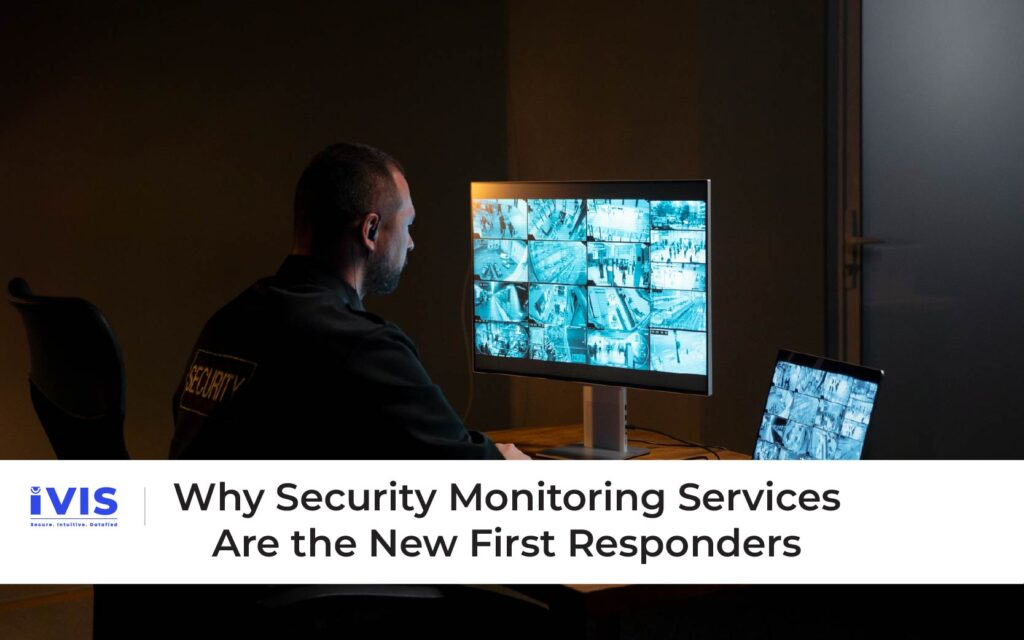
Why Security Monitoring Services Are the New First Responders When we think of first responders, we imagine police officers, paramedics, or firefighters. These brave professionals jump into emergencies with speed and focus. But in the digital-first world, another kind of first responder is emerging. They operate quietly and intelligently, backed by data. Enter Security Monitoring Services. These services don’t race to a scene with sirens but instead work behind the scenes to prevent incidents before they escalate. With advanced video review, AI-powered analytics, and real-time behavioral assessments, they detect patterns, minimize vulnerabilities, and enhance security strategies across multiple locations. As threats grow more complex, businesses, communities, and public spaces need more than boots on the ground. They need eyes that never blink and insights that never sleep. 1. From Reactive to Predictive Most traditional security systems are designed to react. A break-in, a breach, or suspicious behavior happens, and only then does the response begin. Security monitoring services change that. Instead of waiting for something to go wrong, these services analyze e-surveillance footage to flag early signs of unusual activity. Think of it as security with foresight. Whether it is an unexpected after-hours entry or repetitive behavior that signals a future threat, the system helps identify risk patterns well before an incident occurs. By moving from reaction to prediction, organizations can prevent rather than recover. 2. Coverage That Does Not Sleep Threats do not clock in or out. They can emerge at 2 a.m., during a long weekend, or while the building sits empty. Security monitoring services offer persistent visibility, even when staff are off the clock. Rather than relying on occasional manual reviews, these services use technology to evaluate all recorded footage. This ensures nothing goes unseen. If something unusual happens, it is detected through pattern recognition and flagged for action. It is like having a tireless, always-vigilant watchtower without 24/7 staffing. 3. Faster, Sharper Incident Analysis When an incident does occur, traditional methods often involve hours of slow, manual footage review. Time is lost, and critical evidence can be missed. AI-powered security monitoring services can scan hours of video in minutes. These systems highlight keyframes, identify irregular movement, and isolate relevant segments. That means security teams spend less time searching and more time responding. It is not just faster, it is advanced. By turning video into insight, these services help organizations take control of the narrative in critical moments. 4. Scalable and Cost-Effective Protection Hiring, training, and deploying round-the-clock personnel can be expensive, especially for growing companies or multi-location sites. That is why security monitoring services have become an attractive alternative. They reduce dependency on human monitoring by automating e-surveillance analysis. As your organization grows, these services scale with you, without adding new staff to every site. It is intelligent, efficient, and a fraction of the cost of traditional security models. 5. Data-Driven Accuracy Humans make mistakes. Fatigue, distraction, or even weather can impact on-site awareness. However, security monitoring services rely on data, not instinct. By analyzing footage using advanced algorithms, these systems detect the subtleties: repeated entry attempts, loitering, or patterns that deviate from the norm. These are not just alerts. They are contextual warnings that help teams make faster, more accurate decisions. This accuracy ensures nothing slips through the cracks, and everything is backed by verifiable data. 6. Simplified Reporting for Smarter Collaboration Once a threat is identified or an incident occurs, the next step is documentation and coordination. Manual reporting takes time and is often incomplete. Security monitoring services streamline this process with auto-generated reports, clipped video highlights, and easy-to-share summaries. That means internal teams and law enforcement agencies can act faster and with more clarity. Monitoring is only part of the process. The real value lies in communicating the right information at the right time to the right people. 7. Better Visibility for Complex Environments Large campuses, industrial parks, and multi-floor office spaces all present unique challenges. These environments often have gaps in electronic surveillance. Security monitoring services solve this by delivering full coverage through digital video review and intelligent analysis. Even areas that receive little attention during live monitoring can be reviewed with equal detail post-event. From parking lots to access doors to warehouse aisles, these services ensure no area is forgotten. 8. Built for the Modern Threat Landscape Today, security risks go beyond physical intrusions. They are blended with digital threats, coordinated breaches, and unpredictable behavior patterns. Organizations need systems that adapt just as quickly. Security monitoring services provide that edge. With every incident reviewed, every anomaly flagged, and every report refined, the system becomes smarter. Over time, it learns your environment and tailors insights to your specific vulnerabilities. It is modern security for a modern world. Why Security Monitoring Services Matter The role of security has evolved. What was once reliant on live eyes and locked doors is now driven by data, behavior analysis, and digital awareness. Security monitoring services have earned their place as the new first responders, not because they arrive at the scene, but because they prevent the scene from happening in the first place. When looking for a trusted partner in this space, IVIS delivers comprehensive solutions built around intelligent video review, proactive threat detection, and seamless integration with existing e-surveillance infrastructure. Whether for commercial buildings, critical infrastructure, or high-risk zones, IVIS empowers organizations to stay ahead of risk, reduce manual oversight, and make advanced security decisions. With scalable technology and actionable insights, IVIS helps transform passive footage into a powerful tool for protection and prevention, every day, across every site.

Scroll to Top