
Write to us about any queries you have

Contact Form Demo

Video Surveillance Systems

Cloud-Based E-Surveillance: Scalability Meets Security
Blog

Cloud-Based E-Surveillance: Scalability Meets Security

Cloud-Based E-Surveillance: Scalability Meets Security Imagine you are the owner of a six-site retail chain spanning three cities. Each store had its own server room filled with Network Video Recorders (NVRs), storage drives, and dedicated IT staff. When the central IT manager visited one location, he discovered a recorder offline and six cameras unmonitored. By the time the fault was reported, the footage needed for an incident review was gone.   So, what will you do?  This triggers the move: migrating to a cloud-based e-surveillance system. Within weeks, all sites can be connected to a unified cloud video platform. Faults could be diagnosed centrally; storage seamlessly scaled, and access will be available from any device, with no local server dependency. This transformation illustrates a very real shift in how organisations approach security: scalability, flexibility, and robust cybersecurity now live in the cloud.  In today’s dynamic environment, the convergence of surveillance and cloud computing is not optional; it’s strategic. As enterprises expand with multi-location facilities, remote sites, and hybrid workforces, they need surveillance systems that scale easily, remain secure, and integrate intelligence at every level. Cloud-based e-surveillance meets this need: offering rapid scalability, centralised control, lower infrastructure overhead, and advanced security features.  From On-Prem to Cloud: The Evolution of Surveillance Infrastructure Historically, surveillance meant dedicated servers, local storage, tape or disk archives, and site-by-site management. While robust in its time, that model struggles today for several reasons:  Explosive growth in camera counts and video resolutions means storage and computer demand outstrips traditional hardware.  Multi-site and remote locations require central visibility and control; local servers make unified management difficult.  Maintenance, hardware refresh cycles and patching add overhead and risk of downtime.  Integration of analytics, AI and hybrid workflows demands a flexible, scalable architecture.  Enter the cloud. Cloud-based video surveillance (also called VSaaS — Video Surveillance as a Service) enables centralised management, elastic storage, global access and seamless updates.   According to industry research, cloud surveillance systems are highly scalable and allow organisations to add cameras or locations without major infrastructure upgrades. The shift from on-premises to cloud means surveillance can follow the business, rather than constrain it.  What Is Cloud-Based E-Surveillance? Cloud-based e-surveillance refers to a surveillance architecture where video feeds, storage, analytics and management are hosted, processed or orchestrated via cloud infrastructure rather than purely onsite hardware. Key components include:  Cameras and sensors deployed at site, transmitting video footage over network.  Cloud storage & compute that store footage, apply analytics, create dashboards and provide remote access.  Centralised management platform accessible via web or mobile, enabling live/recorded-video review, health-monitoring, alerts and configuration.  Hybrid architectures where edge devices might preprocess, but cloud handles scale, historic storage, cross-site correlation.  Why Cloud-Based E-Surveillance Matters: Scalability Meets Security Scalability and Flexibility: One of the biggest benefits: adding new cameras or sites takes minutes, not weeks. Cloud systems remove the need for new servers or storage drives. Industry sources highlight that cloud video surveillance enables highly scalable systems where expanded storage or camera counts are accommodated without major hardware investment. In fast-moving businesses like, retail chains, logistics hubs, multi-tenant campuses—this means security infrastructure grows with the business, not behind it.  Lower Upfront Costs & Predictable Ongoing Expenses: On-premises setups entail hefty capital expenditure (servers, recorders, drives) and ongoing maintenance. Cloud models typically operate on subscription or pay-as-you-go basis. For example, cloud video surveillance can reduce total cost of ownership by up to 60% over five years compared to traditional systems. This financial model makes it easier for organisations to budget, scale and manage surveillance across multiple sites.  Remote Accessibility & Unified Control: Cloud platforms offer two major advantages: access from anywhere and centralised dashboards. Teams can view real-time feeds, historical footage, configure cameras or respond to alerts from mobile devices or centralised control centres. This is especially critical for organisations with multiple branches, remote sites or decentralised operations. The result: consistent security policy enforcement, rapid incident response and simplified operations.  Enhanced Security & Resilience: Cloud providers invest heavily in infrastructure, redundancy, encryption, disaster recovery and access control. Many cloud-surveillance discussions emphasise that cloud platforms deliver stronger data security, off-site backups and reductions in hardware failure risk. In effect, moving to the cloud can enhance both physical and cyber-resilience of surveillance systems.  Integration with Analytics & AI: Cloud architectures allow easier integration with AI-powered analytics, large-scale video processing and cross-site correlation. As research notes, cloud systems are set to dominate video surveillance thanks to strong support for analytics and automatic updates.   Real-World Use Cases Retail Chains (Multi-Site Monitoring): A retail enterprise deployed a cloud-based surveillance service across 120 stores in three countries. They used centralised dashboards to monitor live feeds, perform health checks on cameras, roll out analytics updates and scale storage seamlessly during high-season promotions.  Warehousing & Logistics: A logistics hub spanning multiple buildings leveraged cloud video to unify visibility, monitor loading-dock operations, integrate with access-control and track incident trends across sites.  Corporate Campuses & Smart Campuses: A multinational firm deployed cloud-based video across campuses in several geographies. Security teams could access any site’s feed, archive important footage centrally, and use analytics to spot recurring patterns (tailgating, loitering, access zone violations).  Remote/Outdoor Sites: Remote solar-farm sites, construction zones, or transport hubs with limited local IT infrastructure benefited from the cloud because minimal local hardware is needed; video streams go to the cloud for archiving and monitoring.  Implementation Considerations & Best Practices While cloud-based e-surveillance offers huge benefits, organisations must carefully plan deployment:  Network Bandwidth & Latency: Video streams can consume significant bandwidth; decide which cameras stream real-time and which perform local pre-filtering.  Hybrid / Edge Strategy: Some analytics may still be optimal on-site (edge) for latency or privacy reasons; use a hybrid cloud-edge model.  Storage Retention & Compliance: Define retention policies, archiving workflows and data sovereignty (especially across geographies).  Security & Access Control: Use encryption in-transit and at-rest, strong authentication, role-based access and audit-logs.  Scalable Architecture & Future Proofing: Choose a system that supports camera counts, site expansion, new analytics modules and platform upgrades.  Change Management & Monitoring: Ensure teams are trained, health

E-Surveillance in Smart Cities - Building Safer Urban Futures
Blog

E-Surveillance in Smart Cities – Building Safer Urban Futures

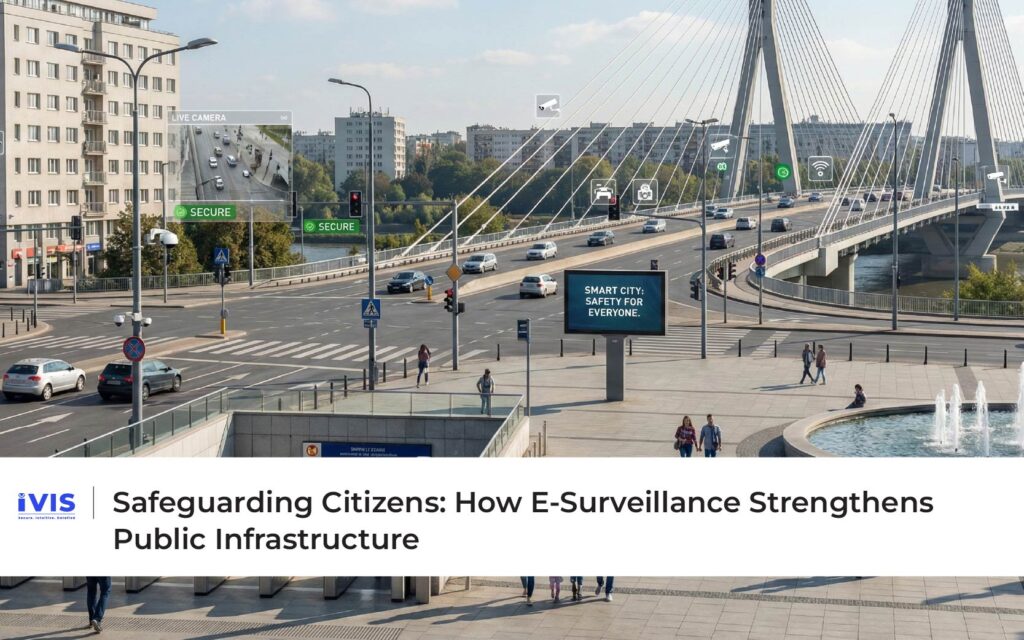
E-Surveillance in Smart Cities – Building Safer Urban Futures It was a busy evening in the city square. The sun had just dipped below the skyline. A group of boys gathered near the bus stop; a delivery robot zipped past, and thousands of phones lit up the sidewalks. Behind the scenes, a hidden group of sensors, cameras, and AI-enabled systems hummed with life.   A sudden alert: the system flagged an object left unattended in a busy pedestrian lane. Within seconds, a security operator received the alert, a camera switched to zoom, and a patrol was dispatched. What might have been a threat was a quickly resolved incident.  This is the new reality of e-surveillance in smart cities – where visibility, analytics and responsiveness merge to help shape safer, more resilient urban environments. As cities grow in size and complexity, traditional security models fall short. The integration of advanced video analytics, networked sensors and real-time monitoring platforms means that surveillance is no longer just reactive – it becomes proactive, strategic and integral to urban life.  The Smart Cities Context: Why Surveillance Matters Global urbanization is speeding up, according to a report by Grand View Research, the global smart cities market is projected to reach USD 3,757.9 billion by 2030, with a compound annual growth rate (CAGR) of 29.4% from 2025-2030.  Within this massive expansion, city surveillance plays a foundational role: one market estimate shows that the city-surveillance segment registered USD 49.5 million in 2024 and is expected to reach USD 183.2 million by 2030 (CAGR ~26.2%).   In India for example, under the Smart Cities Mission, an IIM-B study found that 59,802 CCTV cameras and emergency call boxes were installed across 93 smart cities, contributing to improved real-time crime tracking and reducing overall crime in a sample city (Nagpur) by ~14%.  These numbers reflect a key truth: in the smart city paradigm, public safety and surveillance infrastructure are inseparable. As urban densities rise, traffic flows intensify, and threats become more varied (from theft to crowd incidents to infrastructure failures), the value of intelligent surveillance systems becomes clear.  What E-Surveillance in Smart Cities Looks Like When we talk about e-surveillance in the smart city context, we refer to a layered ecosystem:  Networked video & sensor feeds: Cameras, IoT sensors, vehicle/people counters, environmental detectors.  Integrated command centres: Lines of sight converge in an Integrated Command & Control Centre (ICCC) where analytics and alerts are monitored.  AI and video analytics: Behavioral detection, anomaly detection, crowd or traffic flow analysis, loitering detection, unattended object alerts.  Real-time response & orchestration: Alerts trigger patrols, automated gates, traffic diversions, public alerts.  Data fusion & urban operations: The surveillance data informs traffic management, event planning, urban policing, infrastructure resilience.  For example, a retail district camera might identify a cluster forming late at night (potential loitering or illicit meet-up) and reroute a patrol. A transit hub sensor might alert when crowd density reaches unsafe levels, triggering escalator slow-down or station closure. All of these capabilities rest on the backbone of e-surveillance infrastructure.  Key Benefits of Smart City E-Surveillance Enhanced Public Safety & Crime Reduction: By enabling real-time tracking of incidents and enabling faster responses, cities report meaningful improvements. The IIM-B study showed a ~14% decline in crime in one city after deploying surveillance under the Smart Cities Mission.  Faster Incident Response & Efficiency: Modern analytics reduce reliance on purely manual monitoring. According to a case‐study, AI-powered urban surveillance systems can reduce manual patrol burdens and response times by up to ~40%.  Improved Resource Utilisation & Urban Operations: Surveillance data helps optimise patrol routes, street-lighting schedules, evacuation planning, traffic control, delivering efficiency. Data-Driven Urban Planning: Surveillance feeds provide insights into crowd flows, hotspot behaviours, mobility bottlenecks, enabling smarter design of urban infrastructure. Market Growth Reflects Strategic Value: The city-surveillance market is growing rapidly: e.g., the global urban video surveillance networks market is projected to grow from USD 53.2 billion in 2024 to USD 148.2 billion by 2033.  Challenges & Considerations While the potential is significant, implementation comes with hurdles:  Privacy & Ethical Concerns: Constant monitoring raises questions about civil liberties, data protection, and transparency. Systems must include safeguards, anonymization, and clear policies.   Integration & Legacy Systems: Many cities must manage legacy CCTV, variable network infrastructure, and piecemeal sensor deployments, making integration complex.  Data Overload & Analytics: Vast data flows only matter if analytics, alerts and orchestration can effectively interpret them, otherwise the system becomes noisy.  Maintenance & Operational Costs: Cameras, sensors, network infrastructure, data storage and AI algorithms all incur cost and require upkeep.  Equity & inclusion: Surveillance must not unfairly target particular communities or produce biased outputs; ethical design and oversight are essential.  Implementation Gaps: For example, in one Indian city, ~50% of smart-city cameras were reported by police as non-functional, impacting real-time monitoring capability.   Deployment Strategy: How IVIS Helps For cities planning or scaling e-surveillance systems, IVIS with Scanalitix offers a strategic approach:  Scalable Platform Architecture: From 500 to 50,000 cameras/sensors, the platform handles the scale.  AI-Driven Video Analytics: Integrated modules for behaviour detection, traffic/ crowd analysis, public safety scenarios.  Integrated Command & Control: A unified ICCC view where alerts are triaged, patrols dispatched, events logged and analytics visualised.  Privacy-First Design: Anonymisation, data retention policies, role-based access control, audit logs, to support ethical use.  Hybrid Cloud / Edge Deployment: Ensures redundancy, low latency and flexibility for both dense urban hubs and remote zones.  Continuous Learning & Optimisation: System adapts over time, false-positive reduction, model refinement, event-history feedback loops.  By aligning smart city goals (safety, efficiency, transparency) with a robust e-surveillance foundation, IVIS enables cities to move beyond surveillance as a cost-centre to a strategic urban asset. The Future: Towards Autonomous Urban Intelligence Looking ahead, the evolution of e-surveillance in smart cities will involve:  Edge Analytics + AI Collaboration: Real-time detection and local decisioning, combined with central orchestration and predictive modelling.  Predictive Urban Analytics: Not just reacting to incidents, but forecasting where crowd surges, public disturbances or infrastructure stress may occur — enabling preventive action.  Multi-Modal Sensor Fusion: Cameras, audio sensors (gunshot detection), environmental

Reliable E-Surveillance Solutions for Securing Remote Locations
Blog

Reliable E-Surveillance Solutions for Securing Remote Locations

Reliable E-Surveillance Solutions for Securing Remote Locations Remote locations are easy targets. These sites often face delayed response times, limited staff presence, and difficult terrain. Securing them takes more than just fences and cameras. It demands intelligent systems that adapt, respond instantly, and operate without needing round-the-clock supervision. This is where e-surveillance solutions make all the difference. Why Remote Locations Need Advanced Security Thieves, vandals, and trespassers don’t follow business hours. Construction zones, oil fields, wind farms, and mining sites are high-value targets. Large warehouses also face similar risks. Valuable equipment and minimal on-site supervision make these locations vulnerable to intrusions. Traditional security methods often fall short in these environments. Patrols lack consistency. Maintenance becomes complicated. Connectivity remains unreliable. Criminals take advantage of these gaps. Studies show modern e-surveillance systems reduce crime in public spaces by up to 24–28%, including theft in urban areas and transit hubs. Remote video monitoring offers even greater precision, with AI-enhanced systems minimizing false alarms by up to 95% while slashing labor costs by 40–60% compared to traditional guards. E-Surveillance Solutions: Technology That Thinks Ahead E-surveillance solutions combine physical security with data-driven intelligence. These systems operate on the principle of detection, deterrence, and documentation. Unlike traditional setups, modern e-surveillance solutions do more than just record. E-surveillance systems analyze footage and adapt to changing environments. These solutions deliver visual evidence supported by behavior recognition, movement analysis, and intelligent alerts. These systems use a mix of: High-resolution cameras Remote video monitoring Audio deterrents Motion detection sensors Cloud-based control centers AI-powered video analytics Such integration builds a security layer that remains active at all times. The system does not rely on human presence. The setup reduces downtime. The technology works around the clock. Power of AI and Video Analytics in Harsh Environments Remote locations cannot afford a slow response. Intrusions need to be flagged fast. AI-based video analytics recognizes unusual behavior patterns. The system detects unauthorized access. The technology distinguishes between a person and a passing animal. The solution also tracks vehicles across entry zones. Key features help teams prioritize alerts. There is no wasted effort on false alarms. Only actionable data reaches decision-makers. AI ensures the system grows smarter and more efficient over time. Cloud Access and Centralized Control Distance should never be a barrier. Cloud-enabled e-surveillance solutions give real-time access to all feeds, recordings, and analytics. Managers can check footage from any device. Teams in different cities can collaborate on a single interface. Cloud storage ensures data is not lost due to local damage or power issues. Centralized control is key. A single dashboard can cover multiple remote locations. This minimizes blind spots. The platform maximizes visibility. The setup brings efficiency to an otherwise scattered operation. Voice-Down Deterrence: Prevention in Action Cameras alone do not scare off intruders. However, when the system speaks, people listen. Voice-down technology enables pre-recorded or live verbal warnings to play through on-site speakers. If someone enters a restricted zone, they hear a loud command to leave. This prevents many incidents from escalating further. E-surveillance solutions with voice-down deterrence provide psychological pressure. They let intruders know they are being watched. That pressure forces many to abandon the intrusion. Site-Specific Surveillance That Adapts No two remote locations are the same. A wind farm has different needs than a construction zone. Customizable e-surveillance solutions adapt to the environment. They account for lighting, layout, visibility, and network coverage. Systems can be solar-powered where electricity is limited. Camera towers can be installed quickly without digging. Portable units can be moved as the project progresses. Analytics can be configured to detect specific threats, such as vehicle loitering or fence breaches. Adaptability is what separates modern systems from outdated setups. Lowering Costs and Raising Performance Hiring guards for round-the-clock coverage across multiple sites is expensive. It also brings inconsistency. People get tired. Gaps form. Cameras don’t sleep. Cameras do not blink. Systems do not take breaks. E-surveillance solutions reduce the need for physical patrols. They cut operational costs while increasing coverage. One intelligent system can monitor large areas with minimal manpower. Reports and alerts can be generated automatically, saving time on manual checks. Investing in intelligent e-surveillance becomes more affordable in the long run. Compliance and Insurance Benefits Insurers want proof that safety measures are in place. Sites with e-surveillance solutions show lower risk. This often results in lower insurance premiums and faster, hassle-free claims. Compliance officers also favor systems that provide documented evidence during audits. Footage is time-stamped and securely stored. Access logs are tracked. Reports can be shared with authorities or regulators in minutes. This boosts credibility. It shows commitment to safety. Deterrence That Works Without Delay When a breach happens, every second counts. E-surveillance solutions send alerts in real time. Audio warnings go out instantly. Managers can verify the footage and take action without delay. Faster detection leads to swifter decisions. That is what prevents damage, loss, or liability. Systems that combine video, sound, and analytics act as a force multiplier. They replace reactive security with proactive protection. Integration with Access Control Many remote locations use gates, turnstiles, or smart locks. E-surveillance systems seamlessly integrate with access control measures. Unauthorized entries can be flagged. Authorized personnel movements can be logged. Facial recognition or license plate detection adds another layer. The solution goes beyond monitoring. The technology actively manages and controls movement. It creates a full picture of who enters, who exits, and what happens in between. No Internet? No Problem. Rural areas often face limited or unstable connectivity. That should not block surveillance. Mobile-enabled e-surveillance solutions use LTE cellular networks. They also operate through satellite connectivity to ensure reliable performance in remote locations. Local storage keeps data safe. Once the connection is stable, footage syncs to the cloud. Systems can even work offline for short durations. That flexibility makes them ideal for areas where infrastructure is still catching up. Why IVIS Delivers the Edge Remote location security needs to be intelligent, faster, and more reliable. E-surveillance solutions provide the visibility and deterrence required to

Cloud vs. On‑Premise Video Surveillance Systems: What You Should Know
Blog

Cloud vs. On‑Premise Video Surveillance Systems

Cloud vs. On‑Premise Video Surveillance Systems: What You Should Know Businesses rely on advanced video surveillance systems to protect property, monitor operations, and ensure safety. Choosing between cloud-based and on‑premise systems is a significant decision that affects cost, flexibility, security, and long-term growth. Both solutions offer distinct benefits and trade-offs. Understanding these can help organizations invest wisely based on their needs, goals, and infrastructure. Cloud‑Based Video Surveillance Systems Cloud-based systems store video footage on remote servers. Cameras connect to the internet and stream data to a cloud provider. Users access live or recorded video from any device, anywhere in the world. Providers handle server maintenance, software updates, and data backups. Key Advantages Cloud systems deliver remote access from any internet-enabled device. Monitoring multiple locations becomes simple. Adding new cameras takes minutes, plug and connect to the internet. There’s no need to buy extra servers or storage. Subscriptions cover system access, storage, and support. This model suits businesses wanting fast deployment and low hardware costs. System updates roll out automatically. The provider handles all upgrades, so users consistently access the latest features and security patches. Data is usually backed up across multiple geographic locations, improving reliability and recovery. Challenges and Limitations Cloud surveillance depends on consistent internet connectivity. Network failures or slow upload speeds can cause streaming issues or video loss. High-definition footage consumes a substantial amount of bandwidth, thereby increasing internet costs. Security and privacy also depend on the cloud provider. Most organizations implement strong encryption and follow strict compliance protocols to protect their data. However, they often relinquish some control over where the data is stored and how it is managed. Regulatory or industry requirements may restrict the use of cloud storage, particularly in sensitive sectors such as healthcare or finance. Cost Structure Cloud models typically operate on a monthly or yearly subscription basis, with charges usually applied per camera. Initial hardware costs are low. However, long-term expenses can grow depending on retention periods, resolution, and the number of cameras. Additional fees may apply for extended storage, advanced analytics features, or excess bandwidth usage. Scalability and Maintenance Scaling is seamless. Need more cameras? Just connect and activate. Scaling down reduces ongoing costs without any hardware loss. Maintenance is handled by the provider, eliminating dedicated IT resources and preventing system downtime during updates. On‑Premise Video Surveillance Systems On‑premise systems store video footage locally on servers or Network Video Recorders (NVRs). Cameras connect directly through wired or wireless networks. Video is managed on-site and accessed through internal software or secured remote login. Businesses own and maintain the system infrastructure. Key Advantages Data control remains in the hands of the organization. The footage is stored on-site, with no access granted to third parties. Organizations set their own encryption standards, access rules, and retention policies. Internet outages do not affect video recording since all data flows through the local network. System performance is often higher. There is no internet lag, and real-time monitoring is more consistent. Minimal latency makes this option ideal for high-risk environments, directing immediate response. Challenges and Limitations Initial setup requires a significant investment. Hardware, installation, cabling, and IT configuration can add up. Expanding the system requires purchasing and installing additional equipment. This limits speed and flexibility when growing across locations. Maintenance becomes the client’s responsibility. IT teams handle software updates, repairs, and replacements. Downtime for updates or technical issues can affect surveillance operations. Cost Structure Capital expenditure occurs upfront with hardware purchases. Over time, costs stabilize. Organizations avoid monthly fees but must plan for system upgrades, expansions, and replacements. Long-term, this option may be more cost-efficient depending on scale and use case. Scalability and Maintenance Scaling up requires manual integration of hardware, network changes, and system configuration. The process takes time and planning. Maintenance is typically handled by either internal IT teams or third-party service providers under contract. Managing updates, repairs, and backups increases overhead. Performance and Connectivity Considerations Cloud systems stream data over the Internet. Each high-definition camera typically consumes between 1 and 5 Mbps of bandwidth. A business operating more than 20 cameras may require substantial upload bandwidth. During peak hours, video lag or frame drops can occur. On‑premise setups avoid this issue since video stays on the local network. Performance is stable regardless of internet health. Remote viewing is more intuitive on cloud systems. They include mobile apps and web portals with simplified access. On-prem systems require VPNs or port forwarding, which increases technical complexity. Security and Compliance Cloud providers invest heavily in security infrastructure. Footage is encrypted during transmission and at rest. Most maintain certifications like ISO 27001, SOC 2, and GDPR compliance. That said, the provider still holds responsibility for part of your data protection. Clients need to vet the provider’s compliance and privacy policies. On‑premise systems allow organizations to design custom security layers. Footage remains entirely private. Local storage eliminates risks related to third-party data breaches or cross-border data regulations. This makes them preferable for industries like legal services, government, and healthcare. SDM’s 2024 Industry Forecast found that 93 percent of security professionals rate the current video surveillance market as “very good” or “excellent.” Additionally, 71 percent expect revenue from video surveillance systems, whether cloud-based or on-premises, to increase in 2024. Backup and Disaster Recovery Cloud-based video systems benefit from built-in redundancy. Providers replicate video across multiple data centers, offering high availability and backup by default. In case of server issues or local disasters, the data remains accessible. On‑premise systems need tailored backup strategies. This might include duplicate storage units, off-site backups, or hybrid NVR replication. Disaster recovery becomes more complex and costly, but offers full autonomy. Use Case Scenarios Cloud-Based Systems Multi-location retailers with no central IT team Small offices needing a simple setup Startups with lean budgets and mobile access needs Educational institutions with flexible deployment requirements On-Premise Systems Financial institutions with strict privacy mandates Government facilities with sensitive information Industrial sites with unstable internet Medical practices need complete control over patient footage Hybrid Approach: Best of Both Worlds Some

Scroll to Top