
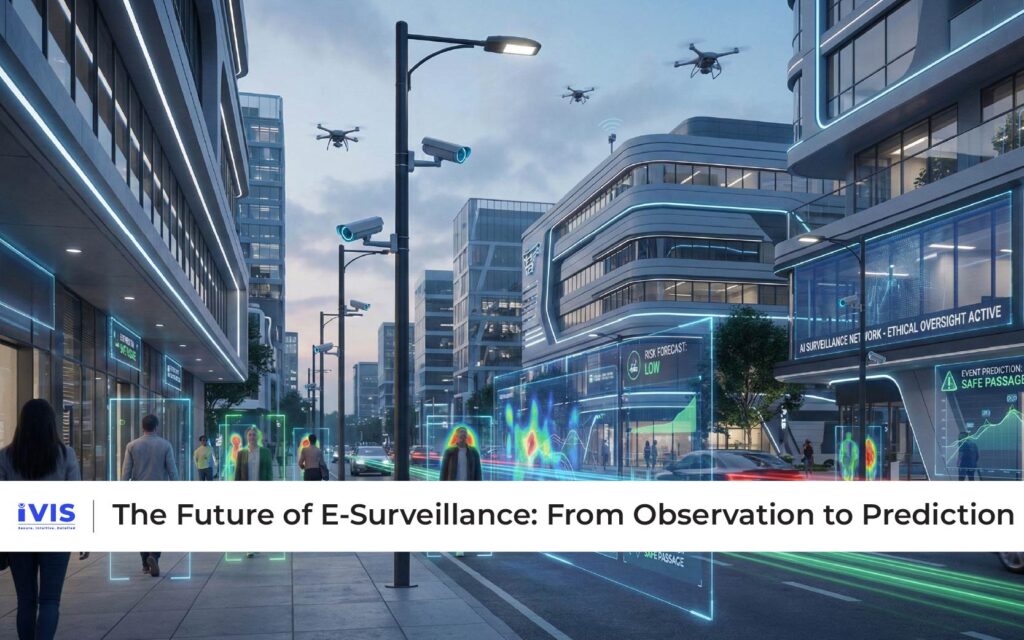
For decades, surveillance meant watching and recording. Cameras captured what happened, and humans reviewed footage after the fact. This model helped investigate incidents, but it rarely prevented them. Today, that paradigm is changing. Surveillance is evolving from passive observation into an intelligent, predictive capability, one that anticipates risks before they escalate.
This shift is being driven by advances in artificial intelligence, video analytics, edge computing, and data integration. Together, these technologies are transforming surveillance into a proactive decision-support system. The result is a future where security teams don’t just respond faster, they act earlier, armed with foresight rather than hindsight.
Modern environments are complex and dynamic. Cities host millions of people daily. Factories run 24/7 with automated machinery. Transport networks move goods and passengers at scale. In such settings, relying on human operators to watch screens is neither efficient nor reliable.
Studies consistently show that humans struggle with sustained attention when monitoring multiple video feeds. Fatigue and information overload lead to missed signals. At the same time, the volume of video data has exploded with high-resolution cameras and expanded coverage.
This gap between what surveillance captures and what humans can process has accelerated the adoption of AI-driven analytics. Instead of watching everything, systems now analyze continuously, detecting patterns, deviations, and early warning signs in real time.
At the core of predictive surveillance is intelligent video analytics. These systems use machine learning models to understand scenes, behaviors, and context. Rather than detecting simple motion, they identify what is moving, how, and why it matters.
For example, analytics can distinguish between normal crowd flow and dangerous congestion, between routine vehicle movement and suspicious routes, or between authorized access and tailgating. According to industry research, AI-enabled video analytics can significantly reduce false alarms while improving detection accuracy in complex environments.
This capability shifts surveillance from event logging to risk recognition. Systems learn what “normal” looks like and flag anomalies that may indicate emerging threats.
The next leap is prediction. Predictive surveillance combines real-time analytics with historical data, environmental context, and pattern recognition to forecast risk. This is similar to predictive maintenance in manufacturing, where systems anticipate equipment failure before it happens.
In public spaces, predictive models can anticipate crowd surges based on time of day, events, and past behavior. In transport hubs, they can forecast congestion and safety risks. In industrial settings, they can predict unsafe interactions between humans and machines.
Research from McKinsey notes that predictive analytics can materially improve operational outcomes by enabling earlier interventions and better resource allocation. Applied to surveillance, this means shifting from reacting to incidents to preventing them altogether.
Prediction requires speed. Sending every video stream to a centralized cloud introduces latency and bandwidth costs. Edge computing addresses this by processing data closer to where it is generated, inside cameras, gateways, or local servers.
Edge-based analytics enable instant detection and decision-making, even in environments with limited connectivity. Only relevant events or metadata are transmitted to centralized platforms for correlation and long-term analysis.
Industry studies show that edge computing significantly reduces response times for AI workloads that require immediacy. For surveillance, this architecture is essential: predictive insights lose value if they arrive too late.
Prediction also depends on context. Video alone is powerful, but its value multiplies when integrated with other data sources, access control logs, IoT sensors, alarms, weather feeds, and operational systems.
When these inputs are orchestrated, surveillance becomes a system of intelligence. For instance, a detected anomaly near a restricted area gains significance when correlated with access logs showing failed badge attempts. A crowd-density alert becomes more actionable when paired with event schedules and transit data.
The World Economic Forum highlights that integrated data platforms are foundational to smart cities and resilient infrastructure. Surveillance, when connected to broader operational data, becomes a planning tool, not just a security measure.
As surveillance becomes more powerful, ethical considerations grow more important. Predictive systems must balance safety with privacy, accuracy with fairness, and automation with human oversight.
International frameworks emphasize principles such as proportionality, transparency, and accountability. Predictive surveillance should focus on behaviors and risks, not indiscriminate against identity tracking. Data minimization, anonymization where possible, and clear governance policies are essential.
Public trust depends on understanding how surveillance works and why it exists. Transparent communication, auditability, and human-in-the-loop decision-making ensure that prediction enhances protection without undermining civil liberties.
The move from observation to prediction delivers tangible benefits across sectors:
The World Bank notes that data-driven, predictive approaches improve resilience and reduce long-term costs by preventing disruptions rather than merely managing them.
As surveillance evolves, organizations need platforms that can unify data, apply intelligence at scale, and support predictive decision-making responsibly. This is where IVIS plays a meaningful role.
IVIS is designed to move surveillance beyond monitoring by integrating real-time video analytics, edge processing, and centralized orchestration into a single operational view. By correlating live feeds with historical patterns and contextual data, IVIS enables early identification of risks and supports proactive interventions. Its architecture supports hybrid deployments, edge, on-prem, and cloud, ensuring speed, resilience, and compliance.
Equally important, IVIS in collaboration with Scanalitix, aligns predictive capabilities with governance. Policy-driven controls, secure data handling, and transparent workflows help organizations deploy advanced surveillance while maintaining ethical and regulatory alignment. In the journey from observation to prediction, IVIS acts as an enabler of foresight—turning insight into timely action.
The future of surveillance will be defined by prediction, not reaction. Advances in AI models, federated learning, and edge hardware will further reduce latency and enhance accuracy. Systems will increasingly simulate scenarios, recommend preventive actions, and coordinate responses automatically, while keeping humans in control.
Surveillance will become less visible but more impactful, embedded into the fabric of operations and infrastructure. Its success will be measured not by how many incidents it records, but by how many it prevents.
Surveillance is undergoing a fundamental transformation. From static observation to intelligent prediction, it is becoming a strategic capability for safety, resilience, and planning. By leveraging AI, analytics, and integrated data, organizations can anticipate risks and act before harm occurs.
Platforms like IVIS illustrate how this future can be realized responsibly, combining predictive intelligence with transparency and trust. As we look ahead, the most effective surveillance systems will not simply watch the world; they will understand it, learn from it, and help keep it safe, before incidents unfold.