
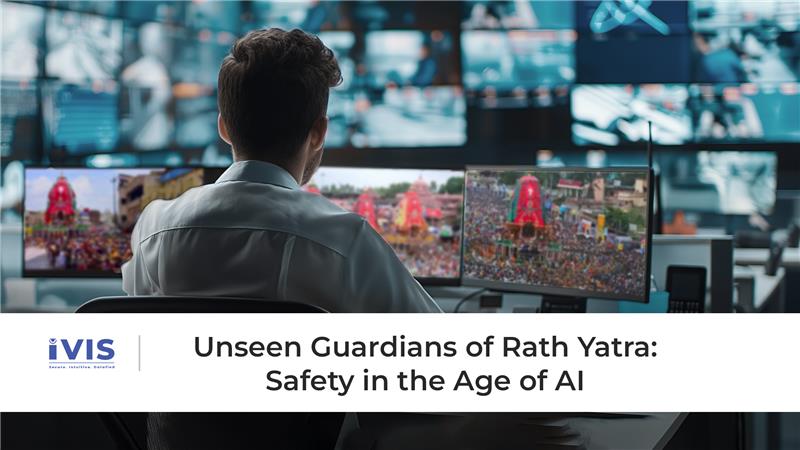
Each year, during the majestic Rath Yatra, an ocean of humanity floods the streets of Puri. As millions walk, chant, and worship in devotion. While the colossal chariots roll forward, this profound expression of collective faith brings significant challenges related to safety, crowd management, and emergency response. AI is now stepping in as the unseen guardian of such events, transforming the way authorities and organizers protect pilgrims while respecting the sacredness of tradition.
In the age of intelligent surveillance, the way we manage mass gatherings is undergoing a tectonic shift. Static CCTV setups no longer suffice. They have evolved into real-time, AI-powered systems that read the pulse of a crowd, sense anomalies, and enable teams to act before incidents escalate. Rath Yatra is one of the world’s largest religious processions. For an event of this scale, the deployment of such systems is valuable and essential.
To grasp the magnitude of security required, consider this: Odisha Police deployed AI-enabled cameras and 10,000 personnel to manage an expected crowd of around 1.5 million devotees during Rath Yatra 2025.
Pilgrims span all age groups. Many travel for days. The event includes tight corridors, open boulevards, vehicle routes, rooftops, high-value temple interiors, and processional paths. Managing all this manually is not feasible.
AI systems offer a scalable solution. They learn from the environment in real time and act faster than any human monitor. They are always watching, but not in a way that intrudes on personal space or faith.
Modern AI-based surveillance operates in layers, much like the temple complex itself. These layers ensure different zones are covered based on risk and importance.
The first point of contact during the Rath Yatra is the crowd entering through the temple gates. Here is what AI handles:
The second tier of monitoring focuses on areas that require higher sanctity and restricted access:
Beyond the sanctum, there is a need to control vehicles, manage entry, and ensure coordinated movement:
Traditional surveillance only records. AI surveillance acts. That is the critical difference.
When suspicious activity is detected, such as someone entering through an unauthorized side gate, the system takes notice. If a fire-like visual appears in the kitchen area, it responds without waiting for manual review. Instead:
This entire cycle happens in seconds. No delay. No confusion. No guessing.
AI systems can also recognize patterns in crowd behavior. For example:
This prediction model is the future of public safety. It is not about reacting to chaos; it is about avoiding it altogether.
One of the biggest concerns at religious events is privacy. AI can operate without using facial recognition, biometric data, or any personal information. It only reads patterns, human shapes, motion, and behavior anomalies. That makes it ethical.
AI isn’t designed to remember individuals—it remembers patterns of risk.
Cameras are programmed not to identify people but to identify moments of concern. The moment that incident is resolved, the data becomes irrelevant. This allows organizers to balance security with spiritual sanctity.
Rath Yatra is just the beginning. Other temple events, spiritual processions, and religious gatherings face similar challenges. These include managing crowd overflow, preventing violence, ensuring fire safety, and protecting restricted areas. With AI, all of these become measurable, manageable, and predictable.
Embracing technology does not mean compromising faith. Instead, it reflects faith strengthened by foresight. Temples and civic planners that invest in this kind of advanced monitoring are securing lives and preserving the experience of worship itself.
The AI ecosystem behind modern temple surveillance is not built on a single solution. It thrives on the integration of specialized platforms that complement one another.
IVIS has partnered with Scanalitix to provide a comprehensive, two-tiered safety solution tailored for large-scale religious events such as Rath Yatra. This partnership combines the strengths of both platforms to ensure that security is reactive and intelligently proactive.
Scanalitix delivers advanced Crowd Management Systems and AI-powered video analytics to monitor, predict, and manage crowd behavior in real-time. Its platform excels in real-time crowd movement tracking, path prediction, congestion forecasting, and anomaly detection. These tools generate live heatmaps and flow insights, helping organizers preemptively manage crowd dynamics and avoid bottlenecks or panic scenarios.
IVIS enhances this intelligence with a robust surveillance infrastructure. It focuses on real-time alert processing, edge-based analytics, and coordination with on-ground response teams. It handles rapid threat identification, alert prioritization, and secure routing to response teams, ensuring fast and efficient intervention when it matters most.
Together, this integrated system offers the best of both worlds:
This partnership ensures that Rath Yatra can be managed with precision and scalability. It also helps maintain a deep respect for cultural and spiritual traditions.
IVIS provides the AI-powered surveillance infrastructure that temples and cities trust to keep sacred events safe. It handles alert screening, rapid escalation, and on-site security coordination, all in real-time.
But AI does not operate in isolation. Platforms like Scanalitix power the crowd management layer, enabling proactive flow control and predictive congestion analysis. This helps organizers make informed decisions in real-time and reduces the risk of overcrowding or delays. Together, IVIS and its technology partners build a resilient, dual-technology system: one that sees ahead and acts now.
Organizers of Rath Yatra and similar high-density spiritual gatherings need more than manpower. They need machine intelligence that never blinks, systems that never sleep, and strategies that scale. With the well-designed AI-backed architecture, devotion can proceed with dignity, and tradition can thrive in the age of data.
If faith is eternal, safety must be too.